1x vs 2x drivetrains
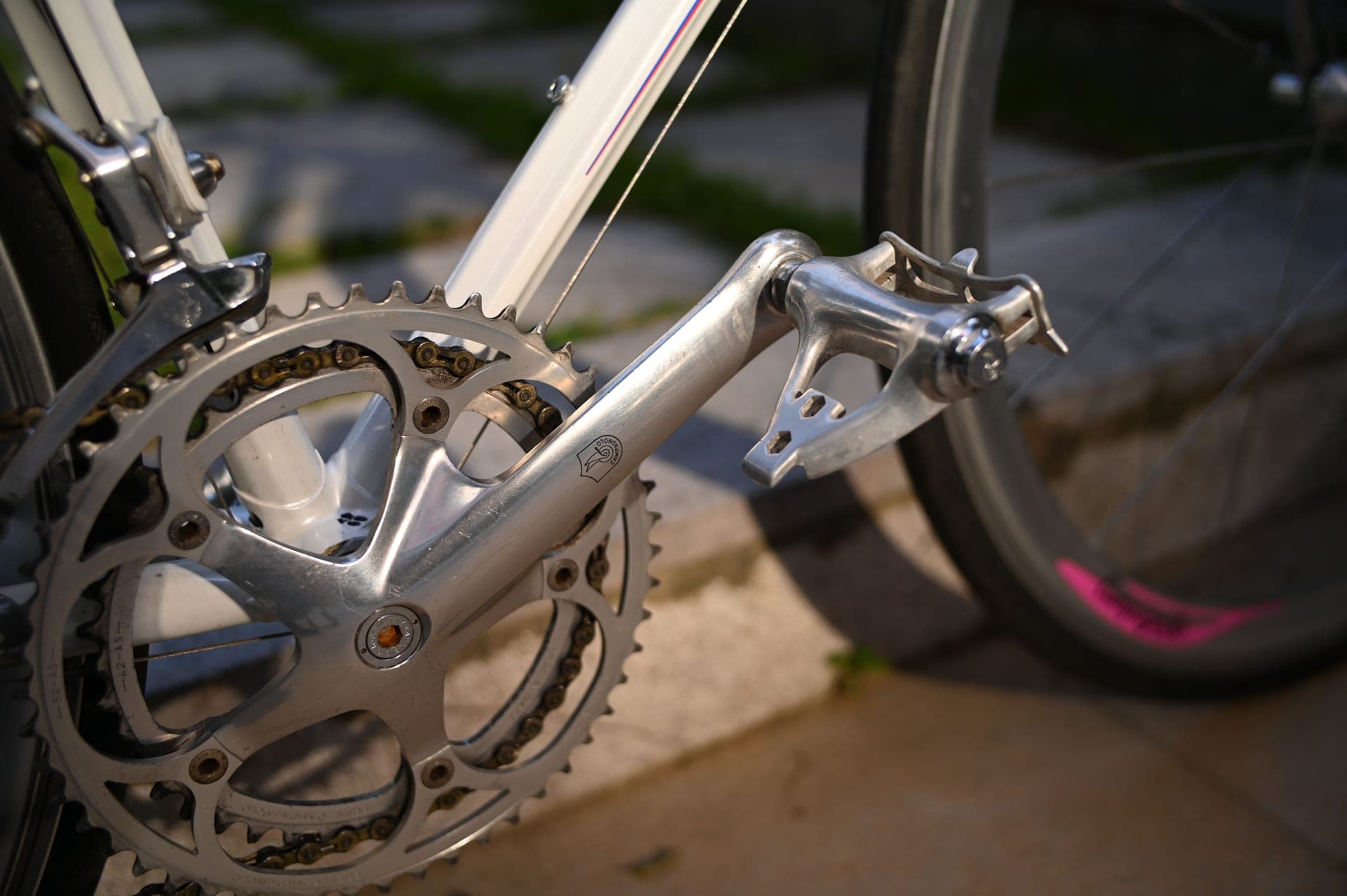
One chainring is simpler and holds its chain better. Two chainrings can give you wide range and small jumps at the same time, because they overlap and multiply. That single fact decides where each one belongs.
Heads up: we earn a commission if you buy through the links on this page, at no extra cost to you. It never decides what makes the list — here’s how that works.
One chainring or two. On the surface it’s a question about simplicity, and the industry sells it exactly that way — a clean single ring against a fussy front derailleur. But the decision that actually matters is a gearing one, and it turns on two numbers that pull against each other: how much total range you have, and how big the jumps are between one gear and the next.
Here is the part almost nobody states plainly. A 2x drivetrain can have a wide total range andsmall jumps at the same time, because its two chainrings overlap and multiply. A 1x drivetrain cannot. With one ring, range and small steps are the same fixed resource, and you spend one to get the other. That single fact explains why 1x rules gravel and mountain biking, why road racers have mostly kept their second ring, and why the “1x has more range” claim collapses the moment you do the division.
The two numbers that describe any drivetrain
Rangeis the spread from your easiest gear to your hardest, written as a percentage: highest ratio divided by lowest ratio. It tells you how much of the world the bike covers — can it crawl up the wall and still pull at 45 km/h?
Step sizeis the jump between two adjacent gears, also a percentage. Small steps let you hold a steady cadence; big steps mean every shift leaves you either spinning slightly too fast or grinding slightly too slow, hunting for a gear that isn’t there. Both of these are pure arithmetic on tooth counts, worked through in the cassette and chainring guide and, for the off-road case, in gravel bike gearing explained. This page is about which one — range or step size — each layout forces you to give up.
Why a 2x can have both range and small steps
The mechanism is multiplication. Your total range is the cassette’s range times the jump between the two chainrings. So a 2x can run a tight cassette — small sprocket-to-sprocket steps, often single-tooth ones at the top — and still reach a wide total, because the front rings add a big, deliberate jump on top of it.
A compact road double is the clean example. A 50/34T chainset is a 47% jump at the front (50 ÷ 34). Put it on a tight 11-30 cassette and the total range comes out at about 401%— with mostly single-tooth steps through the middle where you actually ride. The cassette stayed close-ratio; the second ring did the range. You get both. Shimano’s gravel GRX 48/31 pushes that further, to a published-tooth-count range of 507%, which is worked all the way through in the gravel gearing page.
The reason this doesn’t leave gaps is overlap. The two rings share a big chunk of their gears — the top of the small ring and the bottom of the big ring cover similar ratios — so as you move across the cassette on one ring and then shift the front, the ratios interleave and fill in. You pay for that overlap: a nominal 22-speed 2x gives you maybe 16 genuinely distinct ratios, not 22, and you have to remember which. But the gears you keep are closely spaced and widely spread. That is the whole trick, and one chainring simply cannot do it.
What one ring actually costs — in SRAM’s own numbers
When you delete a chainring, you delete the range that chainring provided. There is no way around that; it’s subtraction. So to claw the range back, a 1x drivetrain fits an enormous cassette — and an enormous cassette stretched over the same twelve sprockets means the jumps get big. This is the step-size tax, and you can read it straight off SRAM’s published cog lists.
SRAM’s mountain-bike XG-1275 Eagle cassette is published as 10-52T with a stated 520% range, and the exact sprocket sequence 10, 12, 14, 16, 18, 21, 24, 28, 32, 36, 42, 52. That is a huge range from one ring — and look at the top two sprockets. The jump from 42 to 52 is a full ten teeth, which is a 23.8% step, sitting exactly where you climb. Spread 520% evenly across the eleven shifts and the average step is about 16%. On a loose climb that is the difference between a cadence you can hold and one you can’t.
The gravel-flavored 1x is tamer but tells the same story. SRAM’s XPLR XG-1251 cassette is published as 10-44T, 440% range, sequence 10, 11, 13, 15, 17, 19, 21, 24, 28, 32, 38, 44. Average step about 14.4% — and the two jumps you meet on a climb are the ugly ones: 32 to 38 is an 18.8% step, 38 to 44 is 15.8%. Compare that to the tight single-tooth steps a 2x keeps in its close-ratio cassette, and you can feel the trade without riding a meter of it.
So the “1x has more range” marketing has it backwards twice over. It usually has lesstotal range than the 2x it replaced — a 440% cassette can’t match a 507% double — and it buys the range it does have with visibly bigger jumps. Both of the cassettes above need SRAM’s XD or XDR driver body to fit that 10-tooth small cog, which is a wheel decision, not a gearing one; that detail sits in the cassette and chainring guide.
Then why does 1x win on gravel and MTB?
Because range and step size aren’t the only axes, and on the surfaces 1x was built for, the other axes matter more. The honest case for one ring is chain security and simplicity, and it’s a strong one.
There is no front derailleur.Nothing to pack with mud, nothing to knock out of alignment against a rock, nothing to drop a chain off mid-descent. On a bike whose entire purpose is surfaces that throw grit at the drivetrain, removing the most alignment-sensitive component on the bike is a real, felt win — one shifter, one thing to think about on a rough climb.
But a single ring feeding a giant cassette runs the chain at steep angles with a lot of slack, which is precisely the condition in which a chain jumps off. So 1x only became viable once two pieces of engineering existed to hold the chain on without a front mech or an add-on guide:
- Narrow-wide chainrings. A bicycle chain alternates wide gaps (at the outer link plates) with narrow ones (at the inner plates). A narrow-wide ring alternates fat and thin teeth to match, so every tooth seats deeply into its matching link and the chain resists lifting off. SRAM markets this as X-SYNC, describing “tall square teeth edges” that “engage the chain earlier than traditional triangle shaped teeth,” with mud-clearing recesses cut for the inner links. The tooth shape is the retention.
- A clutch rear derailleur.A sprung clutch in the derailleur cage resists the cage swinging forward, keeping the lower chain run under tension so it can’t slap and bounce off. SRAM’s own words for its Eagle mechanism are blunt: “ROLLER BEARING CLUTCH technology eliminates derailleur bounce and chain slap without sacrificing precision.” Shimano’s equivalent, Shadow RD+, does the same job with an on/off switch. Either way, the clutch is what lets a 1x survive a rutted descent with the chain still on.
Those two inventions are why 1x took over gravel and mountain biking: it delivers most of the range you need off-road, deletes the component most likely to fail in filth, and holds its chain through impacts a 2x would shed it on. If you buy 1x, buy it for that — the security and the simplicity — not for a range figure that doesn’t out-run a good double.
Why road racers mostly kept 2x
On tarmac at speed, the calculus flips, and it’s the step size that flips it. A rider holding 45 km/h in a bunch is trying to keep a precise cadence, and at that speed a 16-to-20% jump between gears is enormous — it throws you off your rhythm and, in a paceline, off the wheel in front. A road 2x keeps a tight, close-ratio cassette (single-tooth steps across the top) and uses the second ring for the range, so the racer gets small steps exactly where they live. A 1x with a wide cassette can’t offer those close steps without giving up the range, and on smooth tarmac the chain-security advantage that justifies 1x mostly evaporates — there’s nothing throwing the chain off.
There are real 1x road and time-trial applications, and simplicity and a marginal aero/weight saving are honest reasons to reach for one. But for a rider whose day is decided by holding a wheel at 42 km/h, the close steps of a 2x are worth the front derailleur. Where each layout sits across the price ladder — and what moving up a tier actually buys — is in groupset hierarchy explained.
What we haven’t done
We have not ridden any of these drivetrains, so there is no ride feel on this page and no claim about how a shift “feels”. Every specific number here is either division on a tooth count SRAM publishes itself — the 520% Eagle and 440% XPLR cassettes, quoted cog-by-cog and linked — or SRAM’s own wording for its X-SYNC rings and roller- bearing clutch, quoted and linked. The wider 2x range figures (507% on GRX, 401% on a road compact) are worked all the way through, with the formula shown, on the sister gearing pages, and we’ve pointed you there rather than assert them twice. The overlap, the multiplication and the step-size tax are mechanisms you can verify with a calculator, which is the only kind of claim we’re willing to make about gearing.
1x vs 2x, on the things that actually differ
No scores — we’ve ridden nothing. The range and step-size rows are arithmetic on SRAM’s published cassettes and the 2x tooth counts worked through on our gearing pages. The chain-security and shifting rows are mechanism, not opinion.
| What you’re comparing | 1x (one chainring) | 2x (two chainrings) | Which wins |
|---|---|---|---|
| Total gear range | Capped by one cassette (SRAM Eagle 520%, XPLR 440%) | Cassette range × front-ring jump (GRX 507%, road ~401%) | 2x, usually |
| Step size between gears | Big jumps — up to ~24% on a wide 10-52 | Tight, close-ratio cassette, small steps | 2x, clearly |
| Chain security | Narrow-wide ring + clutch derailleur; built to hold | Front mech can shed the chain on impacts | 1x, clearly |
| Weight & complexity | No front derailleur, shifter or cable/battery | Extra ring, mech, shifter and control line | 1x, clearly |
| Front shifting | None — one line of gears, no cross-chaining | A second shift to think about; overlap wastes gears | 1x for simplicity, 2x for range |
| Best use | Gravel & MTB — mud, ruts, impacts, slow climbs | Road racing & fast mixed rides — tight steps at speed | Depends on the surface |
Count the rows. 1x wins security, weight and simplicity; 2x wins range and step size.Which set matters is entirely a question of where you ride — which is why this comparison has no single winner and the gravel world and the road peloton reached opposite answers from the same arithmetic.
What actually decides this purchase
Buy 1x for the surface, not the range.Mud, ruts, dropped chains and slow technical climbing are the honest case for one ring: no front derailleur to clog, a narrow- wide ring and a clutch derailleur holding the chain through impacts. If a salesperson tells you it’s for the wider range, they haven’t divided — SRAM’s own 440% XPLR cassette is narrower than a GRX double.
Buy 2x if your day is decided by cadence at speed.Road racing, fast group rides, tarmac at both ends of a gravel loop — anywhere you need to hold a precise rhythm, the close, single-tooth steps a 2x keeps in its tight cassette are worth the front mech. That’s the overlap working for you.
Decide on your worst climb and your fastest descent, then read the two numbers. Lowest gear (smallest ring ÷ biggest cog) tells you if you’ll walk; the step size tells you if you’ll ever be in the right gear. Range is the marketing headline and the least useful of the three. Do the sums in the cassette and chainring guide.
If you go 1x, the chain-retention parts aren’t optional. A narrow-wide ring and a clutch derailleur are what make one ring survive rough ground. A plain ring and a non-clutch mech will drop the chain, and no amount of range makes up for a chain on the floor.
Don’t pay to convert a working drivetrain.A 2x-to-1x swap is a new ring, a new cassette, often a new derailleur and sometimes a new wheel driver body. If your current setup gets you up the hills without walking, the honest move — the one that costs us nothing to say — is to keep riding it and choose your layout when you buy the next bike, where it’s largely decided for you anyway by the category.
Common questions
Does 1x really have more range than 2x?
Usually the opposite. Deleting a chainring deletes the range it provided, so a 1x claws range back with a big cassette — SRAM’s widest published road/gravel option is the 440% XPLR, and its widest MTB one the 520% Eagle. A 2x multiplies a cassette’s range by the jump between two rings, which is how a Shimano GRX double reaches a published- tooth-count 507%. The 1x range number sounds big on its own; put beside the double it replaced, it’s generally smaller, and it comes with bigger jumps between gears.
Why do 1x setups have bigger gaps between gears?
Because a wide range spread over a fixed number of sprockets forces big steps. SRAM’s published 10-52 Eagle cassette jumps from 42 to 52 teeth at the top — a 23.8% step, right where you climb — and averages about 16% per shift across its range. A 2x keeps a tight cassette and gets its range from the front rings instead, so its steps stay small, often single-tooth through the middle. Same twelve sprockets, very different spacing.
How does a 1x keep the chain on without a front derailleur?
Two parts. A narrow-wide chainring alternates fat and thin teeth to match the chain’s alternating wide and narrow link gaps, so each tooth seats deeply and the chain resists lifting — SRAM calls its version X-SYNC and describes “tall square teeth edges” that engage the chain early. And a clutch rear derailleur keeps the lower chain run under tension so it can’t slap and bounce off; SRAM says its roller-bearing clutch “eliminates derailleur bounce and chain slap.” Together they replace the guiding job the front mech used to do.
Is 1x or 2x better for gravel?
It splits cleanly. 1x wins on mud, dropped chains, simplicity and tire clearance; 2x wins on range and step size. If your gravel includes fast tarmac at both ends, the 2x’s tight steps and wider spread earn their keep. If it’s slow, filthy and technical, the 1x’s security and lack of a front mech to clog earn theirs. The full off-road arithmetic is in gravel bike gearing explained.
Why do road racers still use 2x when mountain bikers switched to 1x?
Because they optimize for opposite things. A mountain biker wants chain security through impacts and doesn’t mind a big jump on a climb; a road racer wants tiny cadence steps at 45 km/h and rides a surface that never throws the chain off. The 2x’s close-ratio cassette gives the racer those small steps while the second ring supplies the range, and the chain-security advantage of 1x has little to do on smooth tarmac. Same trade, different surface, opposite answer.
Have you tested any of these drivetrains?
No. Every number here is division on tooth counts SRAM publishes itself, or SRAM’s own wording for its rings and clutch, both quoted and linked. The wider 2x range figures are worked through with the formula shown on our cassette and gravel gearing pages. There is no ride feel on this page because we haven’t ridden any of it — the mechanisms are verifiable with a calculator, which is the only kind of gearing claim we’ll make.
Sources
- SRAM XG-1275 Eagle cassette (CS-XG-1275-B1) — published 12-speed, 10-52T, stated 520% range, cog sequence 10,12,14,16,18,21,24,28,32,36,42,52, XD driver — retrieved 2026-08-08
- SRAM XPLR XG-1251 cassette (CS-XG-1251-D1) — published 12-speed, 10-44T, stated 440% range, cog sequence 10,11,13,15,17,19,21,24,28,32,38,44, XDR driver — retrieved 2026-08-08
- SRAM X-SYNC direct-mount chainrings (CR-XSNC-DM-A1) — "tall square teeth edges engage the chain earlier than traditional triangle shaped teeth"; mud-clearing recesses for inner links — retrieved 2026-08-08
- SRAM GX Eagle rear derailleur (RD-GX-1-B2) — "ROLLER BEARING CLUTCH technology eliminates derailleur bounce and chain slap without sacrificing precision"; X-HORIZON straight-parallelogram; CAGE LOCK — retrieved 2026-08-08
Read next
- Gravel bike gearing explained
The gearing math worked through for gravel.
- Cassette and chainring guide
What the numbers on cassettes and rings mean.
- Groupset hierarchy explained
Where 1x and 2x sit across the groupset range.
We haven’t ridden or tested any of the products on this page, and we don’t pretend otherwise. Read how we research — or tell us we’re wrong and we’ll log the correction.