How to charge and store an e-bike battery
A lithium pack is a perishable good, and it perishes fastest when it is hot and when it is held full. Every rule below follows from that one fact — including the ones about where you leave it plugged in.
Heads up: we earn a commission if you buy through the links on this page, at no extra cost to you. It never decides what makes the list — here’s how that works.
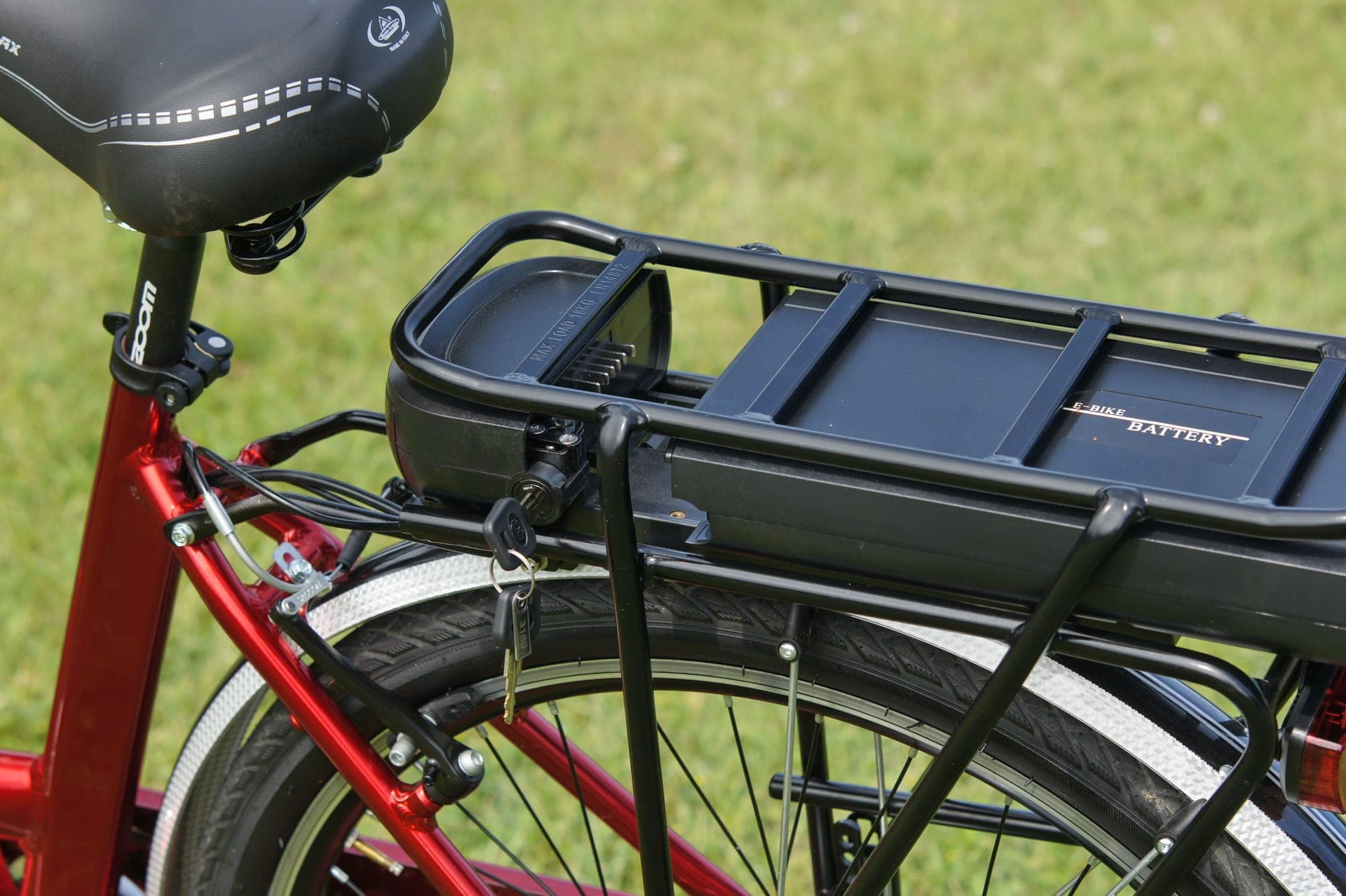
The pack is the single most expensive part of your e-bike, and it is aging whether you ride or not.A lithium-ion battery does not simply run down and refill like a fuel tank. It is a chemical assembly that gets a little older every day it exists — faster when it is hot, faster when it is held at a very high or very low state of charge, and faster the more full-depth cycles you run through it. Almost every care instruction a manufacturer gives you is an attempt to slow one of those four clocks.
That framing matters because the pack is, in a real sense, the bike. Its watt-hours are your range and its price dominates the machine — see what watt-hours actually mean for why. So “how do I charge and store it” is not housekeeping. It is the main lever you have over how long the most valuable component survives, and over whether the thing sitting in your hallway is a fire risk in the meantime.
Why a lithium pack ages — the mechanism behind every rule
There are two kinds of aging happening at once, and understanding the split is what makes the advice make sense rather than sound like superstition.
- Cycle aging is wear from use: every time you discharge and recharge, the cell chemistry degrades a fraction. Deep, full-range cycles are harder on the cell than shallow ones, which is why draining to empty and then refilling to the brim is the most punishing thing you can routinely do.
- Calendar aging is wear from time alone, and it happens even to a pack that never turns a wheel. Its two big accelerants are heat and a high state of charge. A cell held full and warm ages measurably faster than the same cell held half-full and cool. This is the part people miss: the battery you “saved” by leaving it fully charged in a hot garage all winter was quietly wearing out the whole time.
Everything below is downstream of those two mechanisms. Bosch’s published battery-care guidance — some of the most specific in the industry — reads like a direct answer to them: charge at moderate temperatures, don’t store the pack full, don’t store it hot or freezing, and don’t habitually run it flat. Those aren’t arbitrary house rules. They are the chemistry, written as instructions.
How to charge it
Charge at room temperature, on the manufacturer’s charger. Bosch’s guidance is to charge the battery at roughly 20°C (68°F), and its packs carry a temperature monitor that will only permit charging within a defined window. Cold charging in particular is hard on lithium cells, which is why the winter instruction is to bring the pack indoors, charge it warm, and only fit it to the bike just before you ride.
Use the charger that came with the pack — this is a safety rule, not a warranty formality. Bosch says to use only an e-bike charger certified by Bosch for your battery type. The reason is blunt: a mismatched charger is a documented fire cause. The U.S. Consumer Product Safety Commission recorded 156 reports of fire and thermal incidentsinvolving “universal” micromobility chargers between January 1 and May 16, 2024, and its advice is unambiguous: “Use only the charger provided with your micromobility device”, and if you’ve lost it, get a compatible replacement from the manufacturer rather than a generic one that merely fits the socket.
Let it cool before you plug in, and don’t chase 100%.Bosch recommends a resting period after a ride — around 30 minutes — so the pack isn’t charged straight off a hard discharge while it’s still warm. And because a high state of charge accelerates calendar aging, a pack that habitually lives at 100% ages faster than one you top up to somewhere short of full for daily use. The counter-rule matters too: Bosch warns that regularly riding until the battery is completely drained will compromise its ability to hold charge. The kind answer to the cell is to keep it in the broad middle and avoid living at either extreme.
How to store it for a long layup
This is where most damage is done, because storage is passive — the pack sits for months while calendar aging runs unattended. Two numbers from Bosch’s care guidance do most of the work:
- State of charge: about 30–60%.Not full, not empty. Bosch gives the practical version as roughly two to three LED bars on the charge indicator. A partly-charged cell in storage ages slower than a full one, and it has enough headroom that slow self-discharge over the winter won’t drop it into the deep-discharge danger zone.
- Temperature: cool, but not freezing.Bosch puts the optimum storage temperature at about 20°C (68°F) and says not to store the battery below 0°C (32°F) or above 40°C (104°F). Heat accelerates aging; hard freezing is its own stress. A dry indoor cupboard beats a garage that swings from freezing to baking.
Over a long layup, check the pack occasionally and top it back toward that middle band if it has drifted down — a battery abandoned at a low charge for months can self-discharge into a state it never fully recovers from. Storing it at a sensible charge and temperature is the cheapest life-extension there is, and it’s the difference between the pack you own now and the range it will still deliver next spring.
Where NOT to store or charge it — the fire-safety part
Longevity is one reason to care about storage. The other is that a lithium pack that fails does not fail quietly. Thermal runaway is fast, extremely hot, and hard to extinguish, and fire services have turned their experience of it into specific, boring, life-saving rules. The New York City Fire Department’s guidance is worth following to the letter:
- Charge on a hard surface, on the floor. FDNY: “Do not charge your device on any surface other than the floor”. Not on a bed, not on a sofa, not on carpet — a hard, non-combustible surface with space around it, so a pack that vents heat doesn’t immediately ignite soft furnishings.
- Do not block your exit.FDNY is explicit: don’t charge the device near exits and points of egress, including your apartment door, and not in the bedroom. The logic is grim but simple — if the pack ignites, you must be able to get out past it. A battery charging in the one doorway you’d flee through is the worst possible place for it.
- Plug straight into the wall. FDNY says to avoid extension cords and to keep the pack at room temperature, out of direct sunlight, and away from anything flammable.
- Never charge unattended or overnight.The CPSC’s guidance is to remain present during charging, never charge while sleeping, and unplug once charging is complete. A fire you’re awake for is survivable; one that starts while you sleep may not be.
What the certification marks actually mean
The single most effective thing you can do about fire risk happens before you buy: choose a pack and bike certified to the right safety standards. Two numbers matter, and they are not interchangeable.
UL 2849is the standard for the e-bike’s whole electrical system. Per UL Solutions, it provides “electrical and fire safety certification by examining e-bikes’ electrical drive train system, battery system and charger system combinations” — the motor, controller, battery, charger and wiring evaluated together as one assembly, including the risk of electric shock during charging over the product’s life. UL 2271is the narrower standard for the battery pack itself — UL’s Standard for Batteries for Use in Light Electric Vehicle Applications. A system certified to UL 2849 has been assessed as a whole; a pack marked UL 2271 tells you the battery alone was tested. New York City’s micromobility law now requires certification to these standards, which is the clearest signal yet of which mark to look for. When FDNY tells you to look for the UL mark, this is the substance behind it.
When a battery is genuinely worn out
Capacity fade is gradual, not a cliff. A worn pack doesn’t usually die — it just gives you less. The honest way to spot it is to watch range under repeatable conditions: if a full charge that carried you a familiar distance last year now falls clearly short on the same route, in the same weather, in the same assist mode, the cell has lost usable capacity. There is no single mileage or cycle number we’re going to quote you, because published figures vary by pack and we couldn’t verify one from a primary manufacturer source this session — so we’d rather describe the symptom than invent a threshold.
The exception to “gradual” is a safety exception, and it overrides everything about longevity. FDNY says to monitor the pack for odors, changes in shape or color, leaking, or odd noises, and to discontinue use immediately if you notice any of them. A swollen, hissing, hot, smelly, or discolored pack is not a tired battery to nurse through one more season — it is a fire waiting for a trigger, and it should be retired and disposed of properly (lithium packs never go in household trash or normal recycling).
This is also the strongest financial argument for taking the care rules seriously. A replacement pack is the biggest single running cost an e-bike has, and good charging and storage habits mostly just defer that expense — our cost-to-run breakdown puts numbers to why the pack, not the electricity, is the money.
What we haven’t done
We have not tested a battery, cycled a pack to failure, or measured a capacity curve. Every specific figure on this page — the 30–60% storage charge, the temperature limits, the 30-minute rest, the 156 charger-fire reports, the standard numbers — is quoted from the manufacturer, the standards body, or the safety agency that published it, and each is linked below. Where a number would have been convenient but we couldn’t source it — a definitive “replace it after N cycles” — we left it out and told you why. The mechanism is well established; the exact magnitudes belong to whoever actually measured them.
Common questions
What charge level should I store my e-bike battery at?
Around 30–60%, per Bosch’s battery-care guidance — roughly two to three bars on the charge indicator. A high state of charge accelerates calendar aging, so storing a pack full is worse for it than storing it partly charged. Empty is also bad, because a pack left low for months can self-discharge into a deep state it may not recover from. Aim for the middle, and top it back up toward that band if a long layup drains it.
Can I leave my e-bike battery on the charger all the time?
It’s not the best thing for it. Holding a lithium cell at 100% speeds up calendar aging, and separately the CPSC advises unplugging once charging is complete and never charging unattended or while you sleep. For daily use, topping up to short of full and unplugging is kinder to the cell and safer than leaving it on charge around the clock.
Is it safe to charge an e-bike battery indoors overnight?
Charge it indoors if you like, but not overnight and not unattended — the CPSC’s guidance is to be present while charging. FDNY adds the placement rules: charge on a hard floor surface, plugged straight into a wall outlet (no extension cords), away from anything flammable, and crucially not blocking your exit or in your bedroom, so that if the pack fails you can get out past it.
Can I use a cheaper universal charger for my e-bike?
No. The CPSC urges consumers not to use chargers marketed as “universal” unless they’ve been tested and approved for your specific device, after logging 156 fire and thermal incident reports tied to such chargers in under five months of 2024. A charger that fits the socket can still deliver the wrong charging profile. Use the one that came with the pack, or a manufacturer-specified replacement.
What do UL 2849 and UL 2271 mean on an e-bike?
UL 2849 certifies the e-bike’s whole electrical system — battery, motor, controller, charger and wiring assessed together for electrical and fire safety. UL 2271 is the narrower standard covering the battery pack on its own. A system marked UL 2849 has been evaluated as a complete unit; a pack marked UL 2271 tells you only the battery was tested. New York City now requires certification to these standards, and they’re the marks worth looking for when you buy.
How do I know when my e-bike battery is worn out?
Watch range under identical conditions: if a full charge covers noticeably less distance than it did a year ago, on the same route, weather and assist level, the pack has lost capacity. That fade is gradual and normal. What isn’t normal, and means retire it now, is any swelling, odor, leaking, discoloration, heat or odd noise — FDNY says to stop using a pack showing those signs immediately, and to dispose of lithium batteries properly rather than in household trash.
Sources
- Tern Bicycles support KB — "How to Care for Your Bosch E-Bike Battery," restating Bosch's official battery-care figures (store at ~30-60% / 2-3 LED bars; optimum storage ~20°C/68°F, not below 0°C/32°F or above 40°C/104°F; charge at room temperature ~20°C/68°F; use only a Bosch-certified charger; ~30-minute rest before charging; avoid full discharge) — retrieved 2026-08-08
- UL Solutions — E-Bikes Certification: Evaluating and Testing to UL 2849 (scope of UL 2849 as the e-bike electrical drive train, battery and charger system standard; relationship to UL 2271, the battery standard for Light Electric Vehicle applications) — retrieved 2026-08-08
- U.S. Consumer Product Safety Commission — "CPSC Urges Consumers to Not Buy or Use 'Universal' Chargers with Micromobility Products Due to Fire Hazard" (official CPSC news release via PR Newswire): 156 fire/thermal incident reports Jan 1–May 16, 2024; use only the charger provided; be present during charging; unplug when complete — retrieved 2026-08-08
- FDNY (FDNYsmart) — Lithium-Ion Battery Safety Tips (charge on the floor / a hard surface; not near exits, points of egress or the apartment door; not in the bedroom; no extension cords; keep at room temperature and out of direct sunlight; use the manufacturer's cord and adapter; look for the UL mark; stop use immediately on odor, shape/color change, leaking or odd noises) — retrieved 2026-08-08
Read next
- E-bike battery range explained
What watt-hours mean and why the pack is the bike.
- How far can an e-bike go
How the same battery you're caring for turns into range.
- E-bike cost to run
A replacement pack is the biggest single running cost; care defers it.
We haven’t ridden or tested any of the products on this page, and we don’t pretend otherwise. Read how we research — or tell us we’re wrong and we’ll log the correction.