Road vs Gravel Cycling Shoes
Three bolts or two. That's the fork in the road, and it decides whether you can walk into a café without sounding like a tap dancer falling downstairs.
Heads up: we earn a commission if you buy through the links on this page, at no extra cost to you. It never decides what makes the list — here’s how that works.
First, the disclosure that shapes this page: this page links to no shoes and recommends none. It exists to explain the decision, not to sell you the answer. If you have already made the decision and want the models, that is a separate page — the best cycling shoes, six of them, with published specs and live prices. What follows here is the mechanism, which is the part that doesn’t change when the models do.
The road/gravel shoe question sounds like it’s about terrain. It isn’t. It is about how many bolts hold the cleat to the sole, and everything else — walkability, stiffness, mud, the noise you make crossing a tiled floor — is downstream of that.
Two bolts or three: the actual difference
Three-boltis the road standard — Shimano’s SPD-SL, and Look and Time use their own three-bolt patterns. The cleat is large, plastic, and bolts to a flat area on the sole where it sits proud, below the level of the sole itself. Nothing is recessed. When you walk, you walk on the cleat.
Two-bolt is the SPD standard, borrowed wholesale from mountain biking and now near-universal on gravel. The cleat is small and metal, and it bolts into a channel that sits recessed into a lugged rubber sole. When you walk, you walk on the rubber, and the cleat sits down in its slot out of the way.
That single geometric fact — proud versus recessed — generates every practical difference below. It is worth holding onto, because it explains things the marketing presents as separate features.
Walkability, which is the real reason anyone chooses
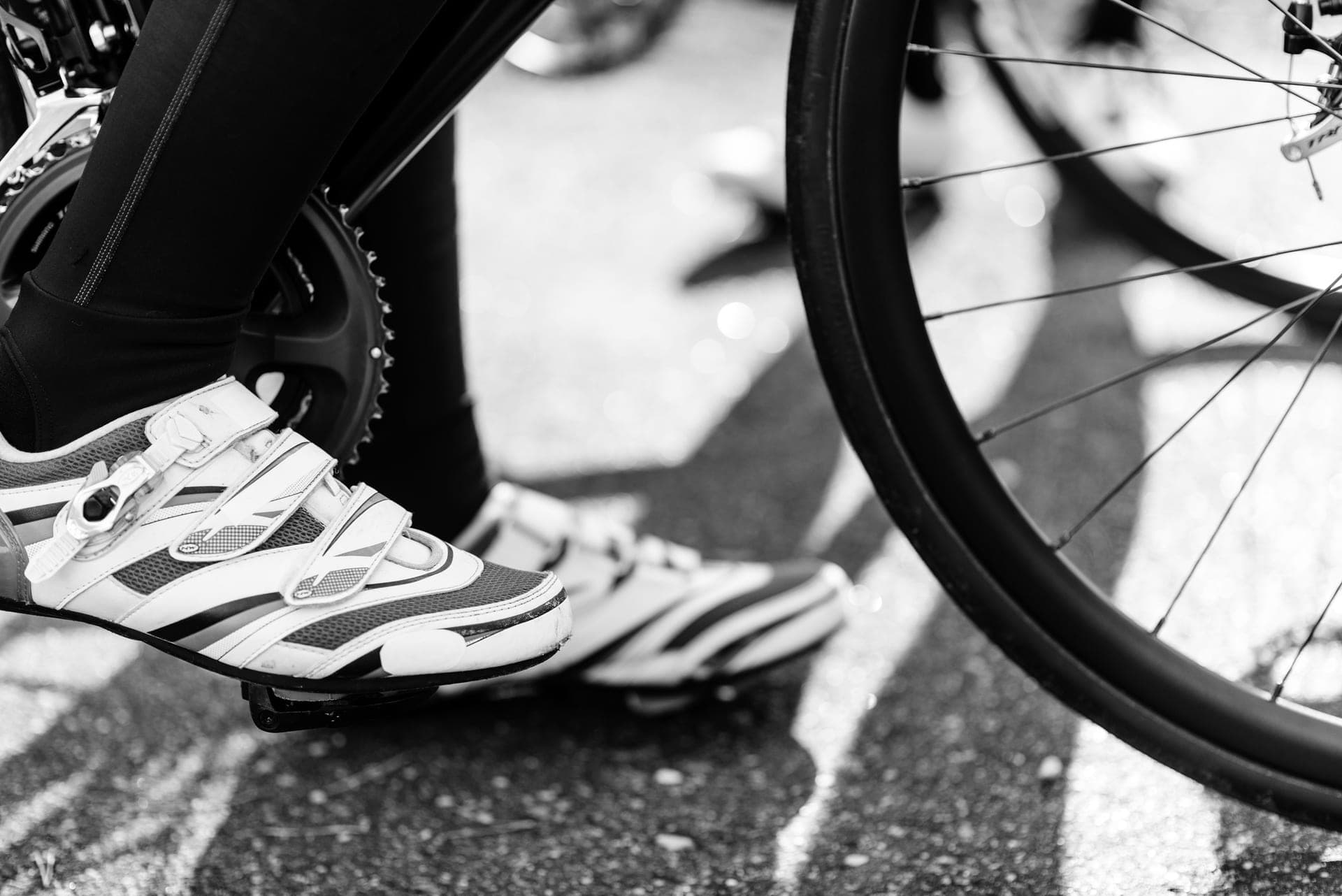
In a three-bolt road shoe you are standing on a plastic wedge bolted under the ball of your foot. The result is the walk every road cyclist recognizes: heels-down, tentative, loud, and genuinely slippery on tile or wet concrete. It is not a design failure. The shoe was never meant to be walked in — it was meant to be clipped in, and every gram and every millimeter of sole went to that job.
In a two-bolt shoe the cleat is below the tread line, so you are walking on rubber lugs like a normal human being. You can cross a café floor, walk a steep pitch, push through a muddy section, stand on a rock. This is the entire reason gravel converged on two-bolt, and it’s not really about gravel: it’s about the fact that gravel riding involves getting off the bike, and road racing doesn’t.
There is a second, less obvious consequence. Recessed cleats survive walking; proud cleats don’t.A road cleat is a consumable being ground down every time you cross a car park. Two-bolt cleats are metal and protected by the tread around them. If you walk in your cycling shoes with any regularity, the three-bolt system quietly charges you for it. The same decision seen from the pedal end — with Shimano’s published float and clip-out figures for both standards — is in SPD vs SPD-SL.
Float: the number Shimano actually publishes
Float is how far your heel can rotate before the cleat releases — the small angular freedom that stops your knee being locked into one plane for ten thousand pedal strokes an hour. It is one of the few things in this category with a published figure, so let’s use it.
Shimano publishes that its yellow SPD-SL road cleat, the SM-SH11, has a “six-degree float range (three degrees in each direction)” and a “13-degree clip-out angle”. It describes it as a versatile road cleat and specifically suggests it for riders who are “new to cycling, experience knee pain, [or] lack flexibility”. Its two-bolt equivalent, the SM-SH51, is published as a single-release, two-bolt cleat with “4 degrees of float” and the same 13-degree clip-out angle.
Which is a useful corrective to a common belief. Float is nota road-versus-gravel property — both systems have it, in comparable amounts, and the road cleat here actually publishes more of it than the off-road one. Float is a property of the specific cleat you bolt on, and on the road side it’s color-coded and swappable for a few pounds. If your knees hurt, the fix is a cleat, not a shoe.
We should say what we don’t know: Shimano publishes these figures for these two cleats, and we did not retrieve pages for the rest of the range, so we’re not going to give you a table of every cleat color. Check the specific cleat you’re buying — the number is on the product page, which is more than most of this category manages. If you are buying the pedals as well, we put the published float figures for all four road systems side by side in the road bike pedal roundup.
Stiffness, and the thing people get wrong about it
Road shoes are stiffer. That much is true and it’s deliberate: a sole that flexes absorbs a fraction of each stroke, so a road sole is built to be a rigid plate — often carbon — that transmits everything and deforms as little as possible. Gravel soles are stiff too, but they have to compromise: you cannot build a sole that is both maximally rigid and comfortable to walk a mile in. Lugs need rubber, rubber flexes.
Here is the part that gets skipped. Stiffness is not free comfort, it’s a trade.A very stiff sole concentrates load into a small area under the ball of your foot, and over long distances that’s where hot spots come from. Riders chase stiffness as though it were a pure good and then wonder why their feet burn at hour four. Racers accept that trade because the efficiency matters more to them than their feet do for three hours. If you’re riding all day on mixed surfaces, a slightly more forgiving sole is not a compromise you’re settling for — it may just be the right tool.
We can’t give you numbers here, and we want to be straight about why. Some brands publish a stiffness index, and it is a brand-internal scale— one company’s 10 is not another’s 10, there is no standard behind it, and nothing makes them comparable. It’s the “4D” problem in another category. So we’re not going to rank shoes on a number that only means something inside one catalog.
Mud, and why the gravel answer is structural
A two-bolt cleat clears mud and a three-bolt one doesn’t. The two-bolt mechanism is small, metal and open, and the lugs around it give the mud somewhere to go. The road pedal presents a broad flat platform for a broad flat cleat, and packed grit between the two means you are standing in a field pushing a plastic wedge at a pedal that has stopped accepting it.
This is the point where the road/gravel distinction stops being about preference. If your route includes a section you might have to walk — a gate, a washout, a hill that beat you — the two-bolt system is not more convenient, it’s the one that still works when you get back on. If you want to know what riding actually puts you in that situation, we’ve laid it out in what is a gravel bike.
So which should you buy
Three-bolt road shoes if you ride paved roads, your stops are planned, and the walking you do is from the front door to the bike and back. You get maximum rigidity, the widest pedal choice at the performance end, and cleats you can swap to tune float.
Two-bolt shoes if you ride gravel, ride mixed surfaces, commute, tour, stop at cafés, or own one pair of cycling shoes for everything. The efficiency cost against a stiff road sole is real and, for the overwhelming majority of riders who are not being paid to pedal, it is smaller than the benefit of being able to walk.
If you’re buying your first pair, buy two-bolt. Not because it’s better — because it’s forgiving. You will get it wrong at a junction and need to put a foot down. You will have to walk a hill. You will stop for coffee. Two-bolt lets all of that happen without it being an event, and if you later decide you want a rigid road plate for Sunday, you’ll know exactly why you want it. That is the same argument we make about buying your first bibs cheap: get the information first, spend against it second.
Three-bolt vs two-bolt, and where it lands
Everything here follows from one fact: the road cleat sits proud of the sole, the off-road cleat sits recessed into it. Float figures are Shimano’s own published specs for two specific cleats — not a general property of either standard.
| What it decides | Three-bolt (road / SPD-SL) | Two-bolt (gravel / SPD) |
|---|---|---|
| Cleat position | Proud of the sole — you walk on the cleat | Recessed into the tread — you walk on rubber |
| Cleat material / size | Large, plastic | Small, metal |
| Walking | Awkward, loud, slippery on tile | Essentially normal |
| Cleat wear from walking | A consumable — ground down every car park | Protected by the surrounding tread |
| Published float (Shimano) | SM-SH11: 6° (3° each direction) | SM-SH51: 4°, single-release |
| Published clip-out angle | SM-SH11: 13° | SM-SH51: 13° |
| Sole stiffness | Maximum — rigid plate, often carbon | High, but traded against walkable rubber lugs |
| Hot spots on long rides | More likely — load concentrated by a rigid sole | Slightly more forgiving |
| Mud | Packs the interface; may refuse to engage | Clears — open mechanism, lugs give mud somewhere to go |
| Unplanned foot-down | A minor event | A non-event |
| Stiffness index published? | Brand-internal scale only — not comparable between brands | Same problem |
Float and clip-out figures quoted from Shimano’s own product pages for the SM-SH11 and SM-SH51, retrieved 17 July 2026. Note that the road cleat publishes MORE float than the off-road one — float is a property of the cleat you bolt on, not of the standard, and the belief that road means less float is simply wrong for these two. This page recommends no products; the shoes we do carry are ranked on the best cycling shoes.
What actually decides this purchase
Bolt count is the whole decision. Proud cleat or recessed cleat. Walkability, mud clearance, cleat wear and how forgiving the system is when you put a foot down all follow from that one thing. Decide it first and the shoe choice narrows to fit and budget.
Be honest about how much you walk.Not how much you plan to ride — how often you end up off the bike. Café stops, gates, a hill you didn’t make, a mechanical two miles from home. Every one of those is an argument for two-bolt, and they’re the parts of riding people forget to account for when they’re imagining themselves racing.
Fix knees with cleats, not shoes.Float is published, it’s color-coded on the road side, and cleats cost a fraction of shoes. Shimano publishes 6° on the SM-SH11 and specifically points riders with knee pain or limited flexibility at it. If your knees hurt, change the cheap part before you replace the expensive one.
Don’t buy a stiffness index.It’s a brand-internal number with no standard behind it, so one company’s 10 tells you nothing about another’s. And stiffness isn’t a pure good anyway — a rigid sole concentrates load under the ball of your foot, which is where hot spots come from on long days.
Buy the pedals and the shoes as one decision. The cleat pattern locks you into a pedal ecosystem, and changing your mind later means replacing both. This is the one purchase in cycling where being decisive up front genuinely saves you money.
Common questions
Can I use road shoes for gravel riding?
You can, and you’ll regret it the first time you have to walk. The three-bolt cleat sits proud of the sole, so any hike-a-bike section is done standing on a plastic wedge on loose ground, and the cleat grinds down while you do it. Then the mud that packs into it may stop it engaging when you remount. It isn’t about whether the shoe can survive gravel — it’s that gravel riding involves getting off the bike, and the road system is built on the assumption that you won’t.
Do two-bolt gravel shoes lose power compared to road shoes?
There’s a real trade — a road sole is built as a rigid plate and a walkable sole needs rubber, which flexes. What we can’t give you is the size of it, because nobody publishes a comparable stiffness figure: the indices brands print are internal scales with no standard behind them, so one company’s 10 means nothing next to another’s. Our honest read is that for anyone not being paid to pedal, the loss is smaller than the benefit of being able to walk — and a very stiff sole brings its own cost in hot spots on long days.
What is cleat float and how much do I need?
Float is the angular freedom your heel has before the cleat releases — it stops your knee being locked in one plane for thousands of strokes. Shimano publishes 6 degrees (3 each way) for the yellow SM-SH11 road cleat and 4 degrees for the SM-SH51 two-bolt cleat, both with a 13-degree clip-out angle. So float isn’t a road-vs-gravel thing at all — both have it, and here the road cleat has more. How much you need is individual and we’re not going to prescribe a number, but Shimano itself points riders new to cycling, or with knee pain or limited flexibility, toward the higher-float option.
Which cycling shoes do you recommend?
Not on this page — it exists to explain the decision, two bolts or three, which is the part that actually matters and the part that stays true when models change. Once you have made that decision, the best cycling shoes ranks six we have priced: published specs, live prices, and a clear statement of what nobody publishes, which in this category turns out to be sole stiffness and, on five of the six, the bolt pattern itself.
Are gravel shoes and mountain bike shoes the same thing?
They share the thing that matters: the two-bolt cleat pattern, recessed into a lugged sole. That means the cleats and pedals are interchangeable, which is why gravel adopted the standard wholesale rather than inventing one. Where they differ is in emphasis — how aggressive the tread is, how much protection the upper has, how stiff the sole is — and none of that is standardized or comparably published. If you already own mountain bike shoes and you’re starting gravel riding, you already own gravel shoes.
Sources
- Shimano SM-SH11 SPD-SL cleat — manufacturer's product page. Source for: six-degree float range (three degrees each direction), 13-degree clip-out angle, composite construction with TPU tips, and Shimano's own guidance for riders new to cycling or with knee pain — retrieved 2026-07-17
- Shimano SM-SH51 SPD cleat — manufacturer's product page. Source for: single-release, two-bolt mounting, 4 degrees of float, 13-degree clip-out angle — retrieved 2026-07-17
Read next
- The best cycling shoes
Six shoes, once you've decided which cleat standard you're buying into.
- SPD vs SPD-SL
The pedal half of this decision, with Shimano's published float figures for both.
- What is a gravel bike
The riding that makes two-bolt the obvious answer.
- The best bib shorts
The other kit decision where buying cheap first is the smart move.
- How to layer for cold-weather cycling
Cold feet are a ventilation problem before they're a sock problem.
- All kit guides
Helmets, bibs, chamois and layering.
We haven’t ridden or tested any of the products on this page, and we don’t pretend otherwise. Read how we research — or tell us we’re wrong and we’ll log the correction.