Rim brakes vs disc brakes
The US federal standard demands one number from both: 4.57 meters from 24km/h. Then it runs the test on a dry, clean course — which is precisely where these two brakes are hardest to tell apart.
Heads up: we earn a commission if you buy through the links on this page, at no extra cost to you. It never decides what makes the list — here’s how that works.
4.57 meters. That is the maximum stopping distance a bicycle sold in the United States is allowed, from 24 km/h (15 mph), under 16 CFR § 1512.5, with no more than 178 N (40 lbf) applied to the lever. Rim brakes clear it. Disc brakes clear it. The regulation does not care which you have.
So on the question the internet argues about — which one stops you — the law’s answer is both, adequately. Which means the argument has to be about something else, and it is. Here’s the something else.
The most interesting thing in the standard is what it doesn’t test
We went and read the test procedure rather than the marketing. 16 CFR § 1512.18(d) specifies that the braking test is conducted on a “dry, clean, smooth paved test course”. Ten runs, dry, every time.
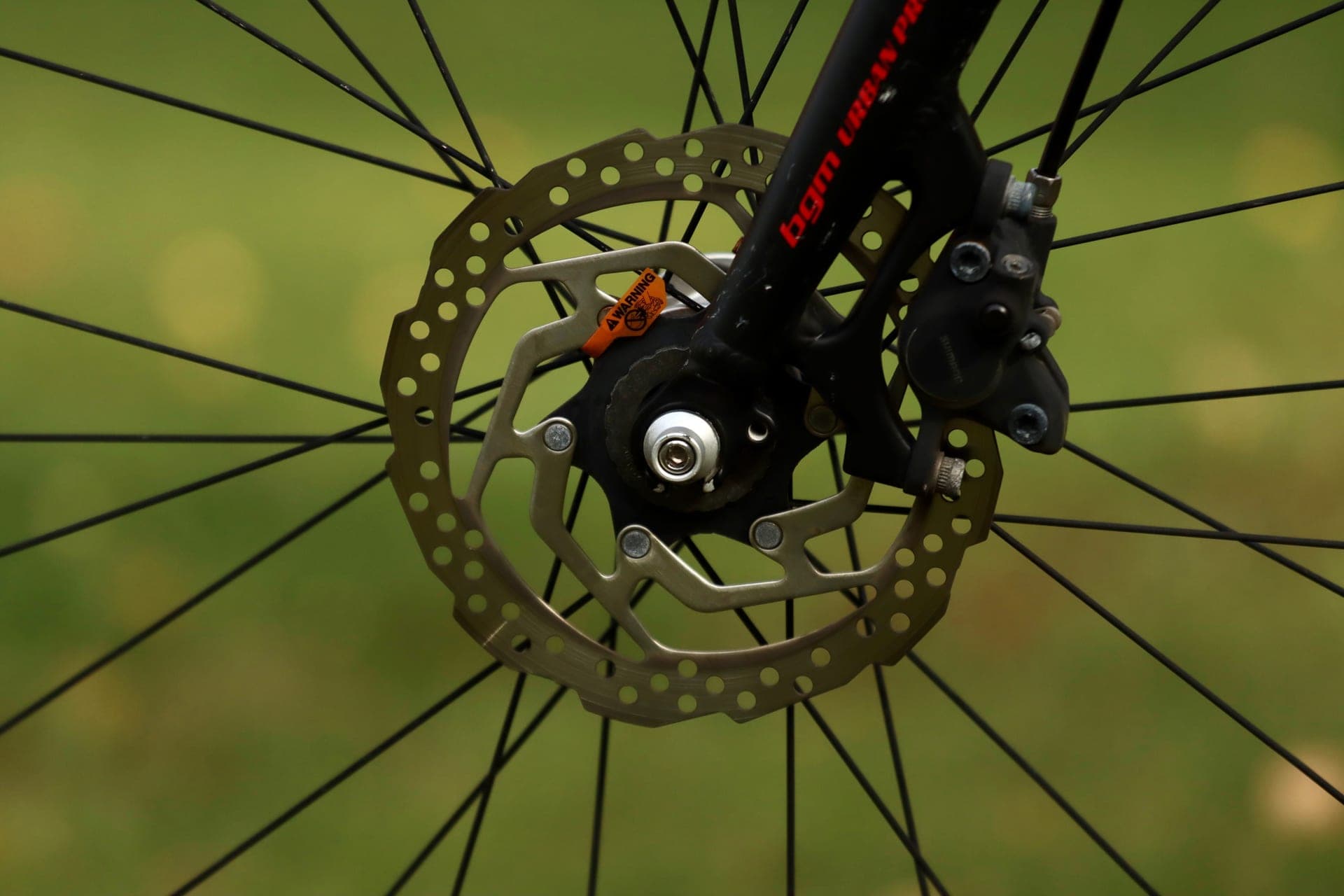
Read that again with the argument in mind. The federal bicycle brake standard has nothing whatsoever to say about braking in the wet — and wet braking is the single largest, least disputed functional difference between these two systems. A rim brake asks a pad to grip a wheel rim that is thirty centimeters from the road surface, collecting spray, and the pad has to wipe that water film off before it can bite. A disc brake asks a pad to grip a rotor near the hub, out of the worst of the spray, with far less surface to clear.
The mechanism is not controversial and you have felt it if you have ever descended in rain on rim brakes: the lever comes back, nothing happens for a beat, and then the bike slows. That beat is water being squeegeed off an aluminum rim. What we are not going to give you is a number for it. There are numbers circulating — percentage improvements in wet stopping distance, quoted confidently across this category — and we could not trace one to a published test we could read, so we’re not repeating them. We have not measured this. Nobody we could find has published a dataset for it with the rigor the chain-lube world has. The mechanism is sound; the magnitude is unpublished, and we’d rather say so.
What actually differs, honestly
Wet and sustained braking consistency.Disc wins, for the mechanical reason above, and also because a long descent heats a rim brake’s braking surface — which on a rim brake is the same aluminum or carbon holding your tire on. Heat in a rim is a structural conversation. Heat in a rotor is a rotor being a rotor.
Which part is the consumable. This is the argument that gets skipped and it is the one with money attached. A rim brake wears out the rim. Not the pad — the rim. Every wet mile grinds grit between pad and braking surface, and the braking surface is part of an expensive wheel. Ride a rim-braked bike through enough winters and you eventually replace wheels because the brake track is thin. A disc brake wears out a rotor and a set of pads, both of which are cheap, bolted on, and designed to be thrown away.
Tire clearance.A rim caliper physically arches over the tire, and its reach sets a hard ceiling on how wide a tire you can fit — which is why rim-brake road bikes generally stop somewhere around 28mm and disc bikes don’t. Given where tire thinking has gone (see our tire pressure guide for why wider and softer got fast), this is arguably the most consequential difference on this list, and it has nothing to do with stopping.
Weight and simplicity.Rim wins, and it isn’t close. A rim caliper is two arms, a cable and a spring. You can fix one at the roadside with a multitool and see exactly what it’s doing. A hydraulic disc system is a sealed fluid circuit that occasionally needs bleeding, has pistons that stick, and produces a rotor that can be bent by a careless car rack. Rim brakes are lighter and you can understand them by looking at them. Those are real virtues.
Noise and irritation. Disc brakes rub. Rotors are thin steel discs running through a slot a couple of millimeters wide, and getting them silent — and keeping them silent after a wheel change — is a genuine recurring annoyance that nobody mentions in the buying guides. Rim brakes squeal too, but a rubbing rim brake is visible and fixable in ten seconds.
The factor that actually decides it, and it isn’t performance
The market has already chosen. Disc brakes were authorized for road racing by the UCI in 2018, the industry followed, and the practical consequence in 2026 is that the choice is largely made for you at the point of purchase: new road bikes are overwhelmingly disc, and the rim-brake ecosystem — wheels, calipers, frames, pads — is a shrinking aftermarket.
That is not an argument that disc is better. It is an argument that disc is available, and availability beats performance every time you need a part. If you’re buying a bike, this decision is mostly not yours. If you already own a good rim-brake bike, the honest answer is the one that costs us affiliate revenue: there is no performance case for throwing away a working rim-brake bike to buy a disc one. Ride it. Keep an eye on the brake track. Buy discs when you buy your next bike, because by then you won’t have a choice anyway.
What we haven’t done
We have not braked-tested anything. There are no stopping distances on this page except the one the federal government publishes, and there is no wet-weather percentage because we could not find one we could source. Everything above is either the regulation, quoted and linked, or a mechanism you can verify by looking at the two systems and thinking about where the water goes.
Rim vs disc, on the things that actually differ
No scores, because we’ve measured nothing. Where the honest answer is “nobody publishes this”, the row says that instead of inventing a winner.
| What you’re comparing | Rim brake | Disc brake | Who wins |
|---|---|---|---|
| Federal stopping-distance rule | Must stop in 4.57 m from 24 km/h | Must stop in 4.57 m from 24 km/h | Neither — same bar |
| How that test is run | Dry, clean, smooth paved course | Dry, clean, smooth paved course | Neither — untested wet |
| Wet braking | Pad must clear a water film off the rim first | Rotor sits near the hub, out of the spray | Disc, on mechanism (magnitude unpublished) |
| What wears out | The rim — i.e. part of the wheel | Rotor + pads — cheap, bolt-on | Disc, clearly |
| Max tire width | Capped by caliper reach (~28mm typical) | Capped by the frame, not the brake | Disc, clearly |
| Weight | Two arms, a cable, a spring | Rotors, calipers, fluid, heavier hubs | Rim, clearly |
| Roadside repairability | Visible, adjustable with a multitool | Sealed hydraulic circuit; bleeding is a workshop job | Rim, clearly |
| Day-to-day irritation | Squeal; pad alignment | Rotor rub after every wheel change | Rim, narrowly |
| Availability in 2026 | Shrinking aftermarket | The default on new road bikes | Disc, decisively |
Count the rows. Rim brakes win three of them— weight, repairability and daily nuisance — and those wins are real. They are also the three that matter least to most riders, and none of them is the row that decides the purchase. The row that decides the purchase is the last one, and it isn’t about braking at all.
What actually decides this purchase
If you’re buying a new road bike: the decision is already made. The field is disc. Do not pay a premium hunting for rim-brake stock on the strength of a weight saving you will never feel, and do not let anyone sell you a disc upgrade as a safety revelation either — both brakes clear the same federal bar.
If you own a rim-brake bike: keep it, and inspect the brake track. This is the only genuinely urgent thing on this page. The rim is your consumable, and rim manufacturers put a wear indicator on the braking surface — a groove or a dot that disappears when the wall is too thin. A rim that fails at the brake track fails catastrophically, with the tire still inflated. Find yours, check it, and if the indicator is gone, that wheel is finished regardless of how the brakes feel.
If you ride in the wet a lot, the case for disc is real.Not because of a number we can show you — we can’t, nobody publishes one we’d trust — but because of where the braking surface sits relative to the spray, and because the alternative wears out your wheels rather than a bolt-on rotor.
If you want wide tires, disc is the only answer. Not a preference. A clearance fact. A rim caliper is a physical arch over the tire and it has a reach limit. This has quietly become the strongest argument for discs and it is nothing to do with stopping — see the tire width guide for where that thinking leads.
Budget for the maintenance you’re choosing. Rim brakes cost you cables, pads and eventually a wheel. Disc brakes cost you pads bought in the right caliper shape, rotors, occasional bleeds and a recurring war against rotor rub. Neither is free; they just charge you differently, and the disc bill arrives in smaller, more frequent installments.
Common questions
Do disc brakes actually stop you faster than rim brakes?
In the dry, on a good rim, the honest answer is: not meaningfully, and the physics say why — stopping distance on a dry road is limited by your tire’s grip and by the point where the back wheel lifts, not by how hard the brake can squeeze. Both systems can already exceed that limit. Both clear the same 4.57 m federal requirement. Where discs genuinely pull ahead is wet, grit, long descents and repeated braking — the conditions the federal test explicitly excludes by running on a dry, clean course.
Should I upgrade my rim-brake bike to disc brakes?
You can’t, in any sense that matters. Disc brakes need a frame and fork with mounts and hubs with rotor mounts — that is a new frame, new fork and new wheels, which is a new bike with your old handlebars. Nobody should pretend otherwise. If your current bike works and its rims aren’t worn through, the correct move is to ride it and buy discs when you next buy a bike.
Are rim brakes dangerous?
No, and anyone telling you so is selling something. A rim brake on a bike sold in the US has to stop that bike in 4.57 m from 24 km/h with a hand force capped at 178 N. The real safety issue specific to rim brakes isn’t braking power — it’s that the brake slowly eats the rim, and a rim that fails at the brake track fails suddenly. That’s a maintenance issue with a known inspection method, not an indictment of the design.
Why did the pros switch to disc brakes?
The UCI authorized discs for road racing in 2018 after a trial period, and the peloton moved. It is worth being clear-eyed about the causation, though: professional teams ride what their sponsors build, and the industry had already committed to disc. We’re not going to tell you the pros conducted an independent evaluation on your behalf. The engineering case for disc in a wet race is real; so is the commercial case for selling everyone a new bike.
Why doesn't this page pick a winner?
Because a winner would be a measurement, and we haven’t measured anything. Every other page on this subject opens with a verdict and then reverse-engineers the reasoning; we’d just be doing that with more confident adjectives. What we can honestly offer is the one number a regulator actually requires, the fact that it’s measured dry, the mechanism behind the wet-weather difference, and the admission that its magnitude is unpublished. Then the table tells you which rows apply to your riding, which is a question only you can answer.
Sources
Read next
- Disc pads: organic vs sintered
If you're on discs, the small pad choice people get wrong.
- Road bike tire pressure
Why tire clearance became the real disc argument.
- Gravel tire width guide
Where the clearance thinking ends up.
- Groupset hierarchy explained
What you're actually paying for as you move up.
- How we research
Why there's no wet-braking percentage on this page.
We haven’t ridden or tested any of the products on this page, and we don’t pretend otherwise. Read how we research — or tell us we’re wrong and we’ll log the correction.