11-speed vs 12-speed drivetrains
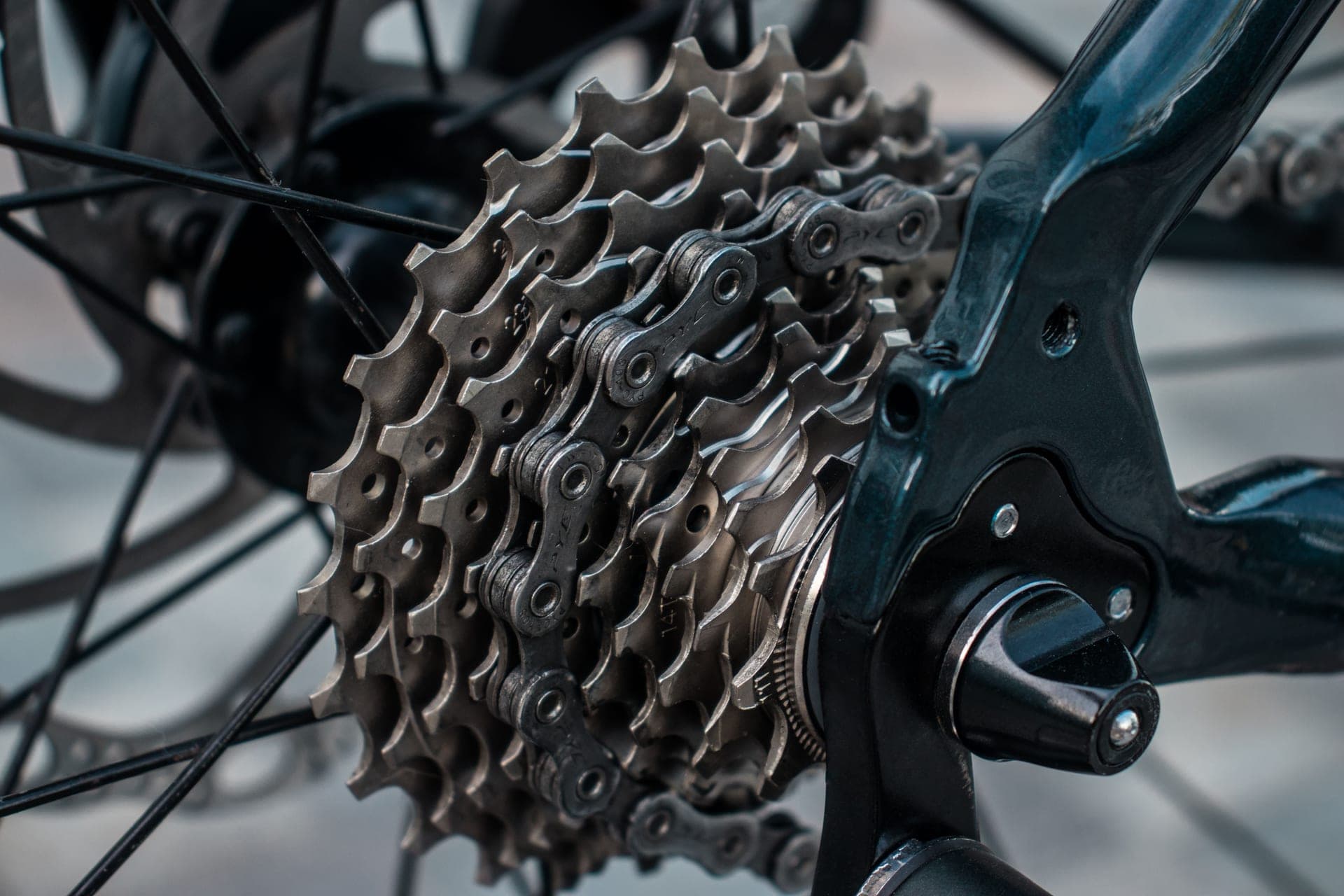
Twelve cogs, in roughly the same freehub width that used to hold eleven. The twelfth sprocket buys you either a wider range or tighter steps — pick one — not the twenty-percent upgrade the marketing implies.
Heads up: we earn a commission if you buy through the links on this page, at no extra cost to you. It never decides what makes the list — here’s how that works.
One sprocket.That is the entire physical difference between an 11-speed drivetrain and a 12-speed one: twelve cogs stacked across roughly the same width of freehub that used to hold eleven. Every claim the marketing hangs on the twelfth cog flows from that single fact — and once you see the fact plainly, most of the claims deflate.
Here is the honest version, up front. Adding a gear does not make a drivetrain twenty percent better; it adds one degree of freedom. You can spend that freedom on a wider range (a bigger climbing cog or a smaller top cog) at the same step sizes, or on tighter steps (filling a gap between existing cogs) at the same range. You do not get both for free. Speed count, in other words, is just one axis of the groupset ladder— and it is the axis the industry finds easiest to put on a box.
What the twelfth cog can actually buy (pick one)
A cassette has two properties a rider feels: its range (roughly the biggest cog divided by the smallest, which sets how easy your easiest gear is versus how fast your fastest one) and its steps(the jumps between neighboring cogs, which set how often a shift lands you at exactly the cadence you wanted). Reading those two numbers off a cassette is a skill in itself — our cassette and chainring guide walks through it. The point for this page is that range and steps pull against each other. Widen one and, for a fixed number of cogs, you coarsen the other.
An extra cog relaxes that tension by exactly one gear’s worth. Manufacturers then choose where to spend it, and you can watch them choose. SRAM’s 12-speed Force cassette (XG-1270) ships in 10-28, 10-30, 10-33 and 10-36 tooth versions, per SRAM’s own model page: same twelve cogs, but the 10-28 is a tight-stepped racing block and the 10-36 is a wide-range one, and no single cassette is both. Shimano’s 12-speed Ultegra cassette (CS-R8100) is offered as 11-30 and 11-34, per the published Shimano compatibility spec. The twelfth cog did not abolish the trade-off. It just moved it one notch.
Notice what SRAM did with the freedom on that top cog: it starts at 10 teethrather than eleven. That is a real, if modest, gain — a 10-tooth cog extends the top of the range and lets SRAM advertise, in its own words on that page, “at least five one-tooth jumps for a smoother gear progression”. It is also the reason SRAM needs a special freehub, which is where the twelfth cog stops being free and starts having consequences.
The chain got narrower — and that is not free either
To fit twelve cogs where eleven used to sit, the chain has to shrink. Sheldon Brown’s reference describes the whole history bluntly: as derailleur systems went from a handful of sprockets up toward twelve, “chains have become ever narrower. First, the rivet pins were shortened, then the internal width for the sprockets and the thickness of the side plates”. A 12-speed chain is a narrower chain than an 11-speed one. That much is not controversial.
What we are notgoing to do is quote you an exact external width in millimeters. Manufacturers do not consistently publish that figure, the numbers that circulate on shopping blogs disagree with each other, and inventing a precise one would be exactly the fabrication this site exists to avoid. The mechanism is clear — less material, tighter tolerances — and the intuitive read is that a narrower chain has a smaller durability margin. The magnitude of that, in real riding, is not something anyone publishes a trustworthy dataset for, and chain life is dominated far more by how you clean and lubricate the thing than by whether it has eleven or twelve gears behind it. The narrower chain is simply the consumable this whole decision quietly touches; our guide to bike chains covers what actually makes one last.
One design wrinkle matters here. SRAM’s 12-speed road cassettes are built for a distinct chain SRAM calls Flattop— the XG-1270 page lists its chain technology as “Road Flattop” — which is not interchangeable with an ordinary 11-speed chain, and Shimano’s 12-speed chains use Shimano’s own profile. “12-speed chain” is not one part you can buy generically; it is a family of brand-specific parts.
Compatibility is where the extra gear actually costs you
This is the section the spec-sheet comparisons skip, and it is the one with money attached. “Can I fit a 12-speed cassette to my wheel?” has no single answer — it has three, depending on what you ride, and they range from “yes, for free” to “you need a new wheel”.
Shimano road, the easy case. Shimano deliberately kept its 12-speed 105 and Ultegra road cassettes starting at an 11-tooth cog, and the payoff is compatibility: the Ultegra CS-R8100 is, per its published spec, “compatible with Shimano 11-speed HG freehub bodies as well as the new Shimano 12-speed HG12 L2 road freehub body”. In plain terms, a rider moving from 11- to 12-speed Shimano road can very often keep the existing wheels and just fit a new cassette. Dura-Ace uses a dedicated 12-speed road freehub, but the volume groupsets do not force one on you.
Shimano mountain, the hard case.Shimano’s 12-speed MTB cassettes go the other way, starting at a 10-tooth cog, and that requires the Micro Spline freehub standard. Sheldon Brown’s reference is precise: “Micro spline 11- and 12-speed bodies are designed to work with a 10-tooth smallest sprocket and have a completely different set of splines both for sprockets and to attach to the hub shell”. A completely different spline means a completely different freehub — and, for most wheels, a new wheel or at least a new freehub body.
SRAM road, the middle case.Because SRAM chose the 10-tooth top cog, its 12-speed road cassettes need SRAM’s XDR driver body, not the plain 11-speed road freehub. The saving grace is dimensional: SRAM states the XDR driver is 1.85mm longer than an XD driver and “occupies the same space as an 11-speed HyperGlide road driver”, sized to fit hubs built for 11-speed road spacing. So the SRAM upgrade is usually a driver-body swap— you change the interface the cassette clicks onto, but you do not re-dish or replace the wheel. More than Shimano road, less than Shimano MTB.
Read those three cases together and the marketing’s tidy “12-speed” label dissolves. Whether the twelfth cog costs you nothing, a driver body, or a wheel is decided entirely by which cog the maker put at the small end — and that choice is upstream of anything you get to feel while riding.
Cross-brand and cross-generation: mostly, don’t
The other honest limit is mixing. A drivetrain is engineered as a matched set — shifter, derailleur, cassette and chain designed for one another’s spacing and cable pull (or, on electronic groups, one another’s proprietary signaling). You cannot generally run a Shimano shifter into a SRAM derailleur, and you should not run a 12-speed chain on an 11-speed cassette or the reverse: the chain’s width and its brand-specific profile are cut for a particular cog spacing, and a mismatch shifts poorly and wears fast. SRAM’s Flattop is the clearest example — it is a purpose-built 12-speed road chain, not a drop-in for an older cassette.
This is why “just upgrade to 12-speed” is rarely one purchase. Change the cog count and you are usually changing the cassette, the chain, the rear derailleur and the shifter together, because those four parts only speak the same language within a generation and a brand. Occasionally you change the freehub too. The gear count is the headline; the matched set is the bill. If you are staying at your current count and only replacing the cassette, our road cassette roundup is sorted by speed count and freehub so you can find the one that fits.
So is 12-speed worth it? Usually you don’t upgrade to it — you inherit it
Here is the answer that costs us affiliate revenue. Almost nobody should chase gear count as such. You replace a groupset because it is worn out, because you want electronic shifting, or because you are buying a new bike — and in 2026 a new mid-range road, gravel or mountain bike arrives at 12-speed by default. The twelfth cog comes along for the ride. You did not upgrade to it; you inherited it when you bought the thing you were going to buy anyway.
If your 11-speed drivetrain works, shifts crisply and covers your hills, the twelfth cog is not a reason to spend. It will not make you faster, it will not make a meaningful dent in your gear gaps unless you specifically buy a tighter-stepped cassette to close a gap that actually bothers you, and it drags a chain-and-cassette-and-derailleur bill behind it. Buy 12-speed when your next groupset or next bike hands it to you. Until then, an 11-speed system is not obsolete; it is one cog short of a marketing bullet point, and those are different things.
What we haven’t done
We have not tested drivetrains, timed a shift, or measured a chain. Every specific figure on this page is a manufacturer’s published spec — SRAM’s XDR dimensions and cassette ranges, Shimano’s freehub compatibility — or Sheldon Brown’s reference on why chains narrowed, each linked below. Where the honest answer was “nobody publishes a clean number” — the external chain width, the real-world wear penalty of a narrower chain — we said so rather than inventing one.
11-speed vs 12-speed, on the things that actually differ
No scores — we’ve measured nothing. Where the honest answer is “it depends on the exact cassette” or “nobody publishes this”, the row says that instead of inventing a winner.
| What you’re comparing | 11-speed | 12-speed | The honest read |
|---|---|---|---|
| What the extra cog buys | Eleven cogs across the freehub | One more cog in the same width | Wider range OR tighter steps — one, not both |
| Chain width & design | Wider chain, generic across the brand | Narrower chain; SRAM road uses a distinct Flattop | Narrower is real; exact mm isn't published, so we don't quote one |
| Shimano cassette ↔ freehub | Standard HG road freehub, 11T start | 105/Ultegra keep 11T & fit the same HG freehub; MTB needs Micro Spline | Road upgrade often needs no new wheel; MTB does |
| SRAM cassette ↔ freehub | HG road driver, 11T start | 10T start road cassettes need an XDR driver body | Swap the driver (same wheel spacing), not the wheel |
| Cross-brand / cross-generation | Matched set within a brand & generation | Same — plus brand-specific 12-speed chains | Don't mix a 12-speed chain onto an 11-speed cassette |
| Wear, cost & upgrade worth it? | Cheaper, mature, everywhere | Pricier consumables; now the default on new bikes | Inherit it with a groupset/bike — rarely worth chasing alone |
Read down the last column. Not one row is a clean win for “more gears”— the twelfth cog is a trade-off you tune, a compatibility question you answer, and a consumable bill you pay. The gear count is the one thing on the box; it is the least of what actually decides this.
What actually decides this purchase
Decide range or steps before you decide speed count.A cassette’s range and its step sizes matter far more to how a bike feels than whether it has eleven or twelve cogs. Work out which gap actually bothers you, or which climb you keep running out of gears on, and choose the cassette that fixes it — the cassette and chainring guide shows how to read those numbers.
Find out which compatibility case you’re in.Shimano road 12-speed (105, Ultegra) usually fits your existing 11-speed HG freehub. SRAM road 12-speed needs an XDR driver body — a swap, not a new wheel. Shimano MTB 12-speed needs a Micro Spline freehub, which for many wheels means a new wheel or freehub body. Answer this before you buy anything, because it is the difference between a cassette and a wheelset.
Budget the matched set, not the headline part.Changing cog count normally means changing the cassette, chain, rear derailleur and shifter together, because those parts only work as a system within one brand and generation. A “cheap upgrade to 12-speed” that quotes you only the cassette price is quoting you the smallest part of the bill.
Buy the right chain, and look after it.The narrower 12-speed chain is the consumable this decision touches most often. Match it to your drivetrain’s brand and speed — SRAM Flattop for SRAM road 12-speed, Shimano’s own for Shimano — and keep it clean, because maintenance decides chain life far more than gear count does. Our chains guide has the detail.
Don’t upgrade for the number. If your 11-speed drivetrain shifts well and covers your terrain, the twelfth cog is not a reason to spend. You will get 12-speed on your next groupset or next bike anyway, and inheriting it is cheaper than chasing it.
Common questions
Is 12-speed actually better than 11-speed?
It has one more gear, which is not the same as being better. That extra cog lets a manufacturer widen the cassette’s range or tighten its steps by one gear’s worth — but not both at once, and not by anything like the margin the marketing implies. Both 11- and 12-speed systems shift beautifully when set up well. The practical truth is that you rarely choose the count; you get it with whatever groupset or bike you buy, and 12-speed is now the default on new bikes.
Can I put a 12-speed cassette on my 11-speed wheel?
It depends on the brand and discipline. Shimano’s 12-speed 105 and Ultegra road cassettes keep an 11-tooth small cog and are, per Shimano’s published spec, compatible with existing 11-speed HG road freehub bodies — so often, yes, with just a new cassette. SRAM’s 12-speed road cassettes start at a 10-tooth cog and need an XDR driver body, which fits the same road hub spacing but has to be swapped onto the wheel. Shimano 12-speed mountain cassettes need the entirely different Micro Spline freehub, which for many wheels means a new wheel or freehub body.
Can I run a 12-speed chain on an 11-speed drivetrain, or vice versa?
As a rule, no. A chain is cut to a particular cog spacing and, increasingly, to a particular brand’s tooth profile — SRAM’s 12-speed road cassettes use a purpose-built “Flattop” chain, and Shimano uses its own. Mixing a 12-speed chain with an 11-speed cassette (or the reverse) generally shifts poorly and wears both parts faster. Match the chain to the drivetrain’s brand and speed.
Are 12-speed chains less durable because they’re narrower?
A 12-speed chain is narrower — Sheldon Brown’s reference describes how chains lost width at the pins, the internal spacing and the side plates as speeds climbed — so it has less material and tighter tolerances, and the intuitive read is a smaller durability margin. We won’t hand you a wear-rate figure, because we can’t find a trustworthy published one, and in practice how you clean and lubricate the chain matters far more to its life than its speed count. See our chains guide for what actually makes a chain last.
Should I upgrade my 11-speed bike to 12-speed?
Usually not on its own. A cog-count change normally means a new cassette, chain, rear derailleur and shifter — sometimes a new freehub too — because those parts work as a matched set. If your 11-speed drivetrain shifts cleanly and covers your terrain, the twelfth cog will not make you faster and will not meaningfully close your gaps unless you deliberately buy a tighter cassette. The sensible move is to let 12-speed arrive with your next groupset or bike, rather than paying to chase one gear.
Sources
- SRAM — XD and XDR Driver Body Explained (XDR is 1.85mm longer than XD and "occupies the same space as an 11-speed HyperGlide road driver"; road-specific, 10-tooth-start cassettes) — retrieved 2026-08-08
- SRAM — Force XG-1270 cassette model page (12-speed; requires XDR driver body; "Road Flattop" chain technology; 10-28 / 10-30 / 10-33 / 10-36 ranges; "at least five one-tooth jumps") — retrieved 2026-08-08
- Shimano Ultegra CS-R8100 12-speed cassette — published compatibility spec ("compatible with Shimano 11-speed HG freehub bodies as well as the new Shimano 12-speed HG12 L2 road freehub body"; 11T small cog; 11-30 and 11-34 ranges) — retrieved 2026-08-08
- Sheldon Brown — Cassette & Freehub speeds reference (chains narrowed by shortening pins, then internal width, then side-plate thickness) — retrieved 2026-08-08
- Sheldon Brown — Shimano Cassettes & Freehubs (Micro Spline 11- and 12-speed bodies use a 10-tooth smallest sprocket and "a completely different set of splines") — retrieved 2026-08-08
Read next
- Groupset hierarchy explained
Speed count is one axis of the groupset ladder.
- Cassette and chainring guide
Reading cassette ranges and what they mean for gaps.
- The best bike chains
Narrower chains are the consumable this decision touches.
We haven’t ridden or tested any of the products on this page, and we don’t pretend otherwise. Read how we research — or tell us we’re wrong and we’ll log the correction.