Shimano 105 vs Ultegra
Two tiers, one spec database. On Shimano's own numbers the gap is 56 grams where it's measurable — and on the chain, it's exactly zero.
Heads up: we earn a commission if you buy through the links on this page, at no extra cost to you. It never decides what makes the list — here’s how that works.
This is the decision most road buyers actually face, and it is normally settled with adjectives. Ultegra is “crisper”. 105 is “almost as good”. Neither statement contains a number, which is convenient for everyone except you.
Shimano runs a public product information database that publishes an average weight and a materials breakdown for every component in both groups. We read it on 17 July 2026 and did the subtraction. Here is what the manufacturer’s own spec sheet says the upgrade buys.
On 12-speed: 40 g on the rear derailleur, 16 g on a like-for-like 11-34T cassette. On 11-speed: 25 g on the rear derailleur. On the chain, both tiers: 257 g each — a difference of zero. And on two components — the 11-speed cassettes and both cranksets — Shimano publishes figures at differentconfigurations, so an honest like-for-like comparison isn’t available at all. We’ll show you exactly where that happens rather than quietly papering over it.
The rear derailleur: the cleanest comparison Shimano gives you
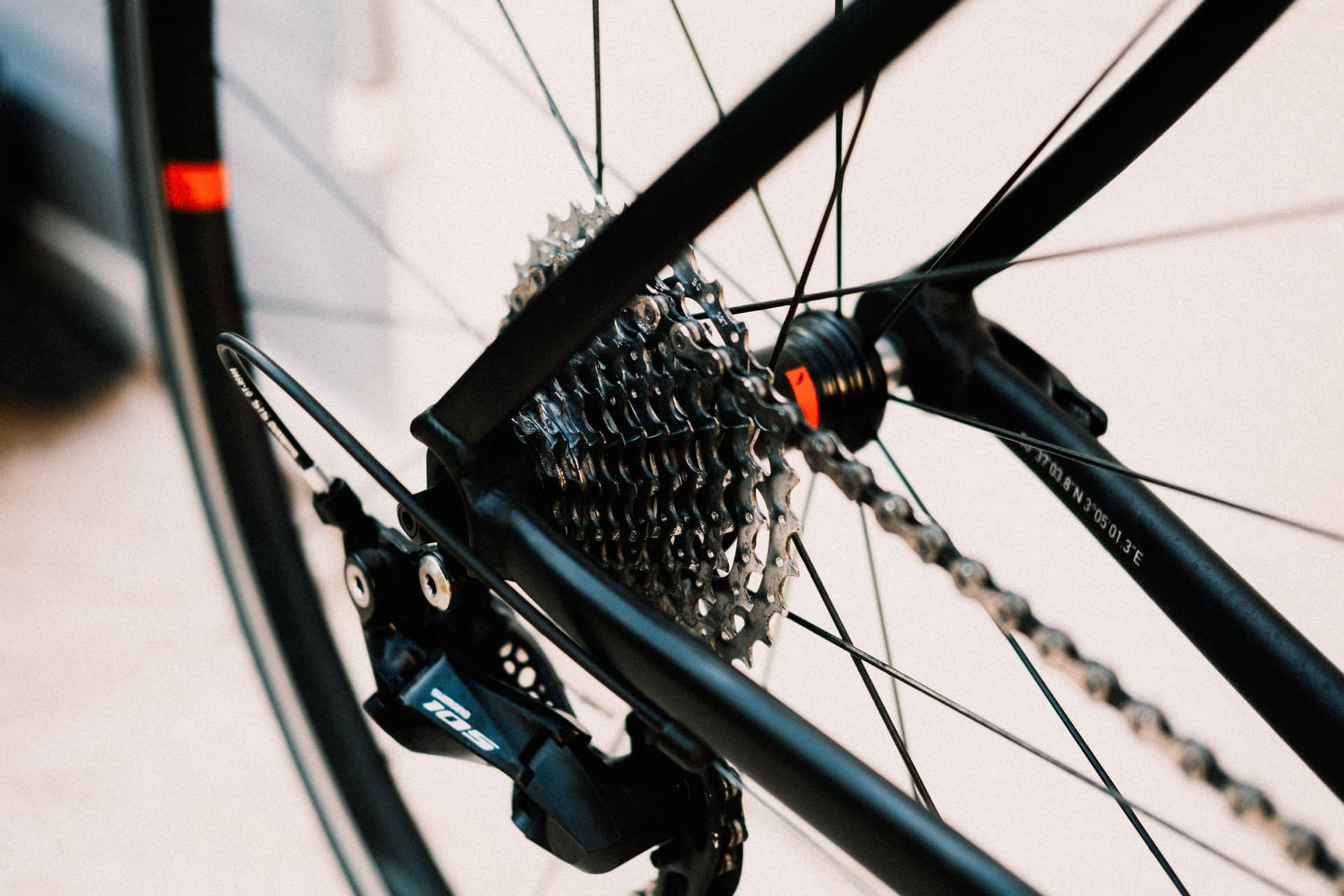
On 11-speed mechanical, Shimano’s spec table lists the Ultegra RD-R8000-SS at 200 g and the 105 RD-R7000-SS at 225 g. Both are short-cage, both take a 30T maximum sprocket, both have 35T total capacity, both use an aluminum bracket body and a GFRP plate body, both use aluminum outer and inner plates. Genuinely the same component at two prices, 25 g apart.
The published construction difference is specific and worth knowing: the Ultegra derailleur lists a guide pulley bearing and a tension pulley bearing. The 105 spec lists neither. That is the clearest example on this page of what a tier actually buys — not a mystery, not a feel, two sealed bearings.
On 12-speed Di2, the gap widens. Shimano publishes the Ultegra RD-R8150 at 262 g against the 105 RD-R7150 at 302 g— 40 g. But note what else changes: the 105 unit takes a 36T maximum sprocket and has 41T total capacity, where the Ultegra takes 34T max and 39T capacity. The cheaper derailleur handles a bigger climbing gear. If your riding is steep, the lower tier is the more capable component on the one spec that affects whether you get up the hill.
The cassette: 16 grams, and a ratio you can't buy at 105
Cassettes are where the tier changes materials, and Shimano publishes the detail. At the one ratio both 12-speed cassettes share — 11-34T — Ultegra’s CS-R8101-12 is published at 345 g and 105’s CS-R7101-12 at 361 g. Sixteen grams.
What the 16 g costs you, in Shimano’s own terms: the Ultegra cassette has two aluminum spider arms to the 105’s one, and an anodized aluminum lock ring where the 105 uses nickel-plated steel. Both carry twelve nickel-plated steel sprockets — the sprockets themselves are the same material. Shimano lists the Ultegra as HYPERGLIDE+ and the 105 as HG.
The more consequential difference isn’t weight at all. Shimano lists the 12-speed Ultegra cassette in 11-30T and 11-34T. It lists the 12-speed 105 cassette in 11-34T only. If you want the tighter 11-30T block — closer ratios, smaller jumps, the thing fast riders on flat roads actually want — it does not exist at 105 in 12-speed. That is a real functional reason to move up, and it has nothing to do with grams.
Where we can't give you a number, and won't invent one
Two comparisons on this page are commonly published elsewhere and shouldn’t be.
The 11-speed cassettes. Shimano publishes the Ultegra CS-R8000 at 232 g at 11-25T and the 105 CS-R7000 at 284 g at 11-28T. Those are different cassettes with different sprockets. The 52 g between them is partly tier and partly the extra teeth, and Shimano does not publish a common ratio for both. So we cannot tell you what the 11-speed cassette upgrade weighs, and neither can anyone else without a scale. The direction is real — Ultegra uses an aluminum lock ring, 105 uses steel — but the magnitude is not published.
The cranksets. Same problem, worse. Shimano publishes the 12-speed Ultegra FC-R8100 at 702 g at 46-36T, and the 12-speed 105 FC-R7100 at 754 g at 50-34T. Different chainrings, different tooth counts, different amounts of metal. Subtracting one from the other produces a number that means nothing. Shimano publishes no common chainring combination for the two cranksets.What it does publish is the material: the Ultegra outer ring is aluminum/CFRP (except at 46-36T), the 105 outer ring is aluminum+GFRP; Ultegra’s chainring bolts are aluminum, 105’s are stainless steel.
This is the part of the comparison that most publishers fill in anyway. We’d rather have the gap on the page. A stated gap is checkable; a confident guess isn’t.
The chain: a difference of zero
Shimano’s chain specifications publish an average weight at a fixed 114 links, which makes them directly comparable. The Ultegra CN-HG701-11 is 257 g. The 105 CN-HG601-11 is 257 g.
The published difference is that the Ultegra chain adds SIL-TEC to the pin link plate — the outer plate — where the 105 chain has SIL-TEC on the roller link plate only. Both get chromizing treatment on the roller link pin. Neither has a hollow pin; that’s reserved for the CN-HG901-11, published at 247 g.
Shimano publishes no wear figure, no durability figure and no efficiency figure for either chain, so there is no way to value the extra coating from the manufacturer’s own data. Our chains roundup ranks the 105 chain above the Ultegra one for exactly this reason, and names the Ultegra chain the one to skip.
So who should buy which?
Buy 105 ifyou ride hills and want the 36T sprocket the 12-speed 105 derailleur supports; if you are building to a budget and would rather put the difference into tires or wheels, where the published weight differences are an order of magnitude larger; or if you simply want the honest answer, which is that 56 g of measurable difference across a derailleur and a cassette is not a performance decision, it’s a preference.
Buy Ultegra ifyou specifically want the 11-30T 12-speed cassette that doesn’t exist at 105; if you want the pulley bearings on the 11-speed mechanical derailleur; or if you have the money and you want the nicer thing, which is a perfectly respectable reason as long as nobody dresses it up as physics.
Buy neither, yet, ifyour current drivetrain is worn. A stretched chain on Ultegra shifts worse than a fresh chain on 105, and it’s quietly destroying a cassette while it does it — see when to replace a bike chain. And if your shifting is vague, that is far more likely to be adjustment than tier: how to adjust a rear derailleur costs nothing and fixes the actual complaint most of the time.
For where these two sit in the wider range — including what Shimano refuses to publish below 105 — see groupset hierarchy explained.
105 vs Ultegra, component by component
Every figure is Shimano’s own published average weight, read from its product information database on 17 July 2026. Rows marked not comparableare ones where Shimano publishes the two tiers at different sprocket or chainring combinations — the subtraction would be meaningless, so we haven’t done it.
| Component | 105 | Ultegra | Ultegra saves | What changes |
|---|---|---|---|---|
| Rear derailleur, 11-sp mechanical (SS) | 225 g — RD-R7000-SS | 200 g — RD-R8000-SS | 25 g | Ultegra lists guide + tension pulley bearings; 105 lists neither |
| Rear derailleur, 12-sp Di2 | 302 g — RD-R7150 | 262 g — RD-R8150 | 40 g | But 105 takes a 36T max sprocket vs Ultegra's 34T — 105 climbs better |
| Cassette, 12-sp @ 11-34T | 361 g — CS-R7101-12 | 345 g — CS-R8101-12 | 16 g | Ultegra: 2 alu spider arms + alu lock ring. 105: 1 arm + steel lock ring |
| Chain, 11-sp @ 114 links | 257 g — CN-HG601-11 | 257 g — CN-HG701-11 | 0 g | Ultegra adds SIL-TEC on the pin link plate. Identical published weight |
| Cassette, 11-speed | 284 g @ 11-28T | 232 g @ 11-25T | Not comparable | Shimano publishes no common ratio for the two — different sprockets entirely |
| Crankset, 12-sp @ 170 mm | 754 g @ 50-34T | 702 g @ 46-36T | Not comparable | Different chainrings. Ultegra ring is alu/CFRP; 105 is alu+GFRP |
Totaling the three comparable 12-speed rows gives 56 gfrom 105 to Ultegra — derailleur plus cassette, chain unchanged. That is the entire published, like-for-like case for the upgrade. Cranksets are excluded because Shimano publishes them at different chainring combinations, and adding an incomparable row to reach a bigger number would be exactly the kind of arithmetic this site exists to avoid.
What actually decides this purchase
Decide on gear range first, because it’s the one thing you can’t undo cheaply. The 12-speed 105 derailleur is published with a 36T maximum sprocket; the Ultegra with 34T. The 12-speed Ultegra cassette comes in 11-30T and 11-34T; the 105 in 11-34T only. Those two facts pull in opposite directions and between them they decide the bike. If you ride steep roads, 105 officially supports the bigger climbing sprocket. If you ride fast and flat and want the tighter block, only Ultegra sells it to you. The cassette and chainring guide has the capacity arithmetic.
Weigh 56 grams against what else 56 grams costs.That’s the full published, like-for-like 12-speed difference — derailleur plus cassette, chain unchanged. It is less than a spare tube and a CO2 canister. If your goal is a lighter bike, there are cheaper grams available almost everywhere else on it, and you already own most of them.
Don’t buy the crankset comparison — it doesn’t exist.Shimano publishes the 12-speed 105 crank at 50-34T and the Ultegra at 46-36T. Different chainrings, different metal, no common configuration. Any figure you have seen for “the crankset weight difference” between these tiers came from somebody’s scale, not from Shimano. Treat it accordingly.
Pulley bearings are the one concrete thing on the 11-speed side.If you’re choosing between mechanical 11-speed groups, Ultegra’s RD-R8000 lists a guide pulley bearing and a tension pulley bearing; the 105 RD-R7000 lists neither. That is a real, published, mechanical difference you can point at — which is more than most tier arguments can offer.
Buy the chain at 105 either way.Both tiers’ chains are published at 257 g per 114 links. There is no weight case, and Shimano publishes no durability figure to make any other case. Our chains roundup names the Ultegra chain the one to skip for exactly this reason — it is the clearest example on the whole site of a tier charging for a difference nobody has quantified.
Fix the drivetrain you have before you buy the one you want. Vague shifting is cable tension or a worn chain far more often than it is tier. Both are free to check: how to adjust a rear derailleur and when to replace a bike chain. Do those two things first and you may find the upgrade you were about to buy was a symptom, not a cure.
Common questions
Is Ultegra actually lighter than 105?
Yes, but by less than the price gap suggests, and not everywhere. On Shimano’s own published figures: 40 g on the 12-speed Di2 rear derailleur, 16 g on an 11-34T 12-speed cassette, 25 g on the 11-speed mechanical derailleur — and 0 g on the chain, where both tiers are published at 257 g per 114 links. Add the comparable 12-speed rows and the upgrade buys about 56 g. For the cranksets and the 11-speed cassettes, Shimano publishes the two tiers at different configurations, so no honest comparison exists.
Can I mix 105 and Ultegra parts?
Within a speed count, Shimano’s spec tables show the two tiers sharing the same compatible chain type and the same spline — the 12-speed 105 and Ultegra cassettes both use the road-dedicated HG spline L2, and both take an HG 12-speed chain. That is what Shimano publishes, and it’s the reason mixed builds are common. What we won’t do is give you a blanket yes: the constraint that bites is speed count and derailleur capacity, not the badge. Check that the derailleur supports your largest sprocket — Shimano publishes a maximum for every model.
Which one climbs better?
On published capacity, 105 does — which surprises people. The 12-speed 105 rear derailleur (RD-R7150) is listed with a 36T maximum sprocket and 41T total capacity; the Ultegra RD-R8150 is listed at 34T max and 39T capacity. The cheaper tier officially supports a bigger climbing gear. Against that, Ultegra offers an 11-30T cassette that 105 doesn’t, which is the opposite trade: closer ratios, less range. Pick the one whose published range matches your terrain, not the one with the nicer name.
Why does the Ultegra chain cost more if it weighs the same?
Because it has more coating. Shimano publishes the Ultegra CN-HG701-11 with SIL-TEC on both the pin link plate and the roller link plate, where the 105 CN-HG601-11 has SIL-TEC on the roller link plate only. Both are 257 g at 114 links. What Shimano does not publish, for either chain, is any wear, durability or efficiency figure — so there is no manufacturer data that tells you what the extra coating is worth. If someone publishes that number we will use it and say so.
Should I upgrade my 105 bike to Ultegra?
Not for the weight. 56 g of published, comparable difference is less than a spare tube. The defensible reasons are functional and specific: you want the 11-30T 12-speed cassette that 105 doesn’t offer, or you want the pulley bearings on the 11-speed mechanical derailleur. If your actual complaint is that shifting feels vague, that is far more likely to be cable tension or a worn chain than tier — and both are free to investigate before you spend anything.
Sources
- Shimano — road rear derailleur specifications (RD-R7000-SS and RD-R8000-SS weights, pulley bearings, capacity, materials) — retrieved 2026-07-17
- Shimano — road Di2 rear derailleur specifications (RD-R7150 and RD-R8150 weights and capacity) — retrieved 2026-07-17
- Shimano — road cassette specifications (CS-R7101-12 and CS-R8101-12 weights by ratio, lock ring and spider arm materials, available combinations) — retrieved 2026-07-17
- Shimano — road crankset specifications (FC-R7100 and FC-R8100 published at different chainring combinations; ring materials) — retrieved 2026-07-17
- Shimano — chain specifications (CN-HG601-11 and CN-HG701-11 average weight at 114 links, plate treatments) — retrieved 2026-07-17
Read next
- Di2 vs mechanical shifting
What electronic shifting actually buys, and what it costs.
- Groupset hierarchy explained
The whole ladder, including where Shimano stops publishing.
- The best bike chains
Where the two tiers weigh identically — and one gets skipped.
- SRAM Rival vs Force
The same question, asked of the other manufacturer.
- Cassette and chainring guide
The ratios each tier does and doesn't offer.
We haven’t ridden or tested any of the products on this page, and we don’t pretend otherwise. Read how we research — or tell us we’re wrong and we’ll log the correction.