Hub vs Mid-Drive Motors
One drives the wheel, the other drives the crank. That single difference decides climbing, chain wear, flat repairs and price — and eleven of the twelve e-bikes on Amazon won't tell you which they are.
Heads up: we earn a commission if you buy through the links on this page, at no extra cost to you. It never decides what makes the list — here’s how that works.
There is exactly one difference between these two systems and everything else follows from it. A hub motor drives the wheel. A mid-drive drives the crank.That’s it. Every advantage, every drawback and every price difference in this comparison is a consequence of where the power enters the bicycle.
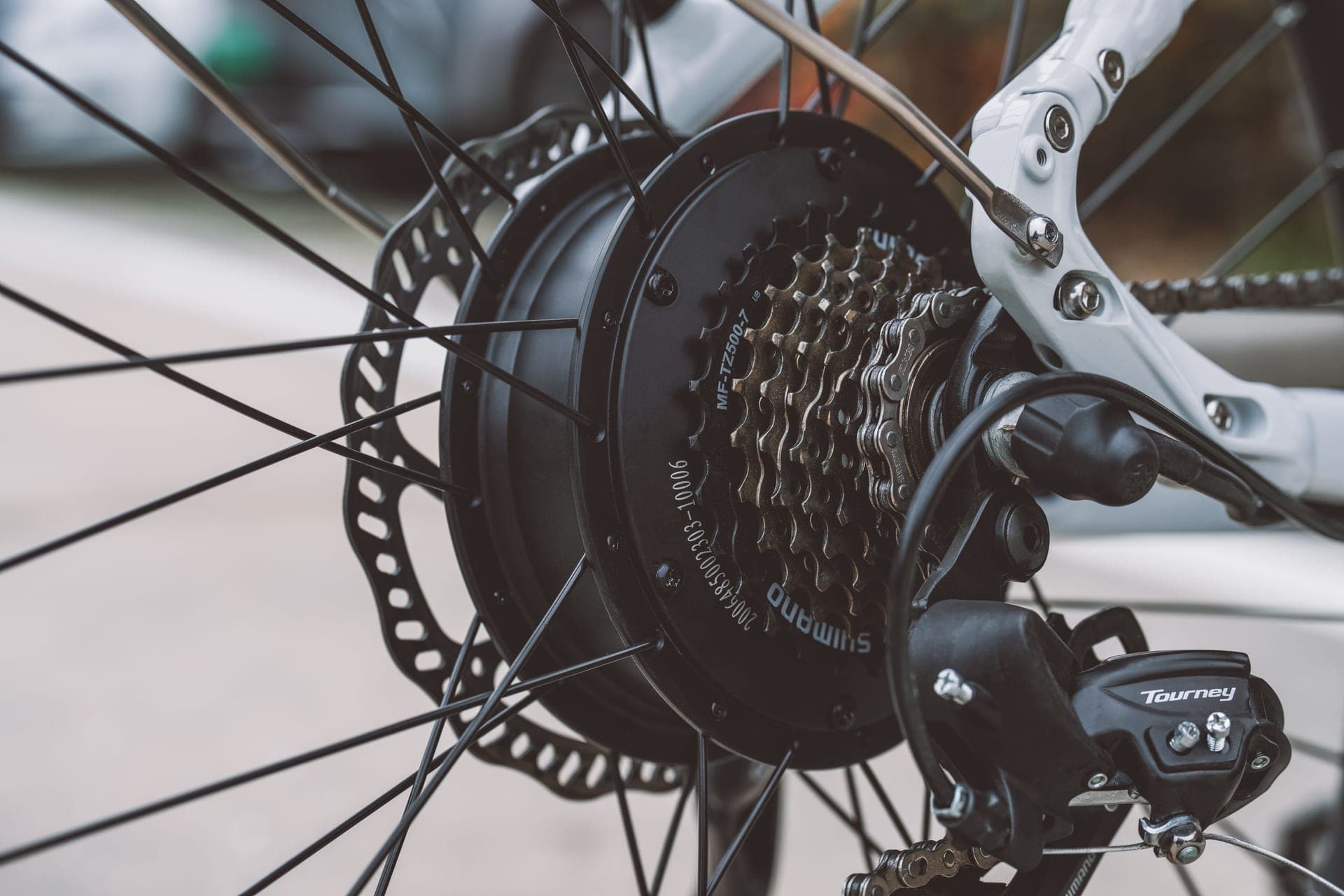
A hub motor is built into the wheel — the axle is the motor. It spins the wheel directly, so it is completely indifferent to what gear you’re in. A mid-drive sits at the bottom bracket and turns the chainring, so its power flows through your chain, your cassette and your gear choice, exactly like the power from your legs.
What that means when the road goes up
This is the practical heart of it. When you hit a steep hill on a normal bike you change down, which trades speed for torque at the wheel. On a mid-drive, the motor gets that trade too — downshift and its torque is multiplied by the same gearing that multiplies yours. It stays in its efficient range while going slowly.
A hub motor gets nothing from your shifting. It is effectively in one gear, permanently. Its worst case is exactly the situation you most want help in: steep, slow, heavy. Motors in that state make heat instead of progress, which is why a hub-drive on a long climb can feel like it’s giving up. Manufacturers compensate with brute wattage — which is why the listings in our catalog advertise 1000W, 1400W and 1500W peak while a premium mid-drive is content with a fraction of that.
The torque trap
Here is a number that will mislead you if nobody explains it. Heybike’s own page for the Mars 3.0 claims 95 N·m of torque. Bosch publishes 85 Nm for its Performance Line CX, which is one of the most respected mid-drives made and costs, on its own, more than several of the complete bikes in our catalog.
So the Amazon bike has more torque than the Bosch? No — the two numbers are not measuring the same thing. A hub motor’s torque is produced at the wheel. A mid-drive’s is produced at the crank, before the gearing.A mid-drive in a low gear multiplies its 85 Nm by the ratio between chainring and sprocket — which at the wheel is a much larger number than the one on the box. The hub motor’s 95 N·m is already the final figure. It gets multiplied by nothing.
We should be scrupulous here: neither spec sheet states where its torque is measured.Heybike doesn’t say “at the wheel”. Bosch’s figure is the standard crank-torque convention for mid-drives. So the honest statement is not “Bosch is really 300 Nm” — we’re not doing that arithmetic on an assumption. The honest statement is: these two numbers are not comparable, nobody tells you that, and one of them is printed in a headline precisely because it looks bigger.
Which one is on the bike you’re about to buy?
Almost certainly a hub motor — and almost certainly the listing won’t say so. We read all twelve e-bike listings in our catalog on 17 July 2026. Exactly one states where its motor is:the Schwinn Parkwood, which says “350W Hub Motor”. The other eleven publish a wattage and stop. The full table is above.
Is that a scandal? Not exactly. A mid-drive costs more than most of these bikes do complete, so there is functionally no chance any of them has one. But that reasoning is an inference from prices, not a fact from a spec sheet, and this site’s entire method is refusing to blur the two. If you want to know for certain, the giveaway is in the photographs: look at the rear hub. If it’s the size of a soup can, that’s the motor.
The thing neither system tells you: how it decides to help
Buyers agonize over hub vs mid-drive and then ignore the spec that actually determines what an e-bike feels like to pedal — the sensor. A cadence sensor notices that the pedals are turning and applies assistance; a torque sensormeasures how hard you’re pushing and scales the assistance to match. Bosch publishes a multi-sensor approach for its CX including a torque sensor that measures pedal force.
Not one of the twelve Amazon listings says which sensor it has.Zero out of twelve, on the specification that most determines whether a bike feels like a bicycle or like a scooter that requires pedaling. We can’t tell you how any of them feels — we haven’t ridden them, and we’re not going to describe a sensation we have not had. What we can tell you is that the question exists, that it matters more than the wattage on the box, and that nobody selling these bikes will answer it.
Where the hub motor actually wins
Two places, and they’re both real. Price: it is the reason an e-bike can exist at these prices at all. Drivetrain wear:a hub motor’s power never touches your chain. A mid-drive pushes its full output through the same chain and cassette your legs use, which is why mid-drive owners talk about chains more than anyone else on a bicycle. How much faster a mid-drive eats a drivetrain, we can’t tell you: no published dataset we could find measures it, and we’re not going to invent a multiplier. The mechanism isn’t in dispute; the magnitude isn’t published.
There’s also a legal footnote worth knowing. Federal law defines a low-speed electric bicycle as one with a motor of less than 750 watts. That figure constrains what a manufacturer can legally build as a bicycle, and it is the reason two of our catalog’s listings land on 750W while others advertise 1500W peak. Whatever “1500W Peak” is measuring, it isn’t the number the statute is talking about — see e-bike classes explained.
The flat tire argument
Nobody mentions this in a spec comparison and everybody meets it eventually. A rear hub motor means your rear wheel contains a motor, has a power cable running into the axle, and is held in with torque washers rather than a quick release. Getting that wheel out to fix a puncture is heavier, fiddlier and more consequential than on a normal bike — you can damage the cable connector if you’re careless, and the wheel weighs what it weighs.
A mid-drive bike has an ordinary rear wheel and an ordinary flat repair. If you buy an Amazon e-bike, you have a hub motor and no dealer network, so this job is yours: read how to fix a flat before you need it, not beside a road at dusk.
The two tables that settle this
1. What actually changes, hub vs mid-drive
| Dimension | Hub motor | Mid-drive |
|---|---|---|
| What it drives | The wheel itself. The motor IS the hub. | The crank. Power goes into your chain and out through your gears. |
| Does it use your gears? | No. Gear choice changes your legs' job, never the motor's. | Yes. Downshift and the motor's torque is multiplied, exactly like yours. |
| Climbing | Motor is stuck in one effective ratio. Steep and slow is its worst case. | Gears down with you, so it holds torque at low speed. |
| Drivetrain wear | Motor power bypasses the chain entirely. | Motor power goes through the chain and cassette. Nobody publishes what that costs you. |
| Fixing a rear flat | Heavier wheel, power cable, torque washers. A genuinely worse afternoon. | An ordinary rear wheel. Ordinary job. |
| Weight distribution | Mass at the rim, at one end of the bike. | Mass low and central, near the bottom bracket. |
| Torque figure, where measured | At the wheel — already past the gearing. | At the crank — before the gearing multiplies it. |
| Cost | Cheap. It is why every e-bike under four figures uses one. | Expensive. The motor alone costs more than several bikes in our catalog. |
| Who services it | You, mostly. These brands have no dealer network. | A shop, usually — mid-drives are the systems shops are trained on. |
2. Where is the motor? What all twelve listings actually say
| E-bike | What the listing says about the motor | Motor location |
|---|---|---|
| Schwinn Parkwood | “350W Hub Motor” | Hub — stated |
| Heybike Mars 3.0 | “1400W Peak Motor” | Not stated |
| Heybike Ranger 2.0 | “1400W Peak Motor” | Not stated |
| Heybike Cityscape 2.0 | “— no motor figure at all” | Not stated |
| Vivi 27.5" Electric Mountain Bike | “Peak 750W” | Not stated |
| Gotrax R7 | “750W Peak Motor” | Not stated |
| Jasion EB5 | “Peak 1000W Brushless Motor” | Not stated |
| ENGWE L20 | “1125W” | Not stated |
| Cyrusher Kommoda | “1500w” | Not stated |
| Hiboy Fat-Tire Electric Bike | “1000W Peak Motor” | Not stated |
| TotGuard 27.5" Electric Bike | “500W” | Not stated |
| isinwheel Step-Thru Electric Bike | “1500W Peak Motor” | Not stated |
One out of twelve. Motor claims quoted from each product’s own live Amazon listing title, read 17 July 2026 (the Heybike Mars 3.0 on 15 September 2026, and the Gotrax R7 and Vivi on 29 September 2026, after the listings we first linked went unavailable). We are confident all twelve are hub motors and we are not going to write that down as a spec — at these prices a mid-drive is not economically possible, but “economically implausible” is an inference, and the whole point of this site is the difference between an inference and a published number.
What actually decides this purchase
If you’re shopping on Amazon, this decision has already been made for you.There is no mid-drive in this price band. The honest advice is to stop comparing systems and start comparing the things that do vary between the bikes actually in front of you: battery capacity, brakes, frame, and whether the seller publishes anything at all. That’s the best e-bikes on Amazon.
Buy a mid-drive when the hills are the point. If your riding is genuinely steep, genuinely loaded, or genuinely long, gearing the motor is worth real money and a hub motor will disappoint you in exactly the place you bought it for. That means a dealer, a brand with a service network, and a budget that is a multiple of everything in our catalog.
Buy a hub motor for flat, short, cheap and self-serviced.Commuting on rolling terrain, errands, a bike that lives outside, a bike you’re not precious about. Hub-drive is not a compromise here — it’s the correct engineering answer, and the drivetrain wear advantage is genuinely on its side.
Ignore the wattage. Ignore the torque figure.One is a peak nobody defines, the other is measured somewhere the listing won’t name. The number that survives scrutiny is battery capacity in watt-hours, because it’s a unit of energy and it means the same thing on every bike. That’s the argument in e-bike battery range explained, and it’s the input for the cost-per-mile arithmetic. If you want the receipts on the first half of that sentence, we audited all twelve listings in e-bike motor power explained: seven print the word “Peak”, four print a bare number with no label, one prints no watt figure at all, and not one publishes a nominal rating or a torque figure in newton-metres.
Whichever you buy, the chain is a consumable.On a mid-drive it’s a consumable under motor load. Even on a hub-drive it’s a heavy bike pushing hard through a bicycle chain. Our workshop and components hubs cover chain wear and replacement properly — it is the cheapest maintenance there is and the most expensive to skip.
If the reason you are reading this is a specific hill, that is now its own page: the best e-bikes for hills ranks our catalog on published rear gear count rather than on a peak watt figure, and records the finding that none of the twelve complete e-bikes we list is a mid-drive at all.
Common questions
Is a mid-drive motor worth the extra money?
If you ride hills, probably yes; if you ride flat, probably not — and the price gap is not subtle. A premium mid-drive costs, as a bare motor, more than most complete e-bikes on Amazon. What you buy is gearing: the motor downshifts with you, so it holds torque at low speed instead of overheating in one effective ratio. On a flat commute that advantage is worth almost nothing, and you’ve paid for it with money and with drivetrain wear.
Do any Amazon e-bikes have mid-drive motors?
None of the twelve in our catalog publishes that it does — and only one publishes its motor location at all. Given that a mid-drive motor costs more than most of these bikes, they are almost certainly all hub-drive. We say “almost certainly” on purpose: that’s an inference from prices, not a fact from a spec sheet, and we don’t promote inferences to facts. Check the photograph of the rear wheel; the motor is not subtle.
Why does a cheap hub motor claim more torque than an expensive Bosch?
Because the two figures are measured in different places. A hub motor produces its torque at the wheel, where the number is final. A mid-drive produces its torque at the crank, before your gears multiply it — so its published figure understates what reaches the ground in a low gear. Neither listing tells you this. It is the single most misleading spec in e-bike marketing, and the fact that it’s technically true in both cases is what makes it work.
Does a hub motor wear out my chain faster?
No — and this is the hub motor’s genuine, underrated advantage. Its power goes straight into the wheel and never touches your chain or cassette; only your legs do. A mid-drive sends its full output through the drivetrain, which is why mid-drive riders replace chains more often. How much more often, we can’t tell you: nobody publishes a dataset that measures it, and we’re not going to invent a number to fill the sentence.
Front hub or rear hub — does it matter?
Yes, but none of the listings in our catalog tells you which they have, so it’s moot for anyone shopping there. The mechanical trade is straightforward: a front hub pulls, which can slip on loose or wet surfaces and makes the steering heavy, but it leaves the rear wheel a normal wheel. A rear hub pushes, which is more secure under power, but complicates every rear-wheel job you ever do. If you can only see photographs, look at where the cable goes.
Sources
- Bosch eBike Systems — Performance Line CX published specifications (85 Nm, 600W, 340% support, multi-sensor including a torque sensor) — retrieved 2026-07-17
- Motor claims — each product's own live Amazon listing title, via the Amazon Creators API (the Heybike Mars 3.0 listing re-read on 15 September 2026; the Gotrax R7 and Vivi listings re-read on 29 September 2026, after the listings we first linked went unavailable) — retrieved 2026-07-17
- Heybike — Mars 3.0 product page ("750W Hub Motor"; "1400W Peak power"; "95 N·m Torque") — retrieved 2026-09-15
- 15 U.S.C. § 2085 — the federal 750W ceiling that constrains what can legally be sold as a bicycle — retrieved 2026-07-17
Read next
- E-bike classes explained
Why 750W is the number the law cares about and 1500W isn't.
- E-bike motor power explained
The full audit: who says “Peak”, who says nothing, and why torque is never published.
- E-bike battery range explained
The one spec that means the same thing on every bike.
- How to fix a flat
The hub motor's real cost, met at the roadside.
- The best e-bikes on Amazon
Where this decision has already been made for you.
- The best e-bikes for hills
Ranked on published gearing - and the mid-drive none of the complete bikes has.
We haven’t ridden or tested any of the products on this page, and we don’t pretend otherwise. Read how we research — or tell us we’re wrong and we’ll log the correction.