Cycling Sunglasses Lens Tints Explained
Category 3, VLT 14.5%, Clarion Red. One of those is a standard, one is a measurement, and one is a paint name. Here is which is which.
Heads up: we earn a commission if you buy through the links on this page, at no extra cost to you. It never decides what makes the list — here’s how that works.
There is exactly one specification on a lens that describes what it does to your vision, and it is a percentage.Visible light transmission — VLT — is the share of light that gets through to your eye. A 6% lens passes six percent of what hits it. An 85% lens is very nearly clear. Everything else printed on the box is either a classification derived from that percentage, or a name.
Tifosi puts it about as plainly as a manufacturer can: “The light transmission is the percentage of light that reaches your eye. The lower the light transmission, the darker the tint.” Once you have that, the rest of this page is just deciding which percentage belongs on which ride.
The category numbers, and where they come from
The 0–4 category printed on a lens or its packaging is a filter classification derived from VLT, defined in the sunglasses standard EN ISO 12312-1. Lens makers publish the bands; Bollé’s lens reference sets them out as category 0 at 80–100% VLT, category 1 at 43–80%, category 2 at 18–43%, category 3 at 8–18% and category 4 at 3–8%, on the scale defined by that European standard.
Two honest caveats. First, the standard itself is paywalled — you cannot read ISO 12312-1 (or ISO 12312-3, the part specifically covering sunglasses for running and cycling) without buying it, so the band boundaries above are the makers’ published summary of a document neither of us can check line by line. Second, the categories are coarse: category 3 spans everything from a light-ish 18% to a properly dark 8%, and two lenses at opposite ends of that band feel completely different on a wooded descent.
Julbo’s guidance on which to choose is the conventional one and worth quoting because it comes from a lens maker rather than a shop: category 3 is “the most versatile and suitable for all sunlight conditions”, and Julbo warns explicitly that “category 4 lenses are not permitted for driving as they filter too much light.” That last line is worth remembering if you are tempted by a glacier-grade lens for a summer ride: it is legally not a driving lens, and a road bike at dusk is closer to driving than to a glacier.
What each category is actually for on a bike
Category 0 (clear or near-clear).Night riding, heavy rain and thick woodland. On a bike a clear lens is not vanity — it is grit protection, and it is the reason a three-lens set usually includes one.
Category 1 (43–80%).Dawn, dusk, deep overcast. This is where cheap “photochromic” lenses spend most of their life, and where a fixed dark lens is genuinely dangerous on technical ground because you cannot read surface texture through it.
Category 2 (18–43%).The underrated band. Bright overcast, changeable spring days, mixed sun and tree cover — the conditions most riders in temperate climates actually get.
Category 3 (8–18%).The default sunglasses band and the right answer for open roads in strong sun. Almost every fixed “smoke” road lens lives here.
Category 4 (3–8%). High mountains, glare off water and snow. Not a road lens, and not a driving lens.
Photochromic lenses: one lens, several categories
A photochromic lens contains molecules that darken with UV exposure, so it slides through categories as the light changes. The specifications that matter are the range and the speed, and Julbo publishes both for its REACTIV 1-3: category 1 to 3, VLT 80% down to 6%, with the lens adapting “from light to dark and back in about 30 seconds, whether it’s hot or cold”.
Read those two claims as a checklist for any photochromic you are considering. A published range tells you where the lens can and cannot work; a published transition time tells you whether it will keep up with a road that ducks in and out of trees. The temperature-insensitivity claim is the one that separates good photochromic chemistry from the rest — cheaper lenses get sluggish in the cold, which is precisely the season you bought them for.
The limitation nobody prints on the box: photochromic lenses respond to UV, and car windscreens block most UV. Drive to a ride wearing them and they will sit far lighter than the conditions outside warrant until a minute or two after you get out of the car.
Tint color is about contrast, not darkness
Two lenses can have identical VLT and feel completely different, because color changes which wavelengths get through rather than how many. The conventions in cycling are consistent enough to be useful:
- Gray / smoke— the neutral option. Reduces brightness without shifting color, which is why it is the safe default for a single fixed lens.
- Rose, red and pink families— the road racer’s tint. Lifts contrast against gray tarmac, which is what makes a patch of gravel or a lip of tar visible a second earlier.
- Brown / amber— contrast in variable light, popular on gravel and trail where the surface is the thing you are reading.
- Yellow and high-transmission tints— flat light and dusk. They do not make it brighter; they make edges easier to separate.
- Mirror coatings— a surface treatment, not a tint. On some lenses it is functional beyond looks: Tifosi describes its Clarion mirror as a hydrophobic coating that “repels water and sweat”.
Contrast claims are the part of this category most prone to marketing, so treat brand-specific contrast technologies as engineering with a commercial interest attached. The color families above, though, are stable across brands and decades, and they are a better guide than any product name.
Polarization: useful, but not automatically
Polarized lenses cut glare reflected off flat surfaces — wet tarmac, standing water, car bonnets. For a rider who commutes in the rain that is a genuine improvement. But polarization also flattens the sheen that tells you a patch of road is icy rather than merely wet, and it can turn a head unit or phone screen into a black rectangle at certain angles. For most road and gravel riding, getting the VLT right matters more than polarization, and it is not a feature to pay a premium for by default.
So: one lens, or a set?
The category system makes the answer obvious once it is written down. If your riding lives in one band — open roads, strong sun, most of the year — buy one good category 3 lens and stop thinking about it. If it spans dawn starts, tree cover and rides that finish after sunset, you need to cover categories 0–3, and there are only two honest ways to do that: carry lenses, or buy a lens that changes.
The two ways out of the one-tint problem
Not a ranking — these are the two mechanisms described above, as things you can buy. One hands you multiple lenses; the other changes one lens for you. Which is right depends entirely on whether you will actually carry and swap a spare.
- Tifosi
Tifosi Sledge
The carry-and-swap route: the listing ships Clarion Blue, AC Red and Clear lenses in one box, so one purchase covers bright sun through to night.
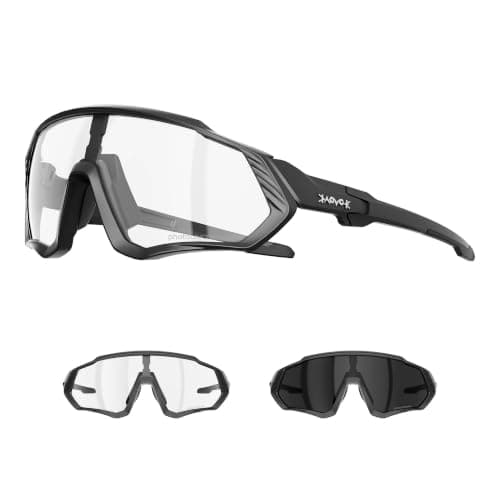
KAPVOE Photochromic Cycling Glasses
The cheapest way to try the automatic route. Note that this listing publishes no VLT range or transition time — if those numbers matter to you, buy a lens that states them.
We haven’t tested any of these — they’re the parts the job above calls for, listed so you don’t have to go hunting. Prices are live from Amazon and we earn a commission if you buy. Prices as of October 18, 2026. #ad
For how those two approaches compare against four other pairs — including which brands publish a transmission figure at all — see our cycling sunglasses roundup. And if you are assembling kit for the dark half of the year, the lens is only half of it: our bike light roundup and lumens explainer cover the other half.
Lens categories, transmission and what they suit
The transmission bands are the lens makers’ published summary of the EN ISO 12312-1 scale, read 18 August 2026. The right-hand column is conventional cycling practice, not a standard — and we have marked it that way rather than dressing it up as one.
| Category | Light transmission (VLT) | Typical lens | Cycling use (convention) |
|---|---|---|---|
| Category 0 | 80–100% | Clear | Night, heavy rain, dense woodland — grit protection |
| Category 1 | 43–80% | Very light / yellow | Dawn, dusk, deep overcast |
| Category 2 | 18–43% | Light tint | Bright overcast and dappled tree cover |
| Category 3 | 8–18% | Standard dark tint | Open road in strong sun — the default |
| Category 4 | 3–8% | Very dark | High mountain and water glare. Not for driving |
A photochromic lens is a row that moves. Julbo’s REACTIV 1-3 publishes 80% down to 6%, which is the top of category 1 to the dark end of category 3 — and that span, not the brand name, is what you are paying for.
Common questions
What VLT is best for cycling sunglasses?
For open roads in strong sun, a category 3 lens — roughly 8–18% transmission — is the conventional answer and the one lens makers themselves recommend as most versatile. For dawn, dusk and woodland, you want category 1 or 2 (18–80%). If your riding covers both, no single fixed lens is right and you need a lens set or a photochromic.
What does 'category 3' mean on sunglasses?
It is a filter classification from the EN ISO 12312-1 sunglasses standard, based on how much visible light the lens transmits. Lens makers publish category 3 as roughly 8–18% transmission — the normal dark-sunglasses band. Category 4 is darker still and, as Julbo states outright, not permitted for driving.
Are photochromic lenses dark enough for bright sun?
The good ones are. Julbo publishes a REACTIV 1-3 range that reaches 6% VLT, which is as dark as a normal category 3 road lens and then some. The question to ask about any photochromic is whether the maker publishes the range at all — several do not, and an unspecified lens could be darkening to almost anything.
Why do my photochromic lenses stay light in the car?
Because they react to UV, and a windscreen blocks most of it. The lens is behaving exactly as designed; it simply is not seeing the trigger. Expect them to take a minute or two to catch up once you are outside and riding.
Do tinted lenses actually help me see the road better?
A well-chosen tint helps in two ways: it brings brightness into a comfortable range so you are not squinting, and color-biased tints raise contrast between the road surface and what is on it. Rose and red families are the traditional road choice for exactly that reason on gray tarmac. What no lens does is make a dark lane brighter — that is what a light is for.
Sources
- Bollé — lens reference (published category bands on the EN ISO 12312-1 scale: category 0 at 80–100% VLT, 1 at 43–80%, 2 at 18–43%, 3 at 8–18%, 4 at 3–8%) — retrieved 2026-08-18
- Julbo — Category of sun lens protection: how to choose (category 3 is "the most versatile and suitable for all sunlight conditions"; "Category 4 lenses are not permitted for driving as they filter too much light"; photochromic lenses "cover multiple categories of sun protection") — retrieved 2026-08-18
- Julbo — REACTIV 1-3 Light Amplifier ("Cat.1 to 3 (VLT 80% to 6%)") and 9 things to know about our lenses ("adapt from light to dark and back in about 30 seconds, whether it's hot or cold"; 100% UVA, UVB and UVC protection) — retrieved 2026-08-18
- Tifosi Optics — Technology page ("The light transmission is the percentage of light that reaches your eye. The lower the light transmission, the darker the tint"; Clarion mirror described as a hydrophobic coating that repels water and sweat; stated ±2% tolerance on transmission figures) — retrieved 2026-08-18
- ISO 12312-3:2022 — Sunglasses for running, cycling and similar active lifestyles (the cycling-specific part of the standard; full text paywalled) — retrieved 2026-08-18
- Julbo — 9 things to know about our lenses — retrieved 2026-08-18
Read next
- The best cycling sunglasses
Six pairs ranked on what their makers publish about the lens.
- Bike light lumens explained
The other half of seeing at dusk, and another number that gets misused.
- How to fit a cycling helmet
Straps, retention dials, and what your glasses arms have to clear.
- How to layer for cold-weather cycling
The season where a category 1 lens earns its place.
We haven’t ridden or tested any of the products on this page, and we don’t pretend otherwise. Read how we research — or tell us we’re wrong and we’ll log the correction.