Bike computer vs phone
Your phone has a better screen, a faster processor and better maps than any head unit on the market. For a lot of riders it is genuinely enough — and this is a page that earns nothing when you keep it in your pocket.
Heads up: we earn a commission if you buy through the links on this page, at no extra cost to you. It never decides what makes the list — here’s how that works.
Let’s get the awkward part out of the way. This site earns a commission if you click through to Amazon and buy a bike computer. It earns nothing at all if you finish this page, put your phone in your jersey pocket, and ride.
A lot of you should put your phone in your jersey pocket and ride.
That’s the sentence that doesn’t appear in this category, and its absence is structural rather than sinister: a page that concludes “buy nothing” makes no money, so those pages don’t get written, so they don’t rank, so the only answers you can find are written by people who need the answer to be a purchase. We’re in exactly that business. We’re just going to tell you about it.
Start here: the phone is the better computer
On the specifications that a bike computer roundup would rank on, it isn’t close, and every honest person in this industry knows it. Your phone has a larger, brighter, higher-resolution screen than any head unit made. It has a vastly faster processor, more memory, a GPS receiver that is at least the equal of theirs, and a live data connection. Its maps are Google’s or Apple’s, updated continuously, against a head unit’s basemap that you update by plugging it into a laptop. It records to Strava natively. It talks to Bluetooth sensors. It is already paid for.
Any comparison table that has the head unit winning on capability is measuring the wrong things. The head unit does not win on capability. It wins, when it wins, on four specific, boring, physical grounds — and they are the entire honest case for spending money here.
The four real reasons to buy a bike computer
One: battery.This is the big one and it’s the one that actually ends the argument for long-distance riders. Running GPS, a screen at full brightness and a recording app for six hours is close to a worst case for a phone battery, and a phone that dies at hour five has also taken your map, your ride file and your way of calling someone. A dedicated head unit is a low-power screen and a GPS chip doing one job, and its battery life is measured in a different unit. Garmin publishes real figures for this on its own support site, and if battery is your reason to buy, that’s the page to read — note that the Amazon listing for the Edge 1040 Solar says only “Long-Lasting Battery” and publishes no number at all, which we cover in the computers roundup.
Two: sunlight. Phone screens are backlit and fight the sun by burning battery to get brighter — which is exactly the wrong trade on a long summer ride. Head units use transflective displays that get more readable as light increases, because they reflect ambient light rather than competing with it. This is a genuine technical difference in the wrong direction for the phone, and it compounds problem one: the sunnier it is, the harder your phone works, the sooner it dies.
Three: weather and vibration. A bike computer is designed to be rained on and shaken for a decade. A phone is designed to live in a pocket. On the vibration half of that, there is a real published warning and we want to quote it precisely rather than stretch it. Apple states in its own support note that “exposing your iPhone to high amplitude vibrations within certain frequency ranges, specifically those generated by high-power motorcycle engines, can degrade the performance of the camera system” — naming optical image stabilization and closed-loop autofocus as the vulnerable parts, and recommending a damping mount even for milder sources like mopeds and scooters.
Now the honest caveat, because this citation gets abused constantly in cycling articles: Apple is warning about engine vibration, and a bicycle does not have an engine. We could find no published measurement of whether road buzz through a rigid handlebar reaches the amplitudes and frequencies Apple is describing, and we certainly haven’t measured it. What we can fairly say is that the failure mechanism is real enough that the manufacturer wrote a support note about it, that it recommends damping even for low-amplitude cases, and that a phone on chipseal is not obviously one of the gentle ones. Treat it as a reason for caution, not as a proven verdict.
Four: the crash math. Your phone probably costs more than most of the head units we list. Putting it on the most exposed point of a bicycle, in a plastic clamp, means the cheapest component in the system is the one holding the most expensive one. A head unit that hits tarmac is an annoyance. A phone that hits tarmac is that plus your entire afternoon.
Which means the answer depends on one question
Not “how serious a cyclist are you”. That’s the question the industry asks, and it’s a flattery mechanism, not a diagnostic. The actual question is:
How long are your rides, and do you need to see the screen while you ride?
If you ride for an hour or two and you want the ride to exist on Strava afterwards, your phone does that from your back pocket, at zero cost, with no compromise whatsoever. You don’t even need a mount. This describes an enormous number of cyclists and none of them need to buy anything.
If you want to look at numbers whileriding, you now need the phone on the bars, and all four problems above arrive at once — battery, sun, vibration, crash risk. This is the point where a cheap head unit starts making sense, and note that it’s a much lower bar than “you must be a serious cyclist”: wanting to see your speed is enough.
If your rides run past about four or five hours, or you navigate unfamiliar routes, or you ride somewhere without coverage, the phone stops being adequate and the argument is over. Battery is not a preference.
The middle path nobody sells you
There’s a third option that gets almost no coverage because there’s no product in it: phone in pocket, cheap computer on the bars. The phone records the ride, holds the map for when you stop and check, and stays charged because its screen is off. A basic head unit shows you speed and distance while you move. Together they cost less than a mid-range Garmin and cover both jobs properly.
Even more heretically: a no-GPS wireless computer and a phone in your pocket is a complete solution for a huge number of riders. The phone provides the satellites; the computer provides the number you glance at. Nobody writes that recommendation because it involves selling you the cheapest thing on the page.
What we can’t tell you
We haven’t run this comparison. We have not put a phone and a head unit on the same bars, ridden until one died, and timed it — that would be genuinely useful and we haven’t done it. Battery drain depends on your phone, its age, its screen, your app, your cell coverage and the temperature, and anyone quoting you a clean number for “how long a phone lasts recording a ride” is telling you about their phone, not yours.
What we’re confident about is the direction of every effect above, because those are mechanisms rather than measurements: transflective screens really do behave the opposite way to backlit ones, GPS and a bright screen really are the two biggest drains on a phone, and a phone really does cost more than most head units. Where the honest answer is “test it on your own phone, on a route you know, before you spend anything” — that’s the answer, and it costs nothing to run.
If the conclusion here is that a phone is your head unit, the mount is the part that decides whether that works. The three premium case systems compare at Quad Lock versus Peak Design versus Rokform — and two of the three want the same out-front space a computer does.
Where each one actually wins
Note the shape of this table: the phone wins nearly everything a spec sheet would rank, and loses the handful of things that decide whether you can use it on a bike. That is the whole argument, in one grid.
| What you’re comparing | Phone you already own | Dedicated bike computer | Who wins |
|---|---|---|---|
| Screen size and resolution | Bigger and sharper than any head unit | Small; two brands even publish the size | Phone, easily |
| Screen in direct sun | Backlit — burns battery to compete with the sun | Transflective — brighter light, more readable | Computer, decisively |
| Maps | Google/Apple, updated continuously | A basemap you update over a cable | Phone, easily |
| Battery on a long ride | GPS + bright screen is a worst case | One low-power job; figures on maker's site | Computer, decisively |
| Rain and vibration | Designed to live in a pocket | Designed to be rained on for a decade | Computer, decisively |
| Cost of dropping it | More than most head units on our roundup | An annoyance | Computer, decisively |
| Recording a ride to Strava | Native, free, from your pocket | Records, then syncs | Tie — both do it |
| Sensors (HR, cadence, power) | Bluetooth only | Bluetooth and ANT+ | Computer, narrowly |
| Price | Already paid for | A new purchase, 16x range | Phone, obviously |
| Calling someone when it goes wrong | That is what it is | Cannot | Phone — and you're carrying it anyway |
The last row is the one that quietly settles it. You are taking the phone with you regardless— nobody rides out without one. So the real question was never “phone or computer”. It was “is the phone I’m already carrying enough, or do I want a second device so the first one can stay in my pocket and stay charged?”
What actually decides this purchase
Run the free test first. Before you spend anything: record your longest typical ride on your phone, screen off, in your pocket, with whatever app you use. Look at the battery percentage at the end. That single data point answers this question for your phone and your riding better than any article can, including this one. If you finish at 60%, you have no problem to solve.
Separate “record it” from “watch it”. These are different needs and conflating them is what sells head units. Recording is free and your phone does it perfectly from your pocket. Watching numbers while you ride is what needs hardware. Be honest about which you actually want — a lot of people buy for the second and only ever use the first.
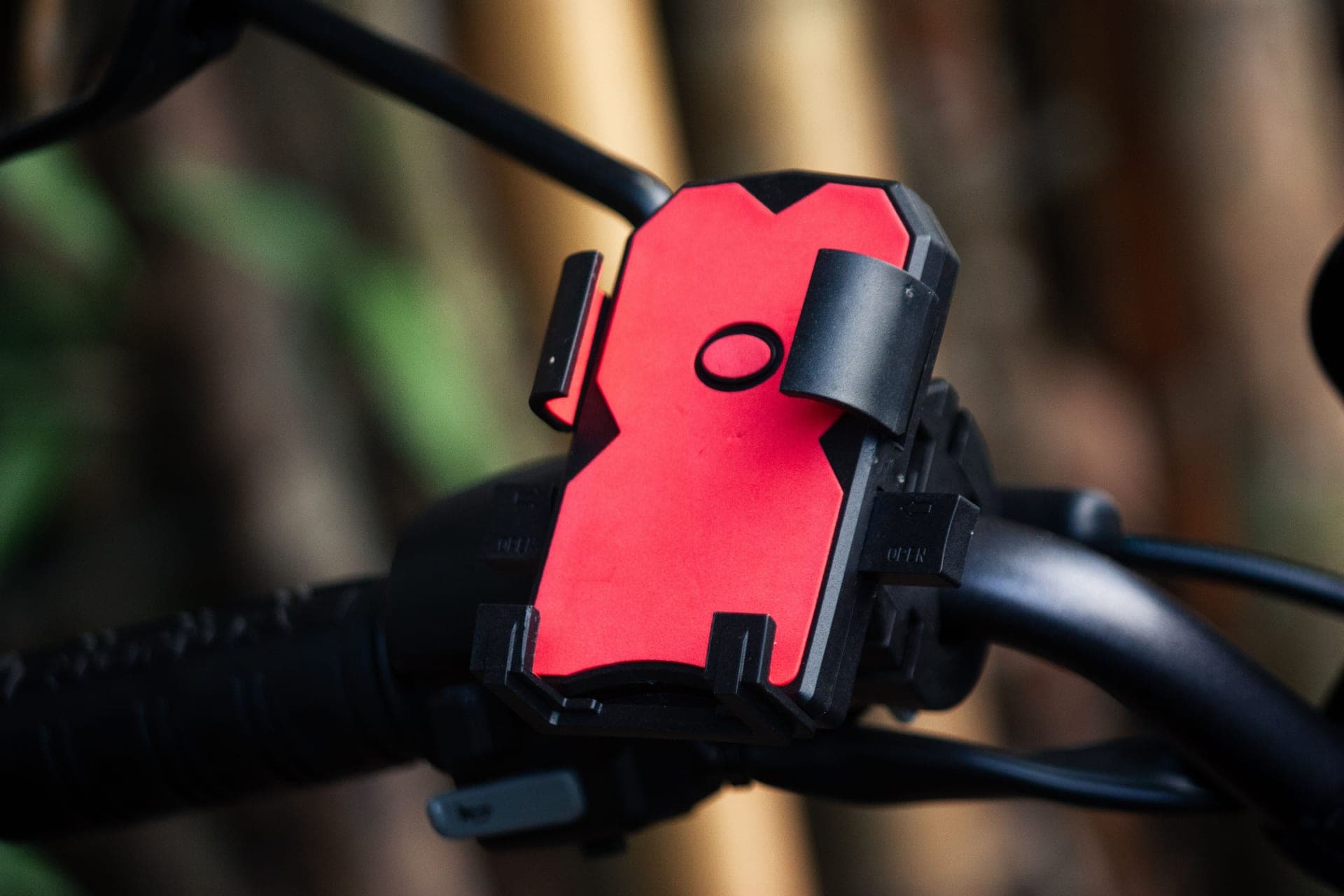
Don’t bar-mount your phone as a permanent solution.If you take one practical thing from this page, take this one. Sustained vibration is genuinely bad for phone camera modules, the mount is the cheapest part of the system holding the dearest, and the sun problem gets worse exactly when your rides get longer. A phone on the bars is a fine experiment and a poor long-term plan. If you are going to do it anyway, do it on a mount that holds the phone by a bonded interface rather than by its buttons — the phone mount roundup sorts the field on exactly that, and on which sellers publish a handlebar diameter at all.
If you buy, buy at the bottom first. The cheapest GPS unit on our computers pagecosts a small fraction of a flagship and does the thing you’re actually about to do with it. Ride it for a season. If you hit its limits, you’ll know precisely which limit you hit and what to buy next — which is a much better basis for spending real money than a roundup written by someone who needs you to spend it. If you have already skipped straight to the premium end, the brand decision is its own question — our Garmin vs Wahoo comparison covers the mount standard and the spec sheets before you commit to either ecosystem.
The reason to spend properly is navigation, not status. Turn-by-turn directions on unfamiliar roads is the one job where a good head unit is genuinely better than a phone in a pocket and genuinely worth the money, because the alternative is stopping every two miles. Everything else on the flagship spec sheet is a refinement.
Common questions
Is a bike computer more accurate than my phone?
Not in any way you’d notice, as far as we can tell — and modern phones use the same satellite constellations the head units do. If someone tells you your phone’s GPS track is meaningfully wrong for normal riding, ask them for the data. We haven’t measured this and we haven’t found a published comparison we’d stake a recommendation on, so treat anyone’s confident answer here — including a confident answer against — with some suspicion. What we’re comfortable saying is that accuracy is not the reason to buy a head unit. Battery is.
How long will my phone last recording a bike ride?
We can’t tell you, and neither can anyone else who doesn’t have your phone. It depends on the phone, the age of its battery, the screen brightness, the app, whether the screen is on, whether you have coverage, and how cold it is. Anyone quoting you a clean number is describing their own handset. The good news is you can find out for free in one ride: record your longest normal loop with the screen off and look at the battery afterwards.
Can I just mount my phone on my handlebars?
You can, and plenty of people do, but understand the three bills you might be paying. The sun problem: a backlit screen fights daylight by draining the battery, so it gets worse exactly as your ride gets longer. The vibration problem: Apple publishes a note warning that high-amplitude vibration can degrade the camera’s stabilization hardware — with the honest caveat that Apple is talking about motorcycle engines, and nobody has published whether a bicycle’s road buzz gets anywhere near that. The crash problem: your phone costs more than most head units, and the mount is the cheapest part of the assembly. For an occasional ride, fine. As a permanent setup, it’s a bet.
What's the cheapest setup that actually works?
Phone in your jersey pocket recording the ride, and nothing else. It costs zero, the ride lands on Strava, and the phone’s battery is fine because the screen is off. If you want to see a number while moving, add the cheapest computer that shows it. That combination is a complete answer for a very large share of riders, and the reason you don’t read it more often is that it involves recommending the cheapest thing on the page or nothing at all.
Why would an affiliate site tell me not to buy anything?
Because the alternative is being wrong on purpose, and readers work that out. We get paid when you buy through our links, which is disclosed on every page, and that incentive is real — the only defense against it is being explicit about what the incentive would have us say and then not saying it. On this page the incentive says “buy the Garmin” and the evidence says “most of you should test your phone first”. Our editorial policyis what we point at when we’re asked to do otherwise.
Sources
- Garmin support — Edge 1040 Solar battery life expectations (Garmin's own published figures, with their stated conditions) — retrieved 2026-07-17
- Apple support — "Exposure to vibrations, like those generated by high-powered motorcycle engines, might impact iPhone cameras" (note: Apple's warning concerns engine vibration, not bicycles; we have not extrapolated it to a verdict) — retrieved 2026-07-17
- Strava — the ride-recording platform both a phone and a head unit target — retrieved 2026-07-17
Read next
- The best bike computers
If you decide the phone isn't enough, start at the bottom of this list.
- The best bike phone mounts
If the phone stays on the bars, this is the part that decides whether it stays there.
- Garmin vs Wahoo bike computers
Once you've decided the phone isn't enough, this is the next decision.
- The best bike lights
The other thing on your bars, and a category with the same spec problem.
- Power meter types explained
The data a phone genuinely cannot give you, and what it costs.
- Our editorial policy
Why a page that earns nothing still gets written.
- Affiliate disclosure
Exactly how this site makes money.
We haven’t ridden or tested any of the products on this page, and we don’t pretend otherwise. Read how we research — or tell us we’re wrong and we’ll log the correction.