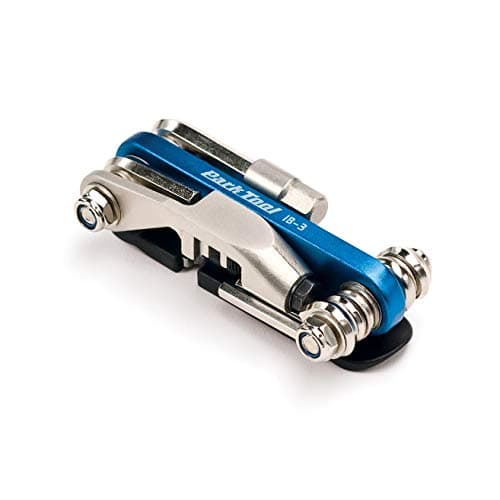
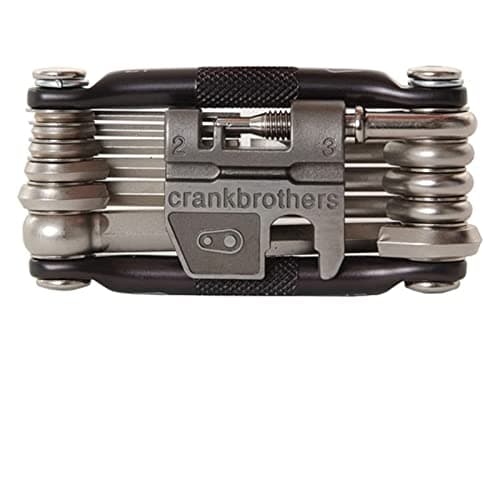
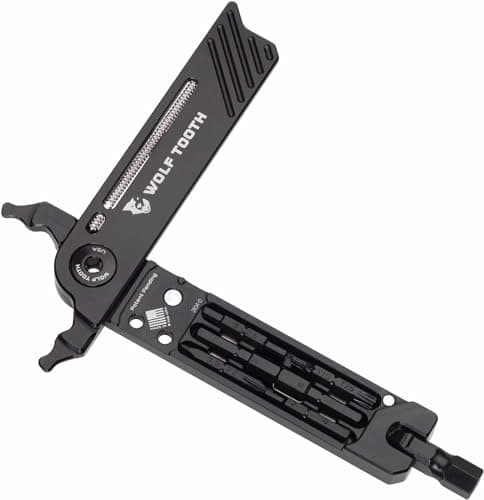
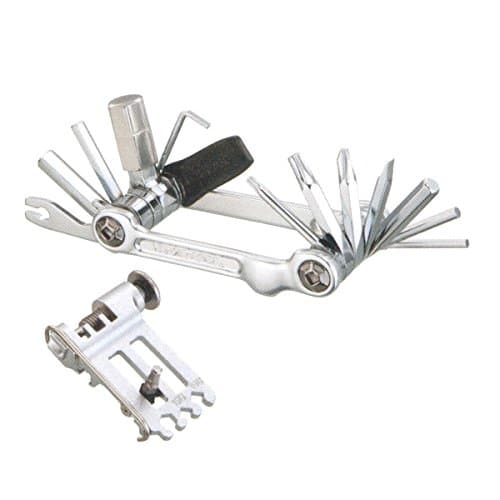
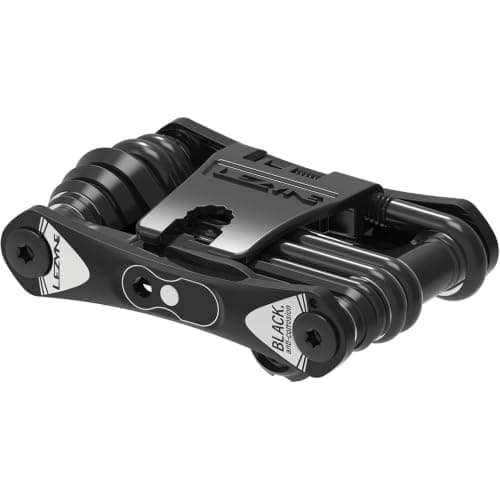
Every multitool on the market is sold on a single number, and it is the wrong number. The Topeak here says 20. The Lezyne says 18 and the Crankbrothers 17. The Park Tool says 13. The Wolf Tooth doesn’t say at all. Ranked on that number, this page writes itself and gives you an answer that is actively bad.
Here is the thing the count hides. A multitool is not a workshop — it is the thing that gets you back to the workshop. The jobs it has to do at the side of a road are few and extremely predictable: tighten a rattling bolt, straighten a knocked seatpost or bar, adjust a rotor bolt, and rejoin a chain that has come apart. That is 4, 5 and 6mm hex, a T25 Torx, and a chain breaker. Six things. Everything past that is either a workshop job you will not do on a verge in the rain, or a function that exists so the box can say a bigger number.
So the useful question isn’t “how many functions”, it’s “which ones, and will the seller say so in writing”. That question turns out to be brutal. Four of these five listings publish a count and refuse to itemize it. One publishes nothing at all. Exactly one spells out every bit, and that is why it wins.
The chain breaker is the only one that matters
Of the six functions above, five are conveniences. A rattling bolt is annoying. A twisted bar is rideable. A dropped seatpost is a miserable but survivable hour. A broken chain is the end of the ride — you cannot pedal, you cannot freewheel home unless it’s downhill all the way, and you are standing still.
Park Tool puts it more bluntly than we would in its own roadside chain repair guide: “if you break your chain out on a ride, you are dead in the water and having these spare parts on hand can make the difference between getting home and calling for a ride.” Its recommended carry list is a chain tool or a multitool with one, plus a master link. Note the second half of that — a chain breaker with no master link to rejoin the chain leaves you shortening a chain and hoping. Park Tool does describe a last-resort reuse of a partially-driven rivet, and is careful to call it “a temporary fix” whose “rivet’s strength has been significantly compromised”. Carry the master link. It weighs nothing.
A multitool’s breaker is a get-home tool, not a bench tool. For sizing a new chain at home you want a T-handle and a locating shelf, and you want a published compatibility range — Park Tool puts a 12-speed chain at 5.3 mm across the rivet against about 7 mm at 6, 7 and 8-speed. The chain tool roundup covers nine of them, including the two on this page’s wavelength that go in a saddle bag.
This is why the “chain breaker” column in the table below is the one to read first, and why it’s so uncomfortable that only one listing in five will confirm it outright.
What “not published” means, and what it doesn’t
We need to be precise here, because the table is unforgiving and could easily be misread. When it says “Not published”, that is not a claim that the tool lacks the function. The Crankbrothers M17 is a famous tool and we would be astonished if it had no chain breaker. But we have not handled it, we do not have one in front of us, and the listing we quote every other fact from does not say. Under our own rules that leaves exactly one honest thing to write, so we write it.
The reason we’d rather print an awkward blank than a confident guess is that this is precisely where gear writing goes wrong. It is very easy to fill that cell from memory, or from another site that filled it from memory, and be right nine times out of ten. The tenth reader buys a tool that can’t rejoin their chain because we were breezy. So: the blanks stay, and they are doing real work — a seller who won’t itemize a roadside tool has told you something about how much they expect you to ask.
One gap is universal and worth flagging on its own: not one of these five listings publishes a weight.For a category whose entire premise is “what will you carry”, that is a remarkable collective silence, and it means nobody — us included — can rank these tools on grams without inventing the figure.
Four of these five sell you a number and then decline to tell you what the number contains. This table is the whole page in one grid: the function count on the left, and on the right the only two functions that will ever get you home. Sorted by how much the seller is willing to put in writing.
Prices are live from Amazon as of October 18, 2026. Function counts, itemized lists and Torx sizes are quoted from each product’s own listing, read on 17 July 2026 — the Lezyne on 17 August 2026, when it replaced a discontinued model — except the Park Tool chain breaker, which the listing omits and Park Tool’s own repair guide confirms. “Not published” does not mean the tool lacks the function — it means the seller won’t say, and we’re not going to say it for them. Every one of these listings also declines to publish a weight, which for a thing you carry in a jersey pocket is its own kind of answer.
Count the functions you’ll use, not the ones on the box. Go and look at your own bike. Are the rotor bolts Torx or hex? Does your seatpost clamp take a 4 or a 5? Is there a single fastener on the bike that needs the 2mm? That audit takes four minutes and tells you more than any roundup, this one included.
A chain breaker without a master link is half a repair.Park Tool’s own carry list pairs them, and the tool is useless to you at the roadside without the link. Tape a spare to the inside of your saddlebag and forget about it for three years.
The listing is the spec sheet, and most of these listings are blank.In every other category we cover, the seller over-publishes: watt-hours, PSI, milliliters, grip compounds. Here, four of five sellers publish a single integer. When you notice that pattern across a whole category, it’s not an accident — it’s what happens when the number on the box does the selling and the contents don’t have to.
Nobody publishes a weight, so nobody can rank these on weight.Including us. If a page tells you which of these is lightest, ask where the figure came from — because it isn’t on any of the five listings behind this page, read on 17 July 2026 and, for the Lezyne, 17 August 2026.
The tool is the cheap part. Same logic as the rest of this hub: the multitool exists to protect a drivetrain worth many multiples of it. If you want the version of this argument with real numbers attached, the chain wear thresholds are where the money actually is.