Floor pump vs mini pump vs CO2
A pump can't cheat one number: the volume of air it moves per stroke. That figure decides which job each tool is built for — and why the honest answer is usually two of them, not one.
Heads up: we earn a commission if you buy through the links on this page, at no extra cost to you. It never decides what makes the list — here’s how that works.
A pump cannot cheat one number: the volume of air it moves per stroke.That single figure decides everything downstream — how fast a tool fills a tire, whether it can reach road pressure without wearing you out, and whether it lives in your garage or your jersey pocket. It is why a floor pump, a mini pump and a CO2 cartridge are not three answers to the same question. They are three tools built for three different jobs, and the honest answer to “which should I buy” is almost always two of them.
Topeak publishes the number outright for one of its floor pumps. The JoeBlow Sport 2Stage is rated to move 715 cc of air per stroke on its high-volume stage, dropping to 258 cc per stroke on the high-pressure stage, up to a 160 psi / 11 bar ceiling, read off a 3-inch analog gauge. A pocket mini pump moves a small fraction of that per stroke, because its barrel is a small fraction of the size. Neither design is “better.” They are built for opposite ends of the same job, and the volume-per-stroke number is where that job is decided.
The one number that sets a pump’s job: air per stroke
Think about what a stroke actually does. You push a piston down a barrel and shove whatever air was in it into the tire. A fat, tall barrel moves a lot of air each push; a pencil-thin pocket barrel moves a little. Fill a tire and the count follows directly from that volume: big barrel, few strokes; tiny barrel, many strokes. There is no cleverness that gets around it, because you are moving a fixed volume of air into a fixed volume of tire either way.
A floor pump wins this on geometry. It is a large barrel you drive with your whole body weight through a long handle, standing up, with both hands. Reaching a road tire’s pressure is a short, unremarkable job. The two-stage design on the Topeak above is the mechanism made explicit: a high-volume stage that dumps a lot of air fast to get a limp tire up to shape, then a high-pressure stage that moves less air but makes the last stretch to full pressure bearable. That is a pump engineered around the fact that the two halves of inflation want opposite things.
A mini pump throws all of that away for one virtue: it fits in a pocket. The barrel shrinks, so the air-per-stroke shrinks, so the stroke count climbs — and it climbs fastest at the top, where the tire is already firm and each stroke has to fight the pressure already inside. This is where the honesty problem lives. A mini pump prints a maximum pressure on the box; Lezyne rates its Pressure Drive to 120 psi / 8.3 bar in a body that weighs roughly 90–110 grams. Read that number for what it is: a ceiling, not a promise. It says the pump will not fail before 120 psi. It says nothing about how many strokes, or how pleasant, the last 30 psi of that will be — and no mini pump on earth makes high road pressure feel good.
The gauge is the other half of the job
Moving air is only half of what “set the pressure” means. The other half is knowing when to stop, and that is a gauge. Here the floor pump is not merely better — it is usually the only one of the three that can tell you a number at all. Park Tool’s published inflation step is plain about the goal: “Inflate to full pressure and check with pressure gauge.” A big, readable dial like the JoeBlow’s 3-inch face is what turns inflation from a guess into a setting.
And there isa target worth hitting exactly. Park Tool notes the reference is printed on the tire itself — “air pressure recommendations written on tire sidewall” — and the pressure you choose inside that range is one of the highest-leverage adjustments on the whole bike. It changes grip, comfort, rolling resistance and how likely you are to pinch-flat. That is the pressure the floor pump’s gauge exists to hit, and it is why the garage tool is the one that actually improves your riding rather than merely rescuing it. Our road bike tire pressure guidecovers what getting it wrong costs you. A mini pump and a bare CO2 head give you no readout at all: you inflate until it feels about right, and “about right” by thumb is a coarse instrument.
High pressure vs high volume — road, MTB and gravel want opposite things
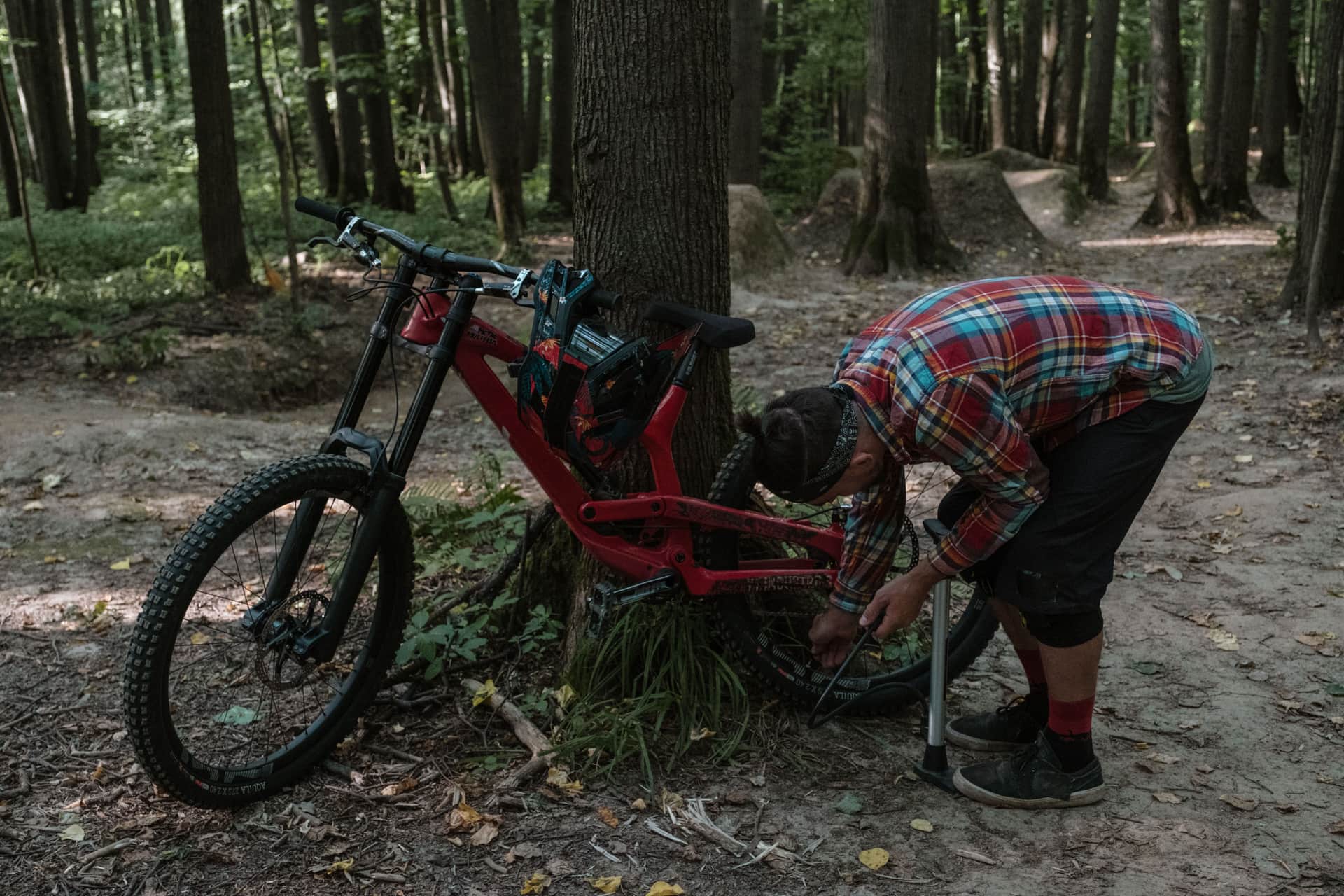
There is a second reason a single pump rarely covers everything, and it is easy to miss because both jobs are called “pumping up a tire.” A narrow road tire wants a small volume of air squeezed to high pressure. A fat mountain-bike or gravel tire wants a large volume of air at low pressure. Those are genuinely different tasks. Filling a big MTB tire to a modest pressure is mostly a volume problem — you need to move a lot of air — and a skinny high-pressure pump optimized for road psi does it slowly, one thin stroke at a time. Push a road tire to high pressure and it becomes a force problem, where a wide high-volume barrel starts fighting you near the top.
A good floor pump papers over this by giving you both, which is exactly what a two-stage pump’s high-volume and high-pressure stages are for. A pocket pump cannot — it is one small barrel, tuned one way. It is worth checking which way your pocket pump is tuned before you need it: a high-pressure mini pump is miserable at inflating a big tubeless MTB tire, and a high-volume one will take a very long time to reach road pressure. The tool matches the tire, not the other way around.
CO2 is a patch, not a pump
CO2 belongs to a different category than either pump, and treating it as a pump is where people get caught out. A cartridge does not move air one stroke at a time; it releases a charge of compressed gas in one burst and inflates the tire almost instantly. For a race, or a cold roadside where you just want to be moving again, that speed is the entire point — it is the fastest way from flat to rolling.
But it comes with two hard limits that a pump does not have. First, it is single-use and finite: one cartridge, one shot (or, if you are careful, a shot and a half), and when it is gone it is gone. A pump never runs out. Second, and less obvious, the gas does not stay put. Cycling press reporting is consistent that CO2 seeps out of a tire faster than the ordinary air a pump delivers, so a CO2-filled tire can be soft by the next day. The same reporting gives the fix: once you are home, let the CO2 out and re-inflate from a proper pump. That is the tell that CO2 is not a set-pressure tool. It is a temporary fill you top up later — a patch, not the repair. When a flat strands you far from home, this is exactly the moment a pocket pump or cartridge earns its place; our guide to fixing a flat is the job it is there for.
Valves decide nothing about performance and everything about whether it works
None of the above matters if the head does not fit your valve. Bikes use two main types: Presta, the narrow threaded valve on most road and performance bikes, and Schrader, the wider car-style valve on many mountain, kids’ and commuter bikes. A tool that only mates with one is useless on the other, so the practical rule is to buy inflation gear that handles both. The floor pump cited above takes Presta, Schrader and Dunlop; the mini pump cited above handles Presta and Schrader. Most modern pumps do, but “most” is not “all,” and it is a five-second thing to check before you are stranded.
Presta valves also have a quirk worth knowing at the roadside: the tip unthreads and has to be open before air will pass, and the pin can stick. Park Tool notes that to get a pump head to seal you may need to help it — “It may be necessary to press downward above the valve in order to engage the pump head” — and that a thin Presta stem levered sideways by a mini pump is a good way to tear the valve. Support the valve with your free hand. This is the same handling on a floor pump and a mini pump; CO2 heads have their own chuck to match, and the same rule applies — match the valve, or you are carrying dead weight.
Why the normal answer is a mini pump and a floor pump
Put the jobs side by side and the “which one” framing dissolves. The floor pump is the set-pressure tool: it lives in the garage, moves a lot of air per stroke, carries a gauge you can read, and its job is to put the exact right pressure in every tire before you leave. The mini pump is the get-home tool: it lives on the bike, never runs out, and its job is to turn a flat into a finished ride even if the finish is approximate. CO2 is the race-and-emergency shortcut: fastest of all, but one-shot and temporary. Those jobs do not overlap enough for one tool to cover them, which is why most riders who ride seriously end up owning a floor pump plus either a mini pump or a CO2 kit — often both in the saddlebag.
One case bends this further: seating a tubeless tire. Popping a stubborn tubeless bead onto the rim needs a fast, large burst of air, which a slow mini pump and a modest floor pump can both struggle to deliver — it is its own pump problem, and one reason dedicated high-volume chargers and tubeless-specific pumps exist. Tubeless vs tubes has the honest version of that trade-off.
What we have not done:we have not bench-tested any of these tools, timed a stroke count, or measured how fast a real tire goes soft on CO2. Every number on this page is a manufacturer’s own published spec or a cited piece of reporting, linked so you can check it. The rest is mechanism you can verify by looking at a pump barrel and thinking about where the air has to go.
Three tools, three jobs
No scores — we’ve measured nothing. Every published figure below is quoted from the maker’s own spec page or cited reporting, linked in Sources. The point of the table isn’t to crown a winner; it’s that each column is good at a different job.
| What you’re comparing | Floor pump | Mini / hand pump | CO2 inflator |
|---|---|---|---|
| Air per stroke / effort | Big barrel — 715 cc/stroke published; few strokes, standing | Tiny barrel — many strokes, hardest near the top | No strokes at all — one instant burst |
| Gauge | Yes — 3in analog dial, set an exact psi | Usually none; you inflate by feel | None — you can't read what you released |
| Portability | Garage tool — it stays home | Pocket / frame — roughly 90–110 g | Tiny cartridge + a small head |
| Best use | Set exact pressure before every ride | Get-home tool after a flat; never runs out | Race or fast roadside patch |
| Valve handling | Presta, Schrader & Dunlop head (cited pump) | Presta & Schrader (cited pump) — check yours | Presta / Schrader head — must match the valve |
| Hits high road pressure? | Yes, easily — and the gauge shows when | Rated 120 psi = a ceiling, not a promise | Instantly — but it seeps out, soft by next day |
Read the rows and the pattern is obvious: only one column sets pressure, only one gets you home for free, and only one is instant. They aren’t competing for the same slot in your kit — which is why the answer is rarely one of them.
What actually decides this purchase
Buy the floor pump first, and never regret it.It is the tool that gets used most, it is the only one with a gauge you can actually read, and correct pressure — set against the number on your tire’s sidewall — is the single cheapest upgrade to how the bike rides and how often you flat. Everything else on this page is a rescue tool; this is the one that improves the riding.
Then choose your roadside tool by its failure mode.A mini pump’s worst case is a tired arm; a CO2 cartridge’s worst case is a second puncture with no gas left. A pump never runs out, so if you only carry one thing, carry the pump. Carry CO2 as well if you race or value the speed — just treat it as a temporary fill, not a set pressure.
Treat a mini pump’s max-pressure rating as a ceiling, not a promise.A pump rated to 120 psi will reach 120 psi the way a treadmill reaches its top speed: technically, with your full cooperation. The rating tells you the pump won’t fail, not that the last stretch will be quick or pleasant.
Match the tool to the tire, not just the valve. A high-pressure mini pump is wrong for a big low-pressure tubeless MTB tire, and a high-volume one is slow to reach road psi. If you own both a road bike and a fat-tire bike, one pocket pump may not suit both.
Check valve compatibility once, at home.Presta or Schrader — confirm your inflation gear handles the valves on the bikes you actually ride, and remember a Presta stem needs the tip open and a supporting hand so a mini pump doesn’t tear it. It is a five-second check that saves a stranded afternoon.
If tubeless is in your future, know that seating a bead is a separate problem. It wants a fast, large burst of air that many mini pumps and modest floor pumps can’t deliver — a reason dedicated high-volume chargers exist. Don’t assume the pump that sets your pressure will also seat a stubborn tubeless tire.
Common questions
Can I just use a mini pump and skip the floor pump?
You can survive on one, but you give up the two things a floor pump is for: a large volume of air per stroke and a readable gauge. A mini pump will get a tire firm enough to ride home, but reaching a precise high road pressure on it is slow and unpleasant, and you can’t see the number you landed on. Since correct pressure changes grip, comfort and flat resistance, the floor pump is the one most riders shouldn’t skip — it’s the tool that gets used before every ride, not just after a flat.
Why does my tire go soft the day after I use a CO2 cartridge?
Because CO2 seeps out of a tire faster than ordinary air does. Cycling press reporting is consistent on this: a tire filled with CO2 can be noticeably soft by the next day, which is why the standard advice is to let the CO2 out once you’re home and re-inflate from a normal pump. It isn’t a sign the cartridge failed or that your tube has a slow leak — it’s the gas behaving as CO2 behaves. Treat a cartridge as a temporary fill you top up later, not as a set pressure.
Will a mini pump really reach the pressure printed on it?
The rating is a ceiling, not a promise. A mini pump rated to, say, 120 psi is telling you it won’t fail before that pressure — not that reaching it is quick or comfortable. Because a pocket pump moves only a small volume of air per stroke, the stroke count climbs steeply near the top where the tire is already firm. You can get there; you just have to earn it, and few people voluntarily hand-pump a road tire to its maximum at the roadside.
Does the valve type change which pump I need?
It changes whether the pump works at all, not how well it inflates. Presta (narrow, threaded) and Schrader (wide, car-style) need matching heads, so the safe move is inflation gear that handles both — most modern floor and mini pumps do. Presta has one extra habit: open the tip before pumping, and support the stem with your free hand so a mini pump doesn’t lever it sideways and tear it, which Park Tool flags when it notes you may need to press down on the valve to engage the head.
What about pumping up a big MTB or gravel tire?
That’s a volume job, not a pressure job — a fat tire needs a lot of air at a fairly low pressure. A high-volume floor pump (or the high-volume stage of a two-stage pump) fills it quickly; a skinny high-pressure mini pump does it slowly, one thin stroke at a time. If your bikes range from narrow road to fat tubeless, check that your pocket pump is tuned for the tire you’re most likely to be stranded with, because one small barrel can’t be optimal for both.
Is a CO2 inflator worth carrying at all if I have a mini pump?
For most riders it’s a nice-to-have, not a must. CO2 is the fastest way from flat to rolling, which matters in a race or when you’re cold and want to be moving. But it’s single-use and the gas leaks out faster than air, so it doesn’t replace a pump — it complements one. Carry the pump as your can’t-run-out tool, and add CO2 if speed is worth the cartridges to you. If you only carry one, make it the pump.
Sources
- Topeak — JoeBlow Sport 2Stage floor pump specifications (715 cc/stroke Stage 1, 258 cc/stroke Stage 2; 160 psi / 11 bar max; 3in mid-mount analog gauge; Presta / Schrader / Dunlop) — retrieved 2026-08-08
- Lezyne — Pressure Drive hand pump specifications (120 psi / 8.3 bar max; ~92–106 g; Presta & Schrader ABS Flex Hose) — retrieved 2026-08-08
- Park Tool — Tire and Tube Removal and Installation ("Inflate to full pressure and check with pressure gauge"; "air pressure recommendations written on tire sidewall"; "It may be necessary to press downward above the valve in order to engage the pump head") — retrieved 2026-08-08
- Cyclingnews — Which is better, a mini pump or a CO2 inflator? (CO2 seeps out of the tire faster than air, leaving it soft the next day; deflate and re-inflate with a pump once home) — retrieved 2026-08-08
Read next
- How to fix a flat
Where the roadside pump earns its place.
- Road bike tire pressure guide
The pressure the floor pump's gauge is there to hit.
- Tubeless vs tubes
Seating a tubeless bead is its own pump problem.
We haven’t ridden or tested any of the products on this page, and we don’t pretend otherwise. Read how we research — or tell us we’re wrong and we’ll log the correction.