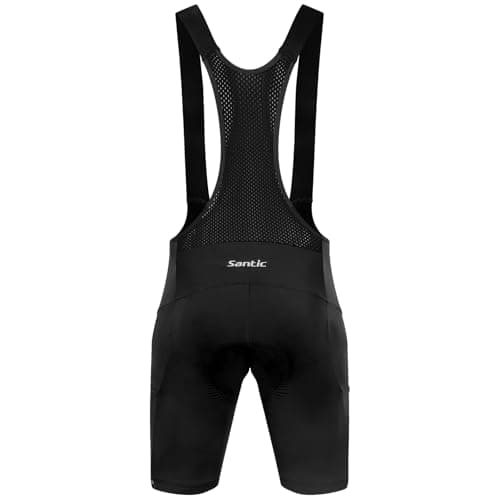
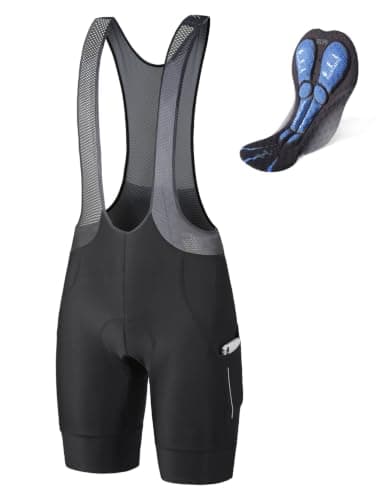
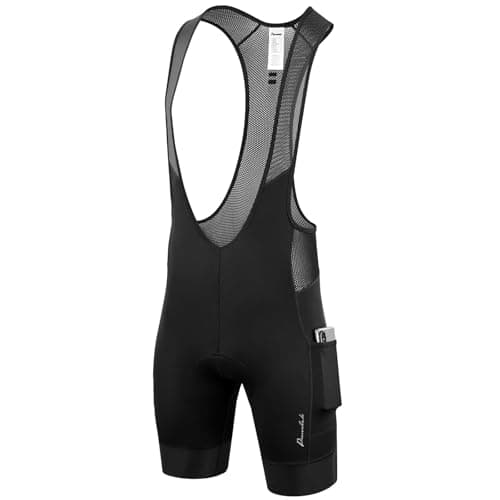
The Przewalski bib is the pick under $50, because it is the only one in the band whose listing publishes a feature you can actually verify — leg pockets — rather than another adjective about the pad. The budget pick is the Santic bib: the cheapest in this catalog and, oddly, the one making the most claims, with gel named in the pad as well as the usual 4D grade.
Three bibs in this catalog had a live price under $50 at the last rebuild and three did not. The table below re-checks that at render time rather than trusting what we typed, and it shows the whole field so you can see what the line actually separates.
“4D padded” is not a specification
Every bib under this cap says it. No standards body defines it, no maker publishes what the dimensions are, and the number has crept upward over the years from 3D to 4D without anything physical changing. Treat it as a category word meaning “this garment has a chamois” — which is useful, and is all it means.
What would actually tell you something is pad thickness in millimeters, density, the size of the sit-bone platform, or the number of hours the maker rates it for. Nobody in this band publishes any of those. Above the cap, one brand publishes an inseam measurement and a reflective fabric claim — which is not a pad specification either, but it is at least a number. Our chamois pad guide explains what the pad is doing and why thickness is a poor proxy for comfort.
What the money above the cap buys
The three bibs above this line are two Pearl Izumis and a Castelli. What their listings actually add is one measurement (a 10.5-inch inseam), one fabric property (reflective), and a brand with a returns reputation. What they are widely believed to add — a better chamois, better grippers, fabric that holds its shape after fifty washes — is not published by anyone and so is not a claim this page will make on their behalf.
There is a real argument for paying it anyway: a bib short is in contact with you for every minute of every ride, and it is the one garment where a bad purchase ends rides early. Our full bib short roundup ranks all six.
Bibs, not shorts, and why it matters at this price
A waisted short has an elastic band across your stomach that digs in when you are folded over on the drops; a bib carries the pad on shoulder straps instead and the problem disappears. At the bottom of the market that difference is larger than any difference between pads, which is why this page is about bibs specifically. Bib shorts versus shorts covers the trade in full, including the one real drawback: the bathroom.
What this page cannot tell you
Nobody here has worn any of these for a single mile. There is no pad test, no wash test and no fit check. Every specification above is read through this site’s reuse layer from the parent roundup, on the date that page records, so the two cannot drift apart.
The figure that would settle this category — hours of comfort, for a given rider, on a given saddle — depends on the saddle and the rider as much as the short, and nobody publishes it. Buy on fit and on the pad claim you can verify, which under this cap is almost nothing, and keep the receipt.
Cheapest first. Pad claim, fabric claim and published features, each in the seller’s own words — then the live price against the cap at render time. Read the first column downward: it is the same two words almost all the way.
Every middle column is a claim the seller publishes in its own listing, not a measurement of ours. Prices are live from Amazon as of November 23, 2026 and 6 of 6 rows carry one right now. 3 of 6 are under the cap at this rebuild, and that verdict is computed from the live price rather than typed into the page. Every “Check price” link is an affiliate link and Amazon pays us at no cost to you. #ad
The only published measurement anywhere in this category — an inseam in inches — belongs to a bib above the cap. Everything under the line sells the pad with an adjective.
Buy for the sit bones, not the pad grade.A chamois can only work if it is under the parts of you that take the load, and that is decided by the saddle as much as the short. If rides hurt, measure the sit bones first — here is how— before you buy a thicker pad.
Order a size up at this price, or expect to exchange. No bib under this cap publishes a measurement, and budget cycling kit is cut small. A bib that is too tight pulls the pad out of position, which is worse than a thin pad.
Two cheap pairs beat one mid-priced pair. Bibs need washing after every ride, and riding in a pad that has not fully dried is how saddle sores start. At these prices owning two is the obvious move.
Nothing goes under a bib short. No underwear: the seams are what cause the damage, and the pad is designed against skin. How to wash cycling kit covers keeping it that way without destroying the elastane.
Check the leg gripper before a long ride, not during one. None of these listings describes its gripper. A gripper that rolls is the most common failure of a cheap bib, and you find out about it twenty miles from home.