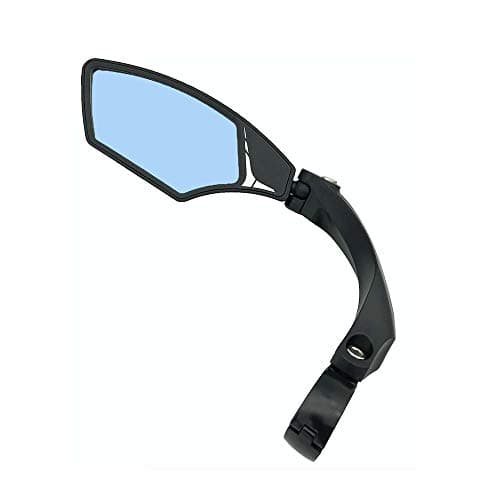
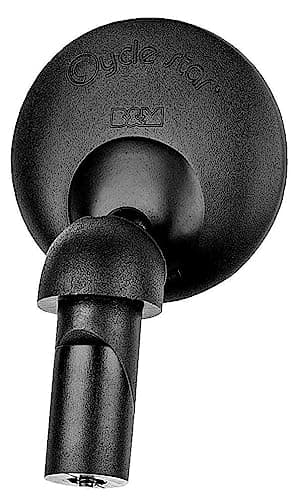
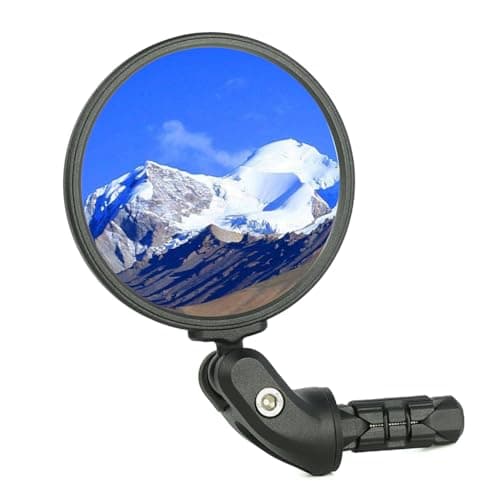
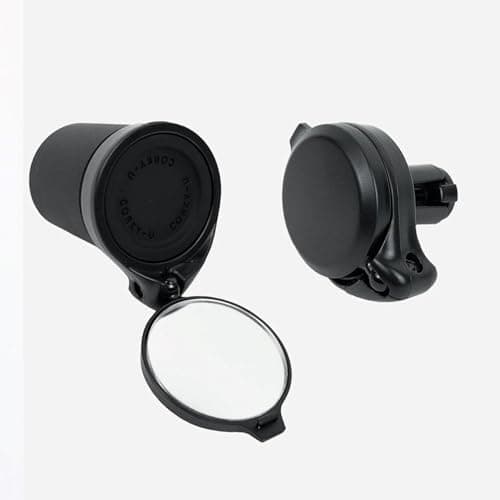
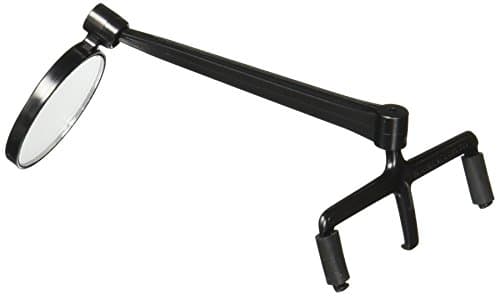
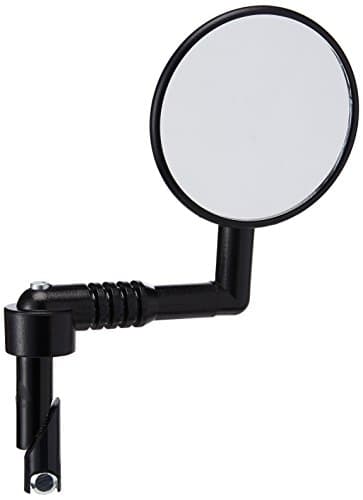
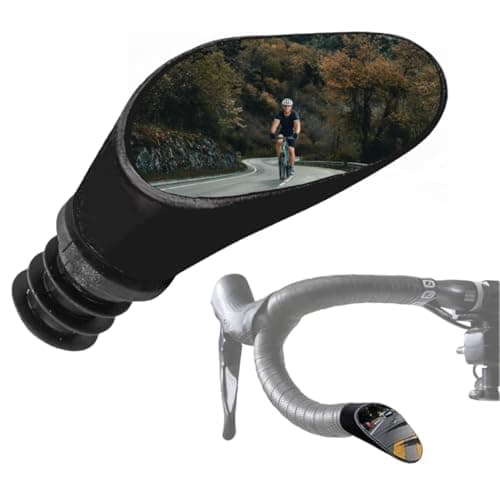
A mirror is a mount problem before it is an optics problem.Half the mirrors sold will not physically fit the bike you own: a bar-end mirror needs an open bar end, a clamp mirror needs an exposed round section the tape and the levers have not claimed, and an eyeglass mirror needs glasses. That is why this page sorts on mount type first, and why the top completion Google offers for the category — best bike mirror for drop bars— has exactly one honest answer in this field.
The optics come second, and they come with an uncomfortable finding. One of these seven listings publishes a single optical number, and that number is a diameter. Busch & Müller publishes Ø60 mm. Nobody publishes a radius of curvature, a field of view, or a magnification factor. For comparison, the federal standard that governs mirrors on cars regulates an outside convex mirror to an average radius of curvature of “not less than 889 mm and not more than 1,651 mm” and the inside mirror to a horizontal field of view of “at least 20 degrees”. Bicycle mirrors are measured by nobody.
No mirror is required, and that is worth knowing
Federal bicycle regulation is specific about what a new bike must carry for rear visibility, and it is reflectors. 16 CFR § 1512.16 requires “a red rear-facing reflector” mounted behind the seat, “an essentially colorless front-facing reflector”, side retroreflectivity, and reflectors on the front and rear surfaces of each pedal. The word mirror does not appear. A mirror is an optional upgrade that a rider adds because it changes how they ride in traffic — not a compliance item, and not a substitute for a rear light, which is what actually makes you visible.
The convex trade, with the one published number that explains it
Almost every bicycle mirror is convex, because a flat mirror the size of a bicycle mirror shows you a strip of road and nothing else. Curving the glass buys width and costs magnification — the image shrinks, so objects read as farther away than they are. That is not a theory; it is why the federal standard requires a convex passenger-side car mirror to be marked “Objects in Mirror Are Closer Than They Appear.”
The practical consequence on a bike is precise: a convex bicycle mirror is good at telling you something is there and poor at telling you how fast it is closing. Treat it as a presence detector, take a real look over your shoulder before you move across a lane, and do not try to judge a gap from a 50 mm convex lens at 25 mph.
Two of these seven listings name the lens shape at all. BriskMore publishes “Convex Lens”. Hafny publishes “Wide Angle”, which implies curvature without committing to it. The rest leave it to the photograph.
Mount type, which is the decision
Bar end puts the mirror in the open end of the handlebar. It is the widest view available because the mirror sits low and outboard, past your hip, and it uses no clamp space at all. On a drop bar it competes with bar plugs and bar-end shifters; on a flat bar it competes with your grips.
Bar clamp wraps around an exposed round section of handlebar. It is the easiest to aim and the easiest to fit on a flat bar or an e-bike, and it is the hardest to fit on a drop bar, where the tops are taped and the clamp area beside the stem is already carrying a light and possibly a phone mount. Measure the free span before ordering.
Eyeglass or helmet mounts move with your head, which multiplies the effective field of view and makes it the only option on a cockpit with nothing left to give. The cost is a learning curve and total dependence on remembering your glasses.
Drop bars: why this is the hard case
A taped drop bar offers a mirror almost nowhere to live. The tops are wrapped, the hoods are occupied, and the only unwrapped round section — beside the stem — usually has a light or a computer on it. That leaves two options: a bar-end mirror in the end of the drop, which is what the Sprintech is for, or an eyeglass mirror, which is what the Third Eye is for.
If you are re-wrapping anyway, plan the mirror into that job rather than after it — the bar tape roundup covers what gets disturbed when a clamp goes on over fresh wrap, and a bar-end mirror wants the plug end free before the tape goes on.
E-bikes make the case stronger
Mirror usefulness scales with speed differential and with how much of your attention the road ahead is already taking. On an e-bike you are travelling faster than the traffic expects a bicycle to travel, your bike is heavier and slower to swerve, and a shoulder check costs you more line than it does on a road bike. Hafny’s listing is the only one here that names e-bikes as an intended use; BriskMore’s names electric bikes and scooters. Our e-bike accessories page ranks the other purchases whose character changes once a motor is involved.
The alternative that is not a mirror
A mirror shows you what is behind when you look. Rear-facing radar warns you without being looked at, which is a different job: the Garmin Varia RTL515 on our bike lights roundupis a tail light that also pushes approaching-vehicle alerts to a head unit or a phone. The two are complements rather than substitutes — radar tells you something is coming, a mirror tells you what it is and where in the lane it sits. If you only buy one, buy the one that matches how you ride: radar for fast rural roads, a mirror for city traffic with constant lane changes.
What we could not check
We have not fitted these mirrors, measured a field of view, or ridden with any of them. Every specification above is the live Amazon listing text for the exact ASIN linked, read on 5 October 2026. Mirrycle’s brand product page was requested as a secondary source and returned HTTP 403 to automated retrieval, and Busch & Müller’s returned HTTP 404, so nothing on this page is attributed to a manufacturer site. Where a listing publishes no lens size, no material and no mount diameter — which is most of them — the table below says so rather than estimating.