How to Lock a Bike
A good lock used badly is a bad lock. The rear triangle, a fixed object, and as little air inside the shackle as possible — in that order.
Heads up: we earn a commission if you buy through the links on this page, at no extra cost to you. It never decides what makes the list — here’s how that works.
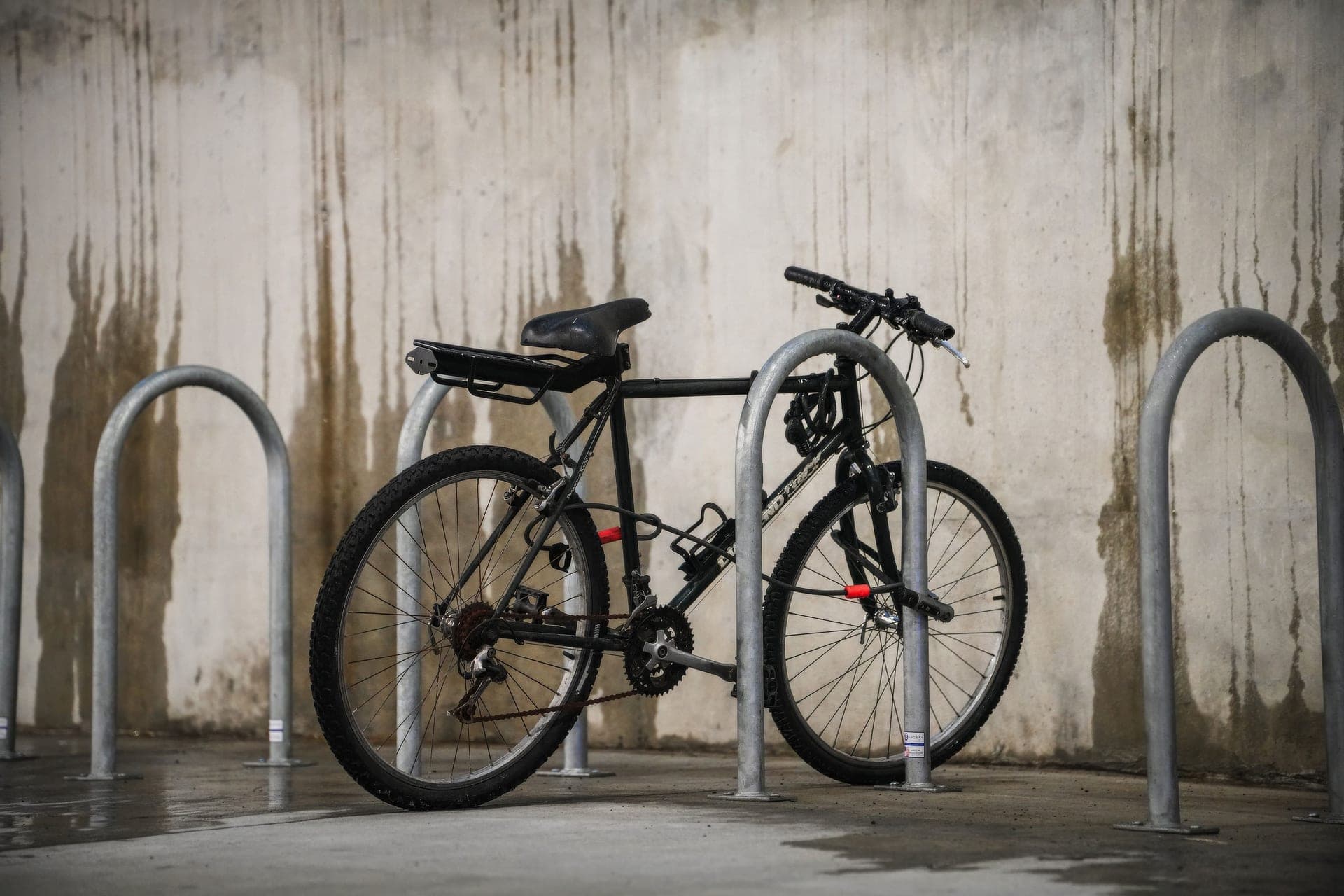
Put the U-lock through the rear triangle of the frame and the rear wheel, around something fixed to the ground, with as little empty space inside the shackle as you can manage. That one sentence is most of the method. The rear triangle catches the frame and the rear wheel in one pass, and a full shackle gives a thief nothing to insert a lever into.
Everything else on this page is either a refinement of that, a mistake to avoid, or an answer to the awkward situations the autocomplete suggestions are full of — locking to a bike rack, locking with a cable, locking with nothing to lock to.
The thing you are defending against
Worth being specific, because it changes what you do. The US Department of Justice’s problem-oriented policing guide to bicycle theft sets out the attack techniques and the situational factors behind them, and the short version is that bike theft is overwhelmingly opportunistic and tool-assisted. Thieves carry small tools, they prefer a quick job in a predictable location, and they lift, lever and cut rather than pick.
So the goal is not an unbreakable lock, which does not exist. The goal is to make your bike the slower, noisier, more awkward option than the bike next to it, and to deny the specific attacks that are quick: levering a lock with space in it, lifting a bike off the top of a post, and unbolting the parts you did not secure.
Step 1: pick what you lock to, before you pick how
A bike is only as secure as the object it is attached to. Three tests, in order:
Is it fixed to the ground? A purpose-built bike rack, a signpost set in concrete, railings. Not a wheelie bin, not a plastic bollard, not scaffolding.
Can the bike be lifted off the top?This is the mistake that catches careful people. A signpost with no sign on it, a short bollard, a fence post — a thief does not need to defeat your lock if they can lift the whole bike over the top of the thing it is locked to. Look up before you walk away.
Can the object itself be cut or dismantled faster than your lock? Thin railings, a wooden fence, a chain-link gate. The lock stops being the weak point and starts being irrelevant.
And the situational part of the DOJ guide that applies to a commuter in particular: predictability is exposure. A bike in the same place at the same time every weekday is a learnable target. If you have a choice of two racks, the busier and more overlooked one is the better one.
Step 2: what goes inside the shackle
The priority order is frame first, rear wheel second, front wheel third, and the reason the rear wheel ranks above the front is that it is the more expensive wheel and it sits inside the rear triangle, where one pass of a U-lock catches both.
So: shackle through the rear triangle — the space between the seat tube, the seat stays and the chainstays — capturing the rear wheel’s rim within it, and around the fixed object. Done correctly this attaches the frame and the rear wheel with one lock and leaves the shackle fairly full.
Fill the shackle. Empty space inside a U-lock is where a bottle jack, a length of scaffold pole or a long screwdriver goes, and leverage is how most U-locks actually fail. This is the entire argument for a short shackle: a Mini-style U-lock is deliberately too small to get a lever into, which is also why it will not reach around a fat lamp post. That trade-off is real and it is the one thing to think about when buying.
Keep it off the ground. A lock resting on the pavement can be smashed against it with the ground taking the force. Position the lock high, with the keyway facing down and away from easy access.
Step 3: the parts you did not lock
Modern bikes are full of quick releases, which is convenient for you and for everyone else.
Front wheel.If it is quick-release and you only have one lock, take it out and lock it alongside the rear, or use a cable through it. The included cable on a U-lock combo is for exactly this — it is not a lock in its own right and should never be the only thing securing the frame.
Saddle and seatpost. A quick-release seat clamp means your saddle is a thirty-second theft. Swap the lever for a bolt, or loop the cable through the saddle rails.
Everything bolted on. Lights, computer, pump, bag, and on an e-bike the battery and display. Take them with you. A bike that has been stripped of its accessories is a bike you still cannot ride home.
On an e-bike, take the battery. It is the single most valuable removable component on the bike and most are designed to come off. Our e-bike accessories page covers the rest of what comes off an e-bike when you park it.
What to look for in the lock itself
Three published things, and one that is not published at all.
Shackle diameter, if the maker prints it. A 13 mm hardened steel shackle is a published figure and it resists a bolt cutter in a way a cable does not. Thickness is the one physical property that correlates with how long an attack takes.
Security ratings, carefully.Kryptonite publishes a Kryptonite scale and ABUS publishes an ABUS Security Level, and these are separate proprietary scales with no conversion between them. “Security Level 10” from ABUS is not comparable to a number from Kryptonite, and a listing that prints one and not the other is not telling you it is better. Our lock roundup goes through this properly, including which of the two listings prints a rating at all.
Shape, because it decides how you can use it. A short U-lock is leverage-resistant and limited in reach. A folding lock reaches further and wraps awkward objects, at the cost of more joints. A cable is a deterrent and nothing more.
And the thing nobody publishes: how long the lock survives an angle grinder. No lock in our catalogue publishes an attack-time figure, and the honest answer is that a cordless grinder defeats essentially any bicycle lock given a minute or two of uninterrupted work. That is why location and visibility are part of the method rather than an afterthought.
The two locks we list, and what each one's shape is for
Not a ranking — these are the two locks in our catalogue, included here because the method above assumes a rigid lock rather than a cable. Their shapes solve different problems, and the roundup covers why their security ratings cannot be compared with each other.
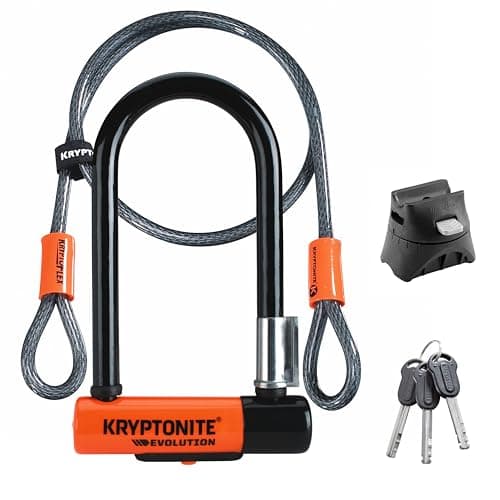
Kryptonite Evolution Mini-7 U-Lock
A short U-lock with a published 13 mm steel shackle and a 4 ft cable for the front wheel. The short shackle is the leverage-resistance argument, and the reason it will not reach a fat post.
$95.58 · View on Amazon$109.95 −13%
- ABUS
ABUS Bordo Folding Lock
A folding lock with a published 90 cm length, for the days when the only thing to lock to is too wide for a U-lock. Combination rather than key, with a frame holder included.
We haven’t tested any of these — they’re the parts the job above calls for, listed so you don’t have to go hunting. Prices are live from Amazon and we earn a commission if you buy. Prices as of October 18, 2026. #ad
“There is nothing to lock it to”
A real autocomplete completion and a real problem. Options in descending order of effectiveness:
Walk further. Two minutes of walking to a real rack beats any technique in this section.
Lock the bike to itself and put it somewhere overlooked. Shackle through the rear triangle and rear wheel means the bike cannot be ridden or wheeled away, only carried. Combined with a busy, visible spot, that is a meaningful deterrent against an opportunist and no defence at all against a van.
Take it inside. Cafés, offices and shops say yes more often than people expect, especially if you ask.
Do not leave it overnight. Every published account of bike theft points the same way: duration and darkness are the two factors most within your control. A bike locked well for twenty minutes at lunchtime is in a different risk category from the same bike locked well from 6pm to 8am. For home storage, our storage guide covers indoors properly.
Three mistakes worth naming
Locking only the front wheel. The classic photograph of a front wheel still attached to a rack. The frame is the bike.
Locking the top tube to a rack and nothing else. It looks secure and leaves the shackle half empty, which is the leverage case.
Treating the cable as a lock. A cable is for the front wheel and the saddle. It is cut with hand tools in seconds and it is the reason a lot of people believe their lock failed when what actually happened is that they used the wrong half of it.
Before it happens: the five minutes that make a stolen bike recoverable
Write down your frame number — usually stamped under the bottom bracket — and photograph the bike from both sides. Register it with a national database if your country has one. Keep the receipt.
None of that stops a theft. All of it is the difference between a police report with a description and a police report with an identifier, which is the difference between a bike that can be returned to you and one that cannot.
What to secure, in priority order
Ordered by what the component costs to replace against how long it takes to steal. The top three rows are the ones a single U-lock should cover; everything below it is what the cable or your backpack is for.
| Part | Secure it with | Time to steal if you don’t | If you only do one thing |
|---|---|---|---|
| Frame (rear triangle) | The U-lock, always | Instant — it rides away | This. Nothing else is close. |
| Rear wheel | Same pass of the U-lock | A minute with a quick release | Free — the rear triangle catches it |
| Front wheel | Cable, or remove and lock beside | Seconds with a quick release | Cable it; it is what the cable is for |
| Saddle and seatpost | Cable, or replace the QR with a bolt | Seconds with a quick release | Swap the lever for a bolt, once |
| Lights, computer, pump, bag | Your pockets | Seconds | Take them with you |
| E-bike battery and display | Take the battery off the bike | Seconds to minutes | Remove it — it is the priciest part |
Row two is free.Putting the shackle through the rear triangle rather than around the top tube secures the frame and the rear wheel in the same pass, at no extra cost and no extra weight — which is why “where you put the shackle” matters more than which lock you bought.
Common questions
What is the correct way to lock a bike?
Put the U-lock through the rear triangle of the frame and around the rear wheel’s rim, attached to something fixed to the ground that the bike cannot be lifted off the top of. Leave as little empty space inside the shackle as possible, keep the lock off the ground, and use a cable for the front wheel and saddle if they are quick-release.
Should I lock the frame or the wheel?
The frame, always and first — the frame is the bike. A locked wheel with an unlocked frame is the classic photograph of a wheel still attached to a rack. The useful detail is that you do not have to choose: the shackle through the rear triangle captures the frame and the rear wheel at once.
Is a cable lock enough?
No. A cable is cut with hand tools in seconds and should only ever secure a front wheel or a saddle alongside a rigid lock. The cable supplied with a U-lock is a supplement, not a second lock — our lock roundup covers what the published shackle diameters and security ratings do and do not tell you.
What do I do if there's nothing to lock my bike to?
Walk to a real rack if you can. If you cannot: lock the bike to itself through the rear triangle and rear wheel so it cannot be ridden or wheeled away, leave it somewhere busy and overlooked, and keep the stop short. Ask whether you can bring it inside — the answer is yes more often than people assume. Never leave it that way overnight.
Can any bike lock stop an angle grinder?
No bike lock in our catalogue publishes an attack-time figure, and the honest answer is that a cordless grinder defeats essentially any bicycle lock given a minute or two of uninterrupted work. That is the reason location, visibility and how long you leave the bike are part of the method rather than an afterthought.
Sources
- US Department of Justice, Office of Community Oriented Policing Services — Problem-Oriented Guides for Police: Bicycle Theft. Source for the characterisation of bicycle theft as opportunistic and tool-assisted, and for the situational factors (location, duration, predictability) the method above is organised around — retrieved 2026-10-17
- Amazon listings for the Kryptonite Evolution Mini-7 and ABUS Bordo 6000C as recorded in content/catalogue.json — source for the published 13 mm steel shackle, the 4 ft cable, the 90 cm folding length and the "ABUS Security Level 10" claim. Neither listing publishes an attack-resistance time, and the two makers' security scales do not convert to each other
Read next
- The best bike locks
The purchase, and why two makers' security ratings cannot be compared.
- How to store a bike
Overnight is a different risk category. This is the answer to it.
- Can you commute on a gravel bike?
Why a nice bike parked daily is the hardest case.
- The best e-bike accessories
What comes off an e-bike when you park it.
We haven’t ridden or tested any of the products on this page, and we don’t pretend otherwise. Read how we research — or tell us we’re wrong and we’ll log the correction.