Skip to content
ChainringClub

The Best Bike Locks

Every lock is sold on a number, and no two numbers are on the same scale. Here is what each of these two actually publishes, what the theft research says thieves actually do, and why the receipt in your drawer matters as much as the steel.

A bicycle locked to a city bike rack against a wet concrete wall.
By Stephen V.Published August 13, 2026How we research

Heads up: we earn a commission if you buy through the links on this page, at no extra cost to you. It never decides what makes the list — here’s how that works.

Quick picks

Tap any row for the full write-up. Specs are the manufacturer's own published claims, read on 13 August 2026.

#ProductBest forPrice
1
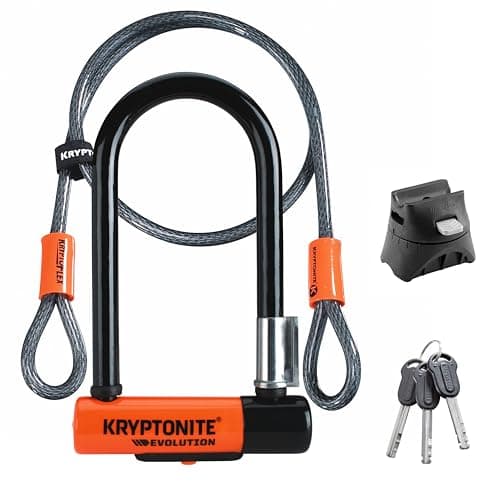
Kryptonite Evolution Mini-7 U-Lock

Kryptonite Evolution Mini-7 U-Lock

The only lock here whose listing gives you a number you can physically verify — and the only one whose maker publishes the full terms of its theft offer before you buy.

Top pick
Buying on measurements and documents rather than on an index
2
ABUS Bordo Folding Lock

ABUS Bordo Folding Lock

A folding lock that reaches things a mini U-lock cannot, sold on a security number we could not verify against ABUS's own documentation.

Reaching around objects a U-lock won't fit, with no key to lose

Two locks, two numbers, and the numbers have nothing to do with each other. The ABUS listing on this page leads with “ABUS Security Level 10”. Kryptonite runs a security scale of its own that also reaches 10. Those two tens are not comparable, are not meant to be comparable, and there is no conversion between them — they are two companies grading their own homework in two different classrooms. If you have ever stood in a shop trying to work out whether a Level 10 beats a rating of 9, the answer is that the question does not have one.

Kryptonite is at least open about what its scale is. Its own support documentation describes “a 10 point system with 10 being ultimate security and 1 being deterrent security”, and it tells you how it intends the number to be used: not as a measurement, but as a recommendation keyed to where you leave the bike. “Kryptonite makes security recommendations based on where you are locking and the length of time that your bike or vehicle will be unattended” — a 1 is for “a low risk area such as out on the trails”, a 10 for “a densely-populated metro area”. Read that way, the rating is a siting guide. It is not a claim about how long the lock survives an angle grinder, and Kryptonite never says it is.

Which raises the obvious question: is anyone grading these things who does not also sell them?

There is an independent test house, and neither listing mentions it

Sold Secure was established in 1992 by Northumbria and Essex Police with Home Office backing, and is now run by the Master Locksmiths Association from a purpose-built test facility in Rugby, Warwickshire. It assesses security products by “manual attack testing”, and it grades them in words rather than numbers:

  • Bronze “Offering theft resistance against a basic tool list (aimed at preventing opportunist crime)”
  • Silver “Offering theft resistance against an enhanced tool list”
  • Gold “Offering theft resistance against a dedicated tool list (aimed at preventing dedicated attacks)”
  • Diamond “The highest level of theft resistance including use of specialist tools (aimed at preventing the most destructive attacks that could include angle grinders)”

Notice what those definitions are made of. Not minutes, not steel grades, not force in newtons — tool lists. Sold Secure says its specifications “vary in the type of attack, tools used, and time spent during the attack”, and the grade tells you which class of tool the product held out against. That is a genuinely different kind of statement from a manufacturer’s index, and it is the only one on this page produced by someone with nothing to sell you.

Two caveats we have to give you honestly. Sold Secure does not publish attack times or numerical thresholds on the page we read, so the grades are ordinal, not quantitative. And it is a British scheme — which matters for a US buyer, because neither Amazon listing on this page mentions a Sold Secure grade at all. We are not going to imply either lock has one. We are pointing out that the most useful rating in the category is the one that survives the trip to a US product page least often.

What the theft research says thieves actually do

The US Department of Justice’s COPS Office publishes a problem-oriented policing guide on bicycle theft (Guide No. 52, 2008, by Johnson, Sidebottom and Thorpe). It is written for police rather than for cyclists, which is precisely why it is worth reading: nobody in it is trying to sell a lock. It sets out six techniques offenders use against locked bikes, and the list reorganizes how you think about the purchase.

  • Lifting “Thieves lift the bike and lock over the top of the post to which the bike is secured.” The lock never fails. The thing you locked to does.
  • Levering — thieves use “the gap between the stand and the bike left by a loosely fitted lock to insert tools such as jacks or bars to lever the lock apart”.
  • Striking “If a cyclist locks a bicycle leaving the chain or lock touching the ground, thieves may use a hammer and chisel to split the securing chain or lock.”
  • Unbolting “If a cyclist locks a bike by the wheel alone, then it may be all that is left when the cyclist returns.”
  • Cutting “Thieves are known to use tin snips, bolt cutters, hacksaws, and angle grinders to cut their way through locks and chains.”
  • Picking “For locks requiring keys, thieves can insert tools into the keyhole itself and pick the lock open.”

Read that list again and count how many are defeated by buying a more expensive lock. Two. Cutting and picking are properties of the lock. Lifting, levering, striking and unbolting are properties of how and to what you locked the bike— the post you chose, the slack you left, whether the lock was resting on the pavement, whether you captured the frame or just a wheel. The guide is blunt about where the losses actually come from: “A consistent finding is that most stolen bicycles, regardless of theft location, are either not locked at all or are secured using a lock that requires little force to break or remove.” And it does not let an expensive lock off the hook either: “it has been proposed that all locks can be overcome if the opportunity is present and the offender is suitably equipped”.

One more figure from the guide, because it changes what a lock is for. At the University of Wisconsin, “for 22 percent of cycle thefts, only the lock and secured wheel remained at the crime scene”. And offenders have a financial reason to work that way — the guide records one who reported getting “10 percent of the list price for a whole bike, but 25 percent of the list price for individual parts”. Locking the frame is not a refinement. It is most of the job.

The paperwork is part of the product

Here is the pairing that convinced us this page needed to exist, and we have not seen anyone else put these two documents next to each other.

The DOJ guide, on why recovered bikes do not come home: “Surveys indicate that most cyclists do not know their bicycle serial number, nor can they provide legal evidence of bicycle ownership, such as a purchase receipt.” The consequence it describes is grim — a bike is recovered, the owner cannot prove it is theirs, and the suspect “may be released without charge and may be given the stolen bike on release”.

Now Kryptonite’s Anti-Theft Protection Offer, which is the closest thing in this category to a guarantee. Kryptonite is careful about what it is: “ATPO coverage is NOT bicycle insurance and there is no affiliation with an insurance company. The offer is administered by Kryptonite.” What it does is defined tightly: “If your bicycle or power sport vehicle is stolen because of the opening or breaking of the Kryptonite lock by force, we will pay you the base cost of your bicycle or powersport vehicle (excluding taxes and accessories)” — up to a published maximum that varies by lock. It is optional, it costs a registration fee (Kryptonite lists 34.99 USD for one year and 54.99 USD for two, pricing updated September 2025), and “You must register within 30 days of purchasing your lock.”

And the registration list asks for, among other things: an itemized lock purchase receipt (Kryptonite specifies it must come from a bike or powersport dealer, retail store or authorized online retailer, and says “We do not accept third party receipts”), the key number stamped on the key handle, your bike’s make, model, base cost and serial number, an itemized bill of sale for the bike, and a photograph of the actual bicycle — “not a photo from the internet”.

So: the research says most owners cannot produce a serial number or a receipt, and the guarantee is built entirely out of serial numbers and receipts, collected within thirty days. The lock you buy is one decision. Whether you spend twenty minutes with a phone camera in the week it arrives is the other one, and it is free.

We will not tell you whether an Amazon order satisfies Kryptonite’s “authorized online retailer” wording, because Kryptonite does not answer that on the page and we are not going to answer it for them. Ask them before you count on it. That is the honest version of this advice and the useful one.

Three security scales, and what they actually are

This is the whole page in one grid. Two of these scales are run by the companies whose products they rate. The third is run by a test house that does not sell locks. Read the last column last, because it is the punchline: the only scale in the room with independent testing behind it is the one neither listing bothers to mention.

ScaleWho runs itIndependent?RangeTest detail publishedOn the locks below
Kryptonite Security RatingKryptonite — the lock manufacturerNo — the maker rates its own products1 to 10No attack times, tools or thresholds published on the support page we readNot printed on the Evolution Mini-7 listing
ABUS Security LevelABUS — the lock manufacturerNo — the maker rates its own productsNot retrievable: abus.com returned HTTP 403 to us on 13 Aug 2026Not retrievable — see aboveListing prints “ABUS Security Level 10”
Sold Secure Bronze / Silver / Gold / DiamondMaster Locksmiths Association, Rugby, WarwickshireYes — a third-party test house, founded 1992Four named grades, no numbersGrades defined by the tool list used in manual attack testing; no times or thresholds on the page we readNeither listing mentions a Sold Secure grade

What each lock’s own listing publishes

LockFormA measurement you can checkA rating you can’tOpens withLive price
Kryptonite Evolution Mini-7 U-LockU-lock (mini) + 4 ft cable13mm steel shackleNone printed on the listingKey$98.40
ABUS Bordo Folding LockFolding lock, 90 cm90 cm length; hardened steel“ABUS Security Level 10”4-digit code$100.90

Prices are live from Amazon as of Aug 31, 2026. Every spec above is quoted from the product’s own live Amazon listing, read on 13 August 2026. Note the shape of the two rows: the company that invented a 1–10 security scale declines to print its number here and gives you a shackle diameter instead, while the company whose scale we could not retrieve prints a number and no shackle diameter. One of those is a figure you can put a caliper on.

The picks, in detail

1

Kryptonite Evolution Mini-7 U-Lock

Top pick
Kryptonite Evolution Mini-7 U-Lock
$98.40 · View on Amazon

$109.95 11%

Price as of Aug 31, 2026. #ad

Best for: Buying on measurements and documents rather than on an index

The only lock here whose listing gives you a number you can physically verify — and the only one whose maker publishes the full terms of its theft offer before you buy.

  • 13mm steel shackle (listing)
  • 4 ft cable included (listing)
  • U-lock, Mini-7 (model name)
  • Key operated
  • Listing prints no Kryptonite security rating

This wins on the two things a buyer can actually audit, and it is worth being precise about what those are. First, the listing publishes a 13mm steel shackle. That is a physical measurement of a physical object; you can take a caliper to it when it arrives and find out whether it is true. Nothing else in this category behaves like that. Second, Kryptonite publishes the whole of its Anti-Theft Protection Offer — what it covers, what it costs, and the eight separate things you must supply to register — on a public page you can read before you buy. That is not a small thing. It is the difference between a guarantee and a sticker.

Good

  • The listing publishes a shackle diameter — a physical measurement, not a position on a private scale
  • Kryptonite publishes its Anti-Theft Protection Offer terms and its registration requirements in full, in public, before you spend anything
  • A mini U-lock leaves very little gap between bike and stand, which is the gap the DOJ guide describes thieves levering

Less good

  • The listing does not print Kryptonite's own 1-10 security rating, which is a strange omission from the company that runs the scale
  • No Sold Secure grade is mentioned on the listing, so the independent picture is missing here too
  • A mini U-lock's small shackle is a security feature and a usability problem at the same time — it fits fewer racks

Skip it if: You regularly lock to fat street furniture, thick bike-share racks or a lamp post. A mini U-lock's whole argument is that it leaves no room for a lever, and the flip side of that argument is that it also leaves no room for the post. Measure the things you actually lock to before you buy a mini anything.

2

ABUS Bordo Folding Lock

ABUS Bordo Folding Lock
$100.90 · View on Amazon

$107.00 6%

Price as of Aug 31, 2026. #ad

Best for: Reaching around objects a U-lock won't fit, with no key to lose

A folding lock that reaches things a mini U-lock cannot, sold on a security number we could not verify against ABUS's own documentation.

  • “ABUS Security Level 10” (listing)
  • Length 90 cm (listing)
  • 4-digit combination (listing)
  • Hardened steel (listing)
  • SH lock holder included (listing)
  • Folding lock

We want to be careful here, because this reads harder on ABUS than we intend. A folding lock solves a real geometric problem: 90 cm of articulated steel wraps around a lamp post and a rear triangle in a way a 7-inch U-lock simply cannot, and the published length is a real, checkable number. The criticism is narrower than it looks. It is that the one figure the listing leads with — “ABUS Security Level 10” — is the one figure on this entire page that we could not trace back to a document from the company that issued it. We tried. abus.com returned HTTP 403 to us on 13 August 2026 across four different paths. There are plenty of blog posts that will tell you what the scale runs to; we are not going to launder one of those into a fact.

Good

  • 90 cm of reach, published — a folding lock goes around things a mini U-lock physically cannot
  • A 4-digit code means there is no key to lose, and no keyhole of the sort the DOJ guide describes being picked
  • Comes with its own frame holder, which sounds trivial and is the difference between carrying a lock and leaving it at home

Less good

  • "Security Level 10" is a position on ABUS's own scale, and ABUS's site returned 403 to us on 13 August 2026, so we cannot tell you what the top of that scale is
  • The listing publishes no thickness for the folding bars — the one dimension a buyer would want
  • No Sold Secure grade on the listing, so there is no independent grade to fall back on either

Skip it if: The number on the box is how you make the decision. It is a 10, ABUS's scale does not stop at 10, and we could not retrieve the page that would tell you where 10 sits. If you want a figure you can check yourself, the U-lock above publishes a shackle diameter and this one does not publish a bar thickness.

What actually decides this purchase

Prefer a dimension to an index. A shackle diameter is a fact about an object. A security level is a position on a scale owned by the company selling you the object, and the two manufacturers here run scales that do not interoperate. When a listing offers you both, read the millimeters.

Four of the six documented attacks are about your technique, not your lock. Lifting, levering, striking and unbolting all come down to what you locked to, how much slack you left, whether the lock is sitting on the pavement, and whether you captured the frame. That is the free half of this purchase and it outperforms upgrading the lock.

Lock the frame. Then worry about the wheels. Twenty-two percent of thefts in the Wisconsin data left the lock and the secured wheel behind, and the offender economics in the DOJ guide reward stripping parts over taking whole bikes. If you lock one thing, lock the thing you cannot ride home without.

Photograph the bike and write down the serial number this week.Not because of Kryptonite’s offer — because of the DOJ’s finding that most owners cannot prove ownership of a recovered bike. If you also want the theft offer, note that the 30-day registration window starts at purchase, and it is the sort of deadline that passes while you are enjoying the bike.

Match the lock to where the bike sleeps, not to where you ride.That is Kryptonite’s own framing of its rating — where you lock and for how long — and it is the right one. The DOJ guide notes that most reported thefts happen “on or near the premises of the victim’s home (including garages and sheds)”, and that US bicycle theft “generally peaks during the warmer months of June, July, and August”. The lock that lives in your hallway is doing more work than the one in your bag.

An e-bike is a different problem.It is heavier, so it is harder to carry away, and it is worth more, so it is worth more effort. If you are working out what an e-bike really costs to own, theft and storage are a line in that arithmetic — we put numbers to the rest of it in are e-bikes worth it.

Common questions

Is an ABUS Security Level 10 the same as a Kryptonite security rating of 10?

No, and there is no conversion between them. They are two proprietary scales run by two manufacturers to rate their own products. Kryptonite publishes that its system is “a 10 point system with 10 being ultimate security”, so a Kryptonite 10 is the top of the Kryptonite scale. We could not retrieve ABUS’s own explanation of its scale — abus.com returned HTTP 403 to us on 13 August 2026 — so we cannot tell you where a 10 sits on it, and we are not going to guess. The only rating on this page produced by an independent test house is Sold Secure’s, and it does not use numbers at all.

How much should I spend on a bike lock?

We do not have a defensible number for you, and neither does anyone quoting the “ten percent of the bike’s value” rule you will see everywhere — we could not trace it to a primary source. What the research does support is a different framing. The DOJ guide finds that most stolen bikes were “either not locked at all or are secured using a lock that requires little force to break or remove”, and that “all locks can be overcome” given opportunity and equipment. So the large gain is getting off the bottom rung, not reaching the top one, and spending the last of your budget on technique and paperwork rather than on steel.

Is a U-lock better than a folding lock?

They fail differently and they fit differently, which is a more useful answer than better. A mini U-lock leaves almost no gap between bike and stand, and gap is what the DOJ guide describes thieves inserting “jacks or bars”into. A folding lock trades that tightness for reach — the one on this page publishes 90 cm, which goes around street furniture a 7-inch shackle cannot. Buy the one that fits what you actually lock to. A lock that will not close around the rack is a lock you leave at home, and the guide is clear that not locking at all is the largest single category of loss.

Does a bike lock come with theft insurance?

Kryptonite’s Anti-Theft Protection Offer is the nearest thing here, and Kryptonite states plainly that it is “NOT bicycle insurance and there is no affiliation with an insurance company”. It is an optional, paid, registered offer administered by Kryptonite that pays the base cost of the bike, up to a published per-lock maximum, if the bike is stolen through the lock being opened or broken by force. You must register within 30 days of buying the lock and supply a receipt, the key number, the bike’s serial number, a bill of sale and a photograph of your actual bike. The ABUS listing on this page makes no comparable offer that we could find.

Where do most bike thefts actually happen?

Closer to home than most people expect. The DOJ guide reports that “most bicycles reported stolen are taken from on or near the premises of the victim’s home (including garages and sheds), or from outside of shops or recreational facilities”, with university campuses and transit hubs singled out as risky facilities. It also notes US theft “generally peaks during the warmer months of June, July, and August”, and that only about “56 percent of bicycle thefts were reported to the police”across the countries surveyed — so the recorded numbers understate the problem substantially.

Have you tested these locks?

No. We have not attacked either of these locks and we have no attack data of our own, so every security statement on this page is either quoted from the manufacturer, quoted from Sold Secure, or quoted from the DOJ guide, each with a link. That is also why this page spends more of its length on scales and paperwork than on steel: those are the parts of this purchase we can actually verify for you from documents, and a lock roundup that invents cutting times would be worth less than nothing.

Sources

We haven’t ridden or tested any of the products on this page, and we don’t pretend otherwise. Read how we research — or tell us we’re wrong and we’ll log the correction.