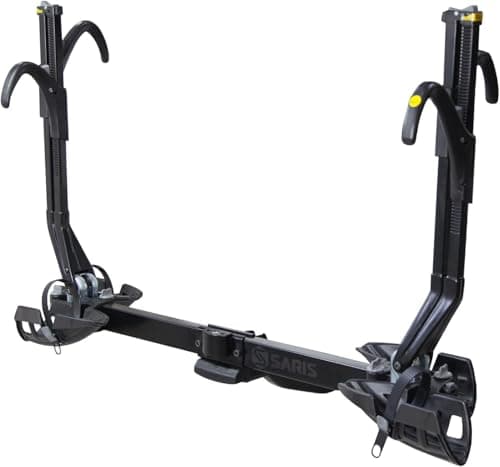
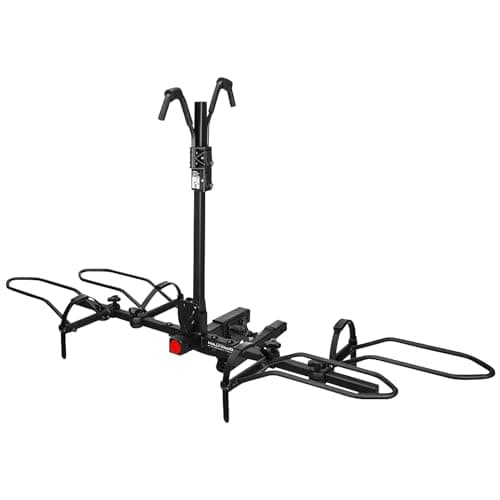
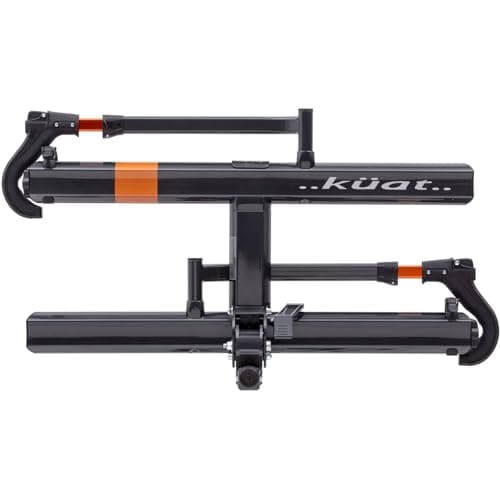
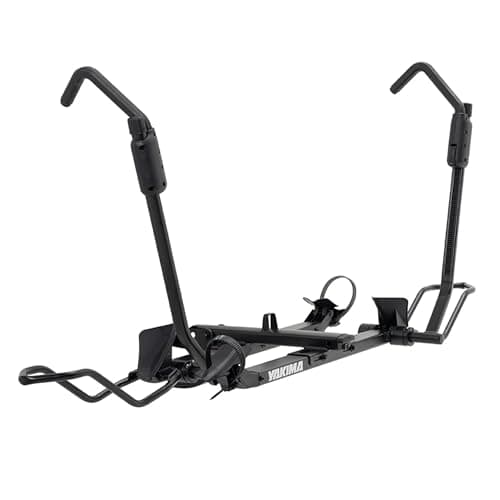
The rack you can buy is decided by your car, not by your bikes. A hitch rack needs a receiver. A roof rack needs crossbars. A trunk rack needs nothing and is worse at everything. That ordering is the whole shape of this decision, which is why this page sorts on mount type first and price second.
Then there is the number almost nobody publishes. Three of these ten listings publish a weight capacity, and the two that publish a per-bike figure differ by a factor of 2.3 — 35 lb and 80 lb. That is not a trivial spread. It is the difference between a rack that will carry a complete e-bike and one that will not, and seven of these ten listings leave you with no way to tell which side of the line they fall on.
The four mount types, in the order they are actually good
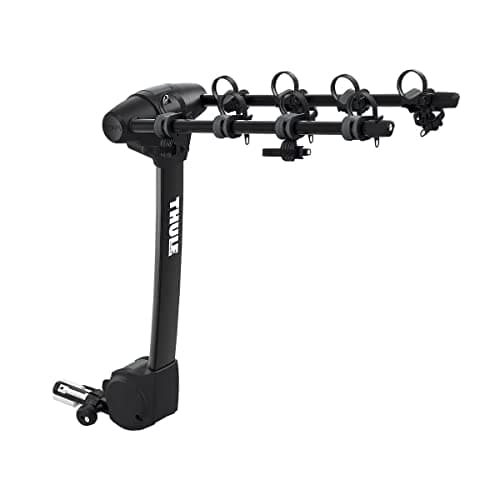
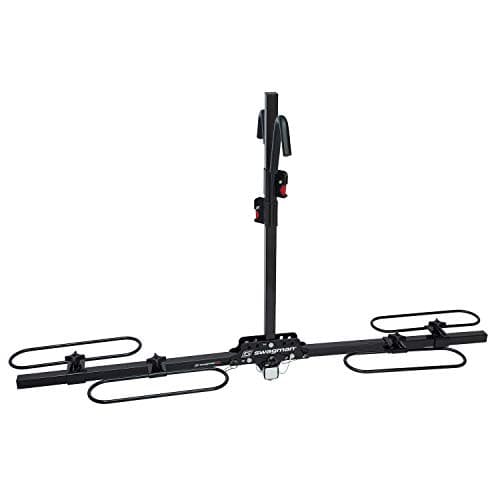
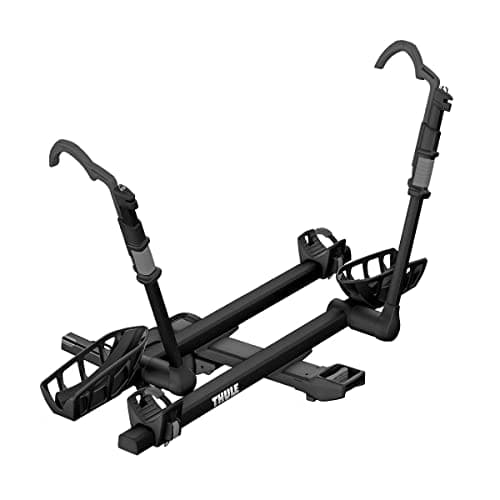
Hitch platformracks carry the bike by its wheels in a tray. Nothing clamps your frame, the bikes cannot swing into each other, and loading is at waist height. They are the best way to carry a bike on a car and they are the most expensive, both to buy and because they presume a hitch receiver you may not have. Thule’s listing publishes the phrase that matters: “No Frame Contact”.
Hitch hangingracks hold bikes by their frames on two arms. Far lighter and cheaper than a platform rack of the same capacity — four bikes for the price of a two-bike platform — and they reintroduce every frame-contact problem. The arms want a straight, horizontal, round top tube, which modern bikes increasingly do not have.
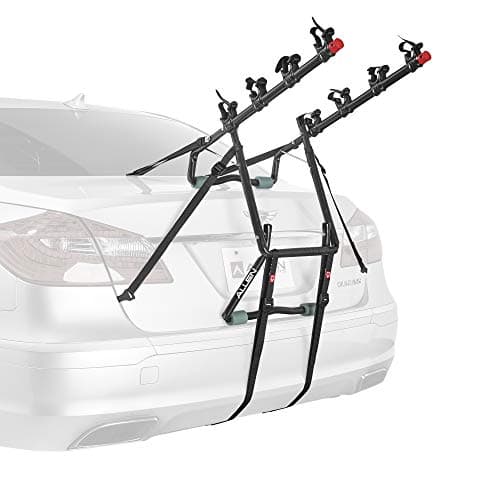
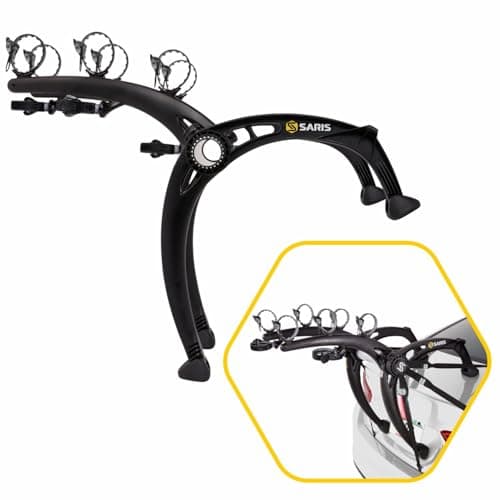
Trunk racks strap to the car body and hang bikes by their frames. They need no permanent fitting at all, they cost the least, they live in a closet between trips, and they are resting against your paint while they do it. For a few trips a year they are the right answer; the honest version of the argument is that they are the right answer because the alternative is not carrying the bike.
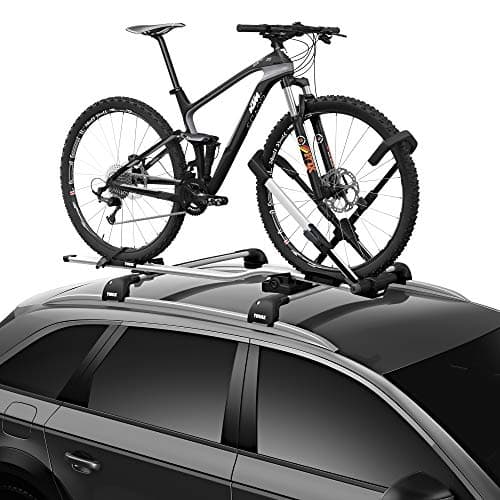
Roof racks put the bike above the car. Nothing is behind the vehicle, so the plate, lights and tailgate stay clear, and no frame clamping is involved on an upright mount like the Thule here. The costs are real: you lift the bike over your head, you lose fuel economy to drag, and you acquire the ability to drive your bike into a parking garage ceiling.
The e-bike problem, which is a weight problem nobody will tell you
This is where the published-capacity audit stops being academic. Complete e-bikes are heavy — much heavier than the conventional bikes most racks were designed around — and the rack industry has responded with the word “e-bike compatible” far more often than with a number.
Three listings here name e-bikes. Of those three, one publishes a per-bike figure (Hollywood, 80 lb each), one publishes a total (Thule, 120 lb) and one publishes neither (Saris SuperClamp EX). Meanwhile the cheapest platform rack on the page publishes 35 lb per bike, which is a limit most e-bikes exceed on their own without a battery argument.
The second half of the problem is on the bike side, and we have run into it before: our e-bike roundups found that e-bike listings overwhelmingly do not publish a weight either. So the two numbers you need to compare are both frequently missing. The only reliable procedure is unglamorous:
Weigh the bike — bathroom scales, bike on, read it, or lift the bike onto the scales in two halves and add — then get the rack’s per-bike limit from the manufacturer for the exact variant and receiver size you are ordering. If you cannot establish both numbers, you are guessing with a bike on a highway. Our e-bike accessories page covers the other purchases whose character changes the moment a motor is involved, and this is one of the starkest.
Frame contact: the question that decides whether a hanging rack fits at all
A hanging rack or trunk rack suspends the bike from its top tube. That requires a top tube which is horizontal, straight, round and strong enough to be clamped. Three common bikes fail that test:
Carbon frames are not designed for a clamping load in the middle of a tube, and a loaded rack on a rough road applies it for hours. Step-through frames — most commuter e-bikes, most comfort hybrids — have no top tube to hang from. Full-suspension mountain bikes have a sloping, shaped, often hydraulically interrupted top tube that the arms cannot reach cleanly.
A platform rack solves all three at once by carrying the wheels. If your bike is in any of those categories, the mount-type decision has been made for you, and the only remaining question is whether your car has a receiver.
The receiver you have, and the one the rack wants
Hitch receivers come in 1.25-inch and 2-inch openings, and a rack built for one does not simply fit the other. Four of these ten listings publish which they take: Swagman and Saris SuperClamp EX name both sizes, Yakima and Kuat name 2 inches only, Hollywood names 2 inches only. The other five racks either do not use a hitch or do not say.
Two practical notes. The smaller receiver is generally rated for less weight, which is why several racks exist in two variants with different capacities — and it is why a capacity figure you read on one retailer’s page may belong to the other variant. Confirm the figure for the exact part number you are buying. And if you have no receiver at all, adding one is a real job on a real car with real wiring near it; price the installation before you decide a hitch rack is the cheap option.
The legal part, which is not optional and varies by state
A loaded rear rack routinely covers the license plate and often the tail lights, and that is regulated. There is no federal rule about bicycle racks, but state vehicle codes are explicit about plate visibility and several name exactly this situation. New York’s is representative and unusually clear: “The view of such number plates shall not be obstructed by any part of the vehicle or by anything carried thereon”, and the same section requires plates to be kept “easily readable”.
“Anything carried thereon” is a bike rack. The practical fixes are standard: a hitch-mounted auxiliary plate and light board, moving the plate temporarily where your state permits it, or choosing a rack and loading pattern that leaves the plate visible. Check your own state’s code rather than assuming — the wording and the tolerance for a partially obscured plate both vary, and a rear-mounted rack is a common traffic stop.
Two more legal and safety points worth knowing. A loaded rack usually makes the vehicle longer than its registered dimensions imply, which matters for parking and for some tolls. And on a hanging or trunk rack, the bikes’ own reflectors end up pointing at the ground — which is one more reason a rear light on the bikeis not a substitute for the car’s.
What a rack does to the bike, and the five minutes that prevent it
A bike on a car is in a wind tunnel at highway speed for hours, pointed in a direction it was never designed to face. Three things follow.
Anything loose leaves. Pumps, computers, lights, bottles and saddle bags all come off before the drive — the contents of what you carry on a ride belong in the car, not on the bike. Second, road grit and salt spray hit the drivetrain directly at speed, so a winter drive is a chain-cleaning event: clean it afterwards, not before.
Third, check the torque of anything the rack clamps when you arrive. A wheel-tray rack pulls down hard on a quick release or thru-axle for hours, and a frame-clamping rack applies a load to a tube in the direction it least likes — the torque guide has the published figures for the bolts worth checking before you ride away from the trailhead.
What we could not check
No rack here has been fitted, loaded or driven with. Every “Listing:” specification above is the live Amazon listing text for the exact ASIN linked, read on 12 October 2026. Thule’s own product page for the T2 Pro XTR returned HTTP 404 to automated retrieval on that date, so no figure on this page is attributed to a manufacturer site. We also found several retailers publishing different total-capacity figures for the same Thule rack, and a lower figure for its 1.25-inch receiver variant — which is exactly why this page quotes only the listing you would buy from, and why it tells you to confirm the number for your own variant. Where a listing publishes no capacity, no e-bike statement and no frame-contact statement — which is most of them — the table below says so rather than estimating.
E-bikes are the hardest case on this page and they get their own walkthrough, because the capacity audit above only works if you also know what the bike weighs: how to transport an e-bike covers getting both numbers, and which rack types are ruled out by frame shape alone.