How to Transport an E-Bike
The answer is a platform hitch rack with a published capacity. The problem is that your e-bike's weight is not published anywhere, and most racks' capacities are not either.
Heads up: we earn a commission if you buy through the links on this page, at no extra cost to you. It never decides what makes the list — here’s how that works.
Use a platform hitch rack that publishes a per-bike weight capacity, and weigh your e-bike before you buy it. Those are the two halves of the answer, and the reason this question is harder than it looks is that neither number is reliably published: on our car rack roundup only three of ten listings publish a weight figure at all, and the e-bike listings in our own catalogue do not publish a bike weight. So you are being asked to match two numbers, and the market hands you neither.
The other reason is that the two cheap, popular rack types are the wrong answer for an e-bike for a structural reason rather than a weight one. Here is the whole decision in order.
Step 1: find out what your e-bike weighs
Not the figure from a forum, not the figure for the model one size up. Yours. The practical method: weigh yourself on a bathroom scale, then pick up the bike and weigh both, and subtract. For a bike you cannot lift, a luggage scale on a hoist or a trip to any weighbridge works.
Why not just look it up? Because we checked, and the complete e-bike listings in our catalogue publish battery capacity, motor wattage, speed, range, wheel size and tire width — and not one of them publishes the weight of the bicycle. A category that will tell you it has a 624 Wh battery and a 1400 W peak motor will not tell you how heavy the object is. If you are still choosing a bike, our e-bike roundup records exactly which figures each listing does publish.
For orientation: the figure matters because an e-bike is heavy in a way that breaks rack assumptions. A hub motor, a frame-integrated battery and fat tires all add mass, and the published per-bike capacities on racks that do publish one range from 35 lb to 80 lb. Those two numbers are 2.3 times apart. There is no version of this where the figure does not matter.
Step 2: rule out the two rack types that cannot do it
Trunk-strap racks are out.They hang the bike by its top tube from straps tensioned against the car’s bodywork, and they are rated for the weight of ordinary bicycles. Two e-bikes on a trunk rack is a load the straps and the bodywork were not designed for.
Hanging hitch racks are mostly out, for a different reason.They also carry the bike by the top tube, which rules out any step-through frame — and a large share of e-bikes, including several in our catalogue, are explicitly step-through. There is no top tube to hang from.
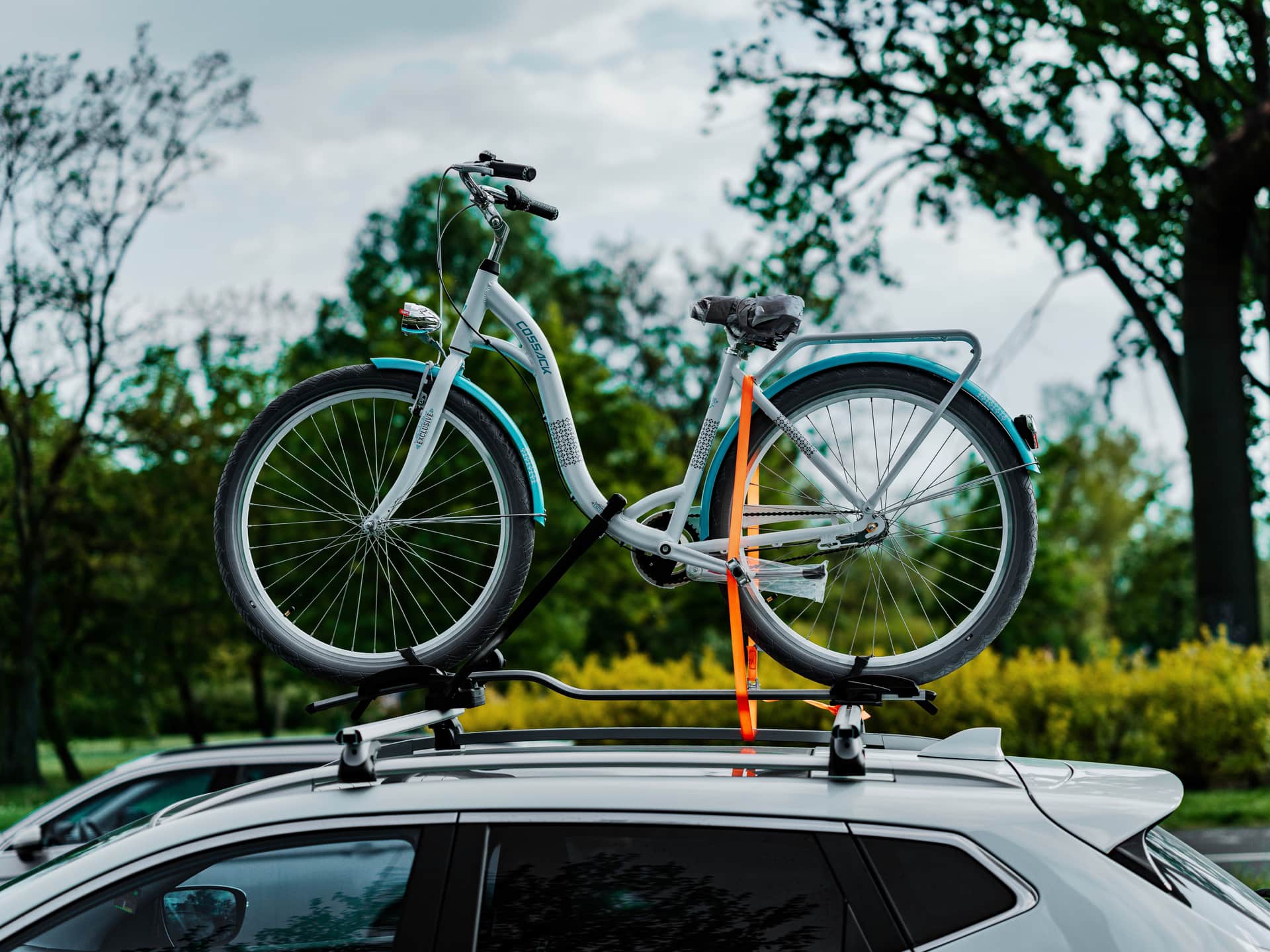
Roof racks are physically possible and practically miserable. Lifting a 50 lb-plus bike above your head onto a roof is the kind of job people do once. Some riders do it with a ramp or by removing the battery first; most should not plan on it.
That leaves platform hitch racks, which carry the bike by its wheels in trays. Thule publishes “No Frame Contact” for its platform rack, which is the property that makes this type work for a step-through frame, a carbon frame and a full-suspension bike alike. Our rack roundup sorts all ten racks by mount type for exactly this reason.
Step 3: check three things on the rack listing
Published per-bike capacity.Not total capacity — per bike. Three of the ten listings on our roundup publish a figure: Thule’s “120lb Load Capacity” (total), Hollywood’s “up to 80 lbs Each” and Swagman’s “35 lbs per Bike”. If a listing does not publish one, you are buying on hope.
Hitch receiver size.1.25 inch and 2 inch are different receivers, and the smaller variant of the same rack is generally rated lower. Four of the ten listings publish the receiver size. Look under your car before you order, and confirm the capacity figure for your exact variant rather than for the model name — we found retailer listings for the same rack disagreeing with each other on capacity.
Whether the listing names e-bikes.Three of ten do. Only one of those three also publishes a per-bike limit, which tells you how much the phrase “e-bike compatible” is doing on its own.
And one thing to check on the car, not the rack: your vehicle’s own tongue weight rating. A hitch has a limit, the rack has a weight, and the bikes add to it. That figure is in your owner’s manual and we cannot look it up for you.
The three racks whose listings publish a weight figure
Not a ranking — these are the platform hitch racks from our car rack roundup whose listings publish a capacity number, which is the specification this job is decided by. The 35 lb per-bike figure is included deliberately, as the example of a published number that rules a rack out for most e-bikes.
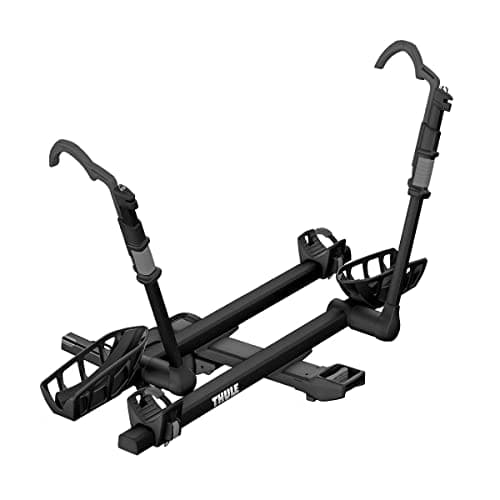
Thule T2 Pro XTR 2 Hitch Bike Rack
Publishes a 120 lb total load capacity, "E-Bike Compatible" and "No Frame Contact" — the three claims this job needs, in one listing.
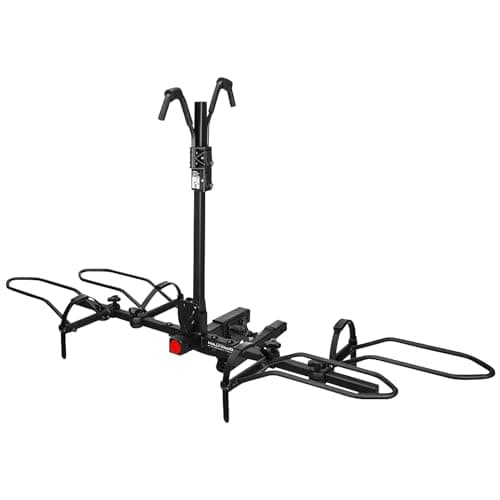
Hollywood Racks Sport Rider Hitch Bike Rack
Publishes the highest per-bike figure on the roundup: up to 80 lbs each, and the listing names fat tire and electric bicycles specifically. 2 inch receiver.
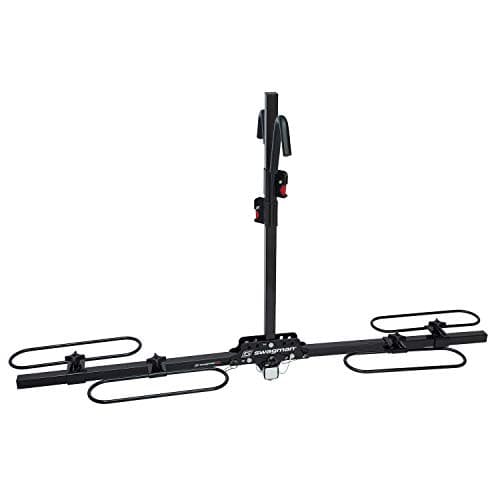
Swagman XC2 Hitch Mount Bike Rack
Publishes 35 lbs per bike — read that as the counter-example. It fits 1-1/4" and 2" receivers and is a platform rack, and most e-bikes are over its published limit.
$99.15 · View on Amazon$199.99 −50%
We haven’t tested any of these — they’re the parts the job above calls for, listed so you don’t have to go hunting. Prices are live from Amazon and we earn a commission if you buy. Prices as of October 17, 2026. #ad
Step 4: the legal bit most people miss
A loaded rear rack usually obscures your license plate, and state vehicle codes address this directly. New York Vehicle and Traffic Law § 402 is explicit: “The view of such number plates shall not be obstructed by any part of the vehicle or by anything carried thereon.”
Your state’s wording will differ and the requirement generally will not. The fix is a rack-mounted plate holder with a light, or re-positioning the bikes so the plate stays visible. Rear lights matter too: a rack that covers your tail lights is a separate problem with the same solution.
Before you drive: the battery
Take the battery off the bike and put it inside the car. Every removable-battery e-bike in our catalogue publishes exactly that word — removable — and there are three good reasons to use it. It takes several pounds off the rack, which is the number you have just spent two steps matching. It keeps a lithium battery out of road spray and off a vibrating rack arm. And it means the bike is much less attractive to steal while you stop for coffee.
Our guide to charging and storing an e-bike battery covers the temperature and state-of-charge points that also apply to a battery sitting in a hot car.
What this page will not tell you is how to ship a battery, which is the other half of this autocomplete stem. Lithium batteries are regulated as hazardous materials for air and ground freight, the rules differ by carrier and by watt-hour rating, and we do not have a verified source to quote. Ask the carrier, and expect the answer to be no.
Two cheaper situations worth naming
A pickup truck bed. Simplest option there is: the bike stands in the bed, held by a fork mount or a wheel chock and strapped down. No capacity question, no plate question, no lifting above shoulder height.
Inside the car. Front wheel out, bike on its side on a blanket, battery removed. For one e-bike and an estate or SUV this is free, secure and weatherproof, and it is what most people should do for a single trip rather than buying a rack. Our pedal removal guide covers the one other thing worth taking off if space is tight.
The honest summary
Platform hitch rack, published per-bike capacity above your bike’s actual weighed weight, correct receiver size, battery in the car, plate visible. If you cannot find a published capacity figure for the rack you are looking at, assume the rack is not the right one rather than assuming it will be fine — this is the one failure mode on this page that happens at 70 mph.
Rack types against an e-bike, and why each one works or does not
Mount type is derived from how the rack is built, not quoted from a listing: a platform rack carries wheels and a hanging rack carries the top tube. Published capacities are the listings’ own, as recorded on the rack roundup.
| Rack type | What holds the bike | Step-through frame? | Lift height | Verdict for an e-bike |
|---|---|---|---|---|
| Hitch platform | The wheels, in trays | Yes — no frame contact | Knee height | The answer, if it publishes a capacity |
| Hitch hanging | The top tube | No | Waist height | Ruled out by frame shape on many e-bikes |
| Trunk strap | The top tube, on straps | No | Waist height | Ruled out — weight and bodywork load |
| Roof | Wheel and/or fork | Yes | Above your head | Possible; almost nobody does it twice |
| Truck bed | Fork mount or chock plus straps | Yes | Tailgate height | The easiest option if you have the truck |
| Inside the car | A blanket and the floor | Yes | Boot sill | Free, secure, weatherproof, one bike |
Two rows are ruled out by frame shape rather than by weight. If your e-bike has no top tube, half the rack market is unavailable to you before capacity is even discussed — and the listings for those racks will not tell you so.
Common questions
Can you put an e-bike on a normal bike rack?
Often not. Trunk-strap and hanging racks carry the bike by its top tube, which rules out step-through frames entirely and loads the straps beyond what ordinary bicycles need. And weight is a real limit: published per-bike capacities on the racks that state one range from 35 lb to 80 lb, and many e-bikes clear the lower figure easily. A platform hitch rack with a published capacity is the type that works.
How much does an e-bike weigh?
We cannot tell you, and nor can the listings: not one of the complete e-bikes in our catalogue publishes a bike weight, even though they publish battery watt-hours, motor peak wattage, top speed and range. Weigh yours — stand on a bathroom scale, then hold the bike and subtract. That number is the input the rack decision turns on.
Should I remove the battery before transporting an e-bike?
Yes, if it is removable, and most are. It takes several pounds off the rack, keeps a lithium battery out of road spray and vibration, and removes the main reason someone would bother stealing the bike off the back of your car while you are inside a diner.
Is it legal if the bike rack covers my license plate?
Generally no. New York Vehicle and Traffic Law § 402 states that the view of the number plates “shall not be obstructed by any part of the vehicle or by anything carried thereon”, and other states have equivalent provisions. Use a rack-mounted plate holder with a light, or arrange the load so the plate and tail lights stay visible.
Can I transport an e-bike in a car instead of on a rack?
For one bike, yes, and it is the option most people should take for an occasional trip. Remove the battery and the front wheel, lay the bike on its side on a blanket, and strap or wedge it so it cannot move. Free, weatherproof and much harder to steal than anything on the outside of the car.
Sources
- New York Vehicle and Traffic Law § 402 — number plates. Quoted for the obstruction provision that a loaded rear rack runs into — retrieved 2026-10-17
- Amazon listings for the ten car racks recorded on /road/best-bike-racks-for-cars — source for the three published capacity figures (Thule "120lb Load Capacity", Hollywood "up to 80 lbs Each", Swagman "35 lbs per Bike"), Thule's "No Frame Contact" and "E-Bike Compatible" claims, and the receiver sizes. Seven of the ten publish no weight figure
- Amazon listings for the twelve complete e-bikes in content/catalogue.json, checked for a published bicycle weight. None of the twelve publishes one, although all publish battery capacity and motor wattage
Read next
- The best bike racks for cars
All ten racks by mount type, and the full capacity audit.
- How to charge and store an e-bike battery
What applies to the battery you just put in a hot car.
- The best e-bike accessories
Where this site draws the line on frame-specific fit.
- The best e-bikes on Amazon
Which figures each e-bike listing actually publishes.
We haven’t ridden or tested any of the products on this page, and we don’t pretend otherwise. Read how we research — or tell us we’re wrong and we’ll log the correction.