How to store a bike
A bike in storage isn't resting — it's slowly corroding, losing air, and fading in any light that reaches it. None of that is inevitable, and the prep that prevents all of it takes about fifteen minutes.
Heads up: we earn a commission if you buy through the links on this page, at no extra cost to you. It never decides what makes the list — here’s how that works.
A stored bike is not a resting bike.Left alone, it keeps doing four things, all of them bad: steel parts pull moisture out of the air and rust, sunlight breaks down every rubber and plastic surface it touches, the tires bleed air until the casing sits deformed under the bike’s own weight, and a lithium battery ages faster at the two charge levels people most often leave it at — full and empty. None of this requires you to ride badly. It requires you to do nothing, in the wrong place, for a few months.
The good news is that every one of those failure modes is slow, mechanical, and cheap to stop. We’re not going to give you a ritual. We’re going to tell you what actually degrades a parked bike and quote the people who publish the numbers — the brake and battery makers, Park Tool, and REI — so you can tell the difference between a real precaution and a habit someone inherited.
Indoors beats outdoors, and it isn’t close
If you take one thing from this page: store the bike inside. Outdoor storage attacks a bike from three directions at once, and two of them are invisible until the damage is done.
- UV.Sunlight degrades rubber and plastic — tires, hoods, saddle cover, cable outers, the paint’s clear coat. It doesn’t announce itself; a tire that has spent a summer in a sunny window looks fine right up until the sidewall crazes and cracks. This is why REI’s own advice for tires that are off the bike is to keep them away from sunlight and heat, and the same logic applies to a whole bike parked against a south-facing wall.
- Moisture.Damp air is enough. You don’t need rain on the bike for the chain, cassette, chainrings, bolts and cable ends to grow a film of surface rust — you just need humidity and time. Electra’s storage guidance is blunt about it: “Avoid damp areas to prevent rust and corrosion.”
- Theft exposure.A bike stored outdoors is a bike a stranger has time to study. This one has no mechanism to explain — it is simply the largest risk on the list and the one no maintenance fixes.
If you genuinely have no indoor option, treat outdoor storage as damage control, not a solution. Use a breathable cover rather than a sealed tarp — a tarp that traps condensation against the frame is worse than no cover, because it turns overnight temperature swings into a daily dew cycle right on your steel parts. And lock it as if it were parked in town, because for a would-be thief it effectively is: a good lock through the frame and a wheel, anchored to something that doesn’t move.
Hanging it up: is hanging by a wheel actually fine?
Yes — for the wheel. A bicycle wheel is a tension structure that already carries your entire body weight, plus impact loads, every time you ride over a curb. The static weight of the bike hanging from one rim is trivially within what that wheel handles all day. Hanging a bike from a hook through a wheel is standard practice; REI treats it as a default, and even suggests, when you have several bikes, that you alternate front and rear wheel hangingso the handlebars don’t fight each other on the wall. The wheel is not the thing to worry about.
The thing to worry about is orientation, if you run hydraulic disc brakes — and here there is a real, published warning, not folklore. Shimano’s dealer manual states plainly that “the disc brake system is not designed to work with the bicycle upside down”. Their reasoning is specific: turn the bike upside down or on its side and any air bubbles sitting harmlessly in the lever reservoir can migrate toward the caliper, and a bike ridden away in that state can have a soft or dead lever until the air works back out. Shimano’s own instruction after inverting a bike is to work the brake lever a few times and confirm the brakes operate normally before riding.
Read carefully, this is notan argument against hanging by a wheel. A bike hung vertically by a wheel is upright — the lever is still above the caliper, which is exactly where the air should sit. The warning is about storing or leaving a hydraulic bike genuinely inverted (wheels up, bars down) for a long spell, which some racks and some garage-flip habits do. Hang it by a wheel, keep it vertical, and the hydraulics never know it left the ground. If you ever do flip it — to work on it, say — just pump the levers before the first ride.
Space-saving options, qualitatively. The choice is mostly about your room, not your bike:
- Vertical wall hook (one wheel up, tire against the wall): cheapest, takes the least floor space, and REI notes this vertical, in-a-corner orientation takes up the least room of any method. The catch is you lift the whole bike to hang it, which gets old with a heavy e-bike.
- Horizontal wall mount (bike parallel to the wall, held at the frame or on tray arms): easy on, easy off, kind to the drivetrain, but it projects the full length of the bike into the room.
- Ceiling hoist / overhead rack:reclaims dead space at the top of a garage, which REI calls out as a strong option for multiple bikes — at the cost of a pulley system you have to trust over your car.
- Floor stand:no lifting, no wall holes, no weight on the tires if it clamps the frame or holds a wheel in a tray — but it uses floor space, which is the thing storage is usually trying to save.
Tires: they lose air whether you ride or not
Air escapes a tire slowly and constantly — it permeates out through the tube and casing even with nothing wrong. How fast varies enough by tire, tube and pressure that we won’t quote a rate; anyone who gives you a tidy “X psi per week” is guessing. What matters is the consequence: a tire left to go soft lets the bike settle onto a flat contact patch, and weeks of that can leave a set in the casing.
There are two honest fixes, and you only need one:
- Top them up periodically.Tires have a manufacturer-recommended storage pressure — REI’s guidance is to find it on the tire maker’s website (or ask a shop) rather than guess — and re-inflating every few weeks keeps the tire holding its shape.
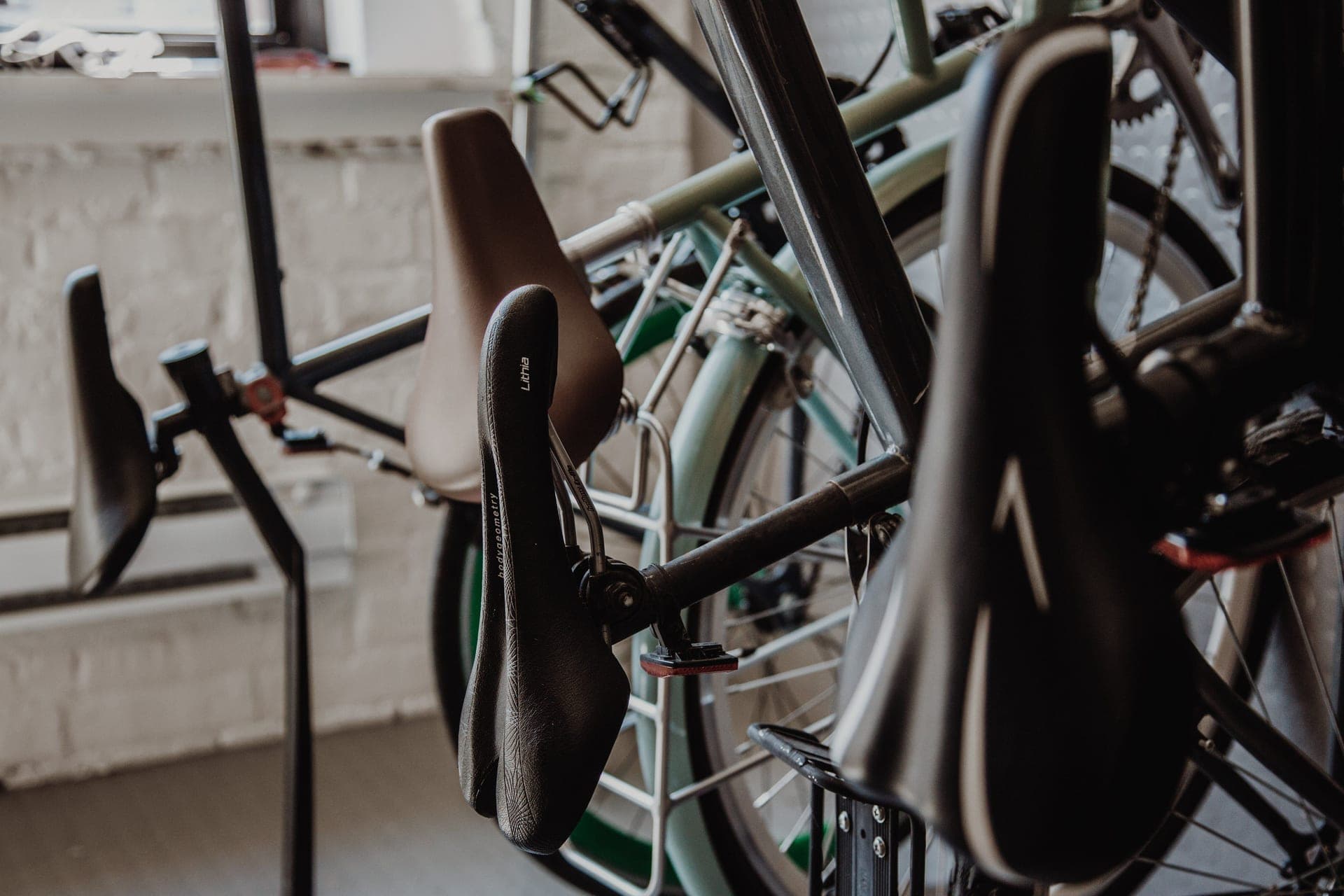
- Or take the weight off them entirely. Hang the bike or put it in a stand that supports the frame, and a slowly deflating tire simply hangs there doing no harm. This is the low-effort option and the reason hanging storage is popular for long layups.
The drivetrain: clean and lube it before the bike sits
This is the step that separates a bike that comes out of winter ready to ride from one that comes out with an orange, stiff chain. A dirty chain going into storage is the worst case: the grime is abrasive, it holds moisture against the metal, and road salt in it is actively corrosive. Left for months, that’s a chain rusting from the inside of every roller. If that has already happened to a chain you own, how to remove rust from a bike chain covers what is recoverable — and the acid-based methods Shimano’s own manual says not to use.
So degrease it, dry it, and re-lube it before the layup. The point of the lube isn’t just to reduce friction — Park Tool describes chain lubricant as displacing moisture and protecting the parts from rust and corrosion, forming a barrier between bare metal and the damp air that would otherwise reach it. That barrier is exactly what a stored chain needs, because storage is nothing but time and damp air. Our chain-cleaning walkthroughis the job to do first — do this before any long layup so the chain doesn’t rust — and our look at chain lubescovers which kind actually protects a drivetrain that’s going to sit, since a thin, fast-riding lube and a moisture-displacing protective one aren’t the same thing.
One free extra: don’t leave the chain parked on the same links for months. Turning the cranks a few times mid-storage moves the lube around and keeps the pivots from setting stiff in one position. It costs ten seconds.
E-bike batteries: cool, part-charged, and indoors
A lithium battery is the one part of a stored bike that degrades from doing nothing, and it degrades fastest at the extremes people default to — parked at 100% because that’s how it came off the charger, or run to empty and forgotten. The rule everyone agrees on is: store it part-charged, cool, and indoors. Battery storage is its own set of rules, and our guide to e-bike range and batteries goes deeper on why heat and charge level are what age a cell. The adjacent mistake is putting an e-bike away wet rather than put away full — riding an e-bike in the rain is fine, and storing it afterwards without drying it is how the chain rusts and the connectors corrode.
Where the makers stop agreeing is the exact number, and rather than paper over that, here it is:
- Bosch recommends storing the battery at roughly 30–60% charge (two to three LEDs), in a dry place between about 32°F and 68°F (0–20°C), and out of the cold — take it off the bike and keep it indoors over winter rather than leaving it in an unheated shed.
- Electra (Trek’s city brand) instead suggests keeping the battery at around 80% charge for long-term storage, in a climate-controlled space between 32°F and 104°F (0–40°C).
Those don’t reconcile into a single figure, and we’re not going to invent a compromise like “70%” to make the page look decisive. Follow the maker of your battery.What both agree on is the shape of the advice, and that shape is the actual takeaway: not full, not empty, not hot, not freezing, and not left for the whole off-season without a glance. Check it occasionally and nudge it back into the recommended band; letting a lithium battery sit until it’s deeply flat is the one clearly damaging outcome. Charge it in a location where a fault has somewhere safe to go, not on a pile of cardboard.
Daily storage is the same rules, quieter
Everything above is written for a long layup, but the daily version is just a lighter dose of it. Bring the bike in out of the weather if you can. Wipe a wet chain and re-lube it rather than letting it dry with grit in it. Keep it out of direct sun. For an e-bike you ride regularly there’s no charge-level game to play — the storage-charge advice is for bikes that will genuinely sit. The difference between daily and seasonal storage isn’t the principles; it’s how much neglect the timescale lets you get away with.
What we haven’t done
We have not stored a fleet of bikes for a controlled year and measured the rust. Everything specific on this page is quoted from a maker who publishes it — Shimano on brake orientation, Bosch and Electra on battery charge and temperature, Park Tool on what lube actually does, REI on hanging and tire storage — and everything else is a mechanism you can verify by thinking about where the water, the air and the sunlight go. Where two makers disagree, we left the disagreement visible rather than picking a winner we couldn’t justify.
Storage solves the overnight problem. For the hours a bike spends parked in public, technique matters as much as hardware — how to lock a bike covers what to put the shackle through, and which parts are left unsecured.
What actually decides this purchase
Indoors is the whole game.Every other decision here is a refinement of “get it out of the weather.” A bike stored dry and shaded barely needs the rest of this list; a bike stored wet and sunlit can’t be saved by any of it.
Pick the rack to fit your room, not your bike.Vertical wall hooks save the most space and are the cheapest; horizontal mounts are the kindest to your back and your drivetrain; ceiling hoists reclaim dead garage air over the car; floor stands ask no lifting and drill no holes. There is no “best” — there’s the one that fits the wall you actually have.
Take the weight off the tires or top them up — choose one.Hanging does it for free; a floor stand that supports the frame does it too. If the bike sits on its wheels, put a re-inflation on your calendar every few weeks and use the tire maker’s storage pressure rather than a guess.
Never store a dirty chain.Clean, dry, lube — in that order — before a long layup, because a protective lube is displacing the moisture that would otherwise rust the chain from inside every roller. It is the single highest-return five minutes in seasonal storage.
For an e-bike, the battery is the part that ages while parked.Part-charged, cool, indoors, and follow your own maker’s exact charge figure — they don’t all agree, and the number that matters is the one printed by whoever built yours.
If it must live outside, it’s a security problem first. A breathable cover, never a sealed tarp, and a lock rated for street parking through the frame and a wheel to a fixed anchor. Outdoor storage is damage limitation, not a plan.
A car is storage too, and the harshest kind. A bike on a roof or hitch rack spends hours in a salt spray at highway speed, pointed in a direction it was never designed to face, which is why the car rack roundup ends with the same advice this page starts with: strip the accessories, then clean the drivetrain when you arrive rather than before you leave. Mount type decides whether anything clamps the frame at all.
Common questions
Is it OK to hang a bike by one wheel?
Yes. A wheel is a tension structure built to carry your whole body weight plus impacts, so the static load of a hanging bike is well within what it handles. Hanging by a wheel is standard practice — REI even suggests alternating front and rear wheels when you hang several bikes so the bars don’t clash. The only real caution is orientation on hydraulic disc brakes: hung vertically the bike is upright and the brakes are fine; it’s leaving a hydraulic bike fully upside down for a long time that Shimano warns against.
Should I store my bike with the tires inflated or let them down?
Keep them holding their shape. Tires lose air slowly no matter what, and a tire left to go soft lets the bike settle onto a flat spot that can set into the casing. Either re-inflate every few weeks to the tire maker’s recommended storage pressure — REI says look it up on the manufacturer’s site rather than guess — or take the weight off the tires entirely by hanging the bike or using a frame-supporting stand, in which case a slowly deflating tire does no harm.
Can I store my bike upside down if it has hydraulic disc brakes?
Not for long. Shimano’s dealer manual says the disc brake system “is not designed to work with the bicycle upside down,” because inverting it lets air bubbles in the lever reservoir drift toward the caliper and leave the brake soft until they work back out. A quick flip to fix a flat is fine — just pump the levers a few times and confirm the brakes feel normal before you ride. It’s long-term inverted storage that you want to avoid. Hung vertically by a wheel, the bike is upright and unaffected.
What charge should I store my e-bike battery at over winter?
Part-charged, and follow your own battery maker — because they disagree on the number. Bosch recommends roughly 30–60% charge, stored cool and dry (about 32–68°F) and indoors rather than in a freezing shed. Electra recommends around 80% for long-term storage in a climate-controlled space. What they agree on is the principle: never full, never empty, never hot or freezing, and don’t leave it untouched all season — check it occasionally and top it back into the recommended range.
Do I really need to clean and lube the chain before storing the bike?
For a long layup, yes — it’s the highest-value step. A dirty chain holds grit, moisture and road salt against the metal for months, which is how a chain rusts from inside the rollers. Cleaning and re-lubing first lays down a protective film; Park Tool describes chain lube as displacing moisture and protecting against rust and corrosion, which is exactly what a chain that’s about to sit needs. Our chain-cleaning guide is the place to start.
Is storing a bike outside under a cover good enough?
It’s a last resort, not a plan. Outdoor storage exposes the bike to UV that degrades rubber and paint, damp that rusts the drivetrain, and far more theft risk. If you have no choice, use a breathable cover — never a sealed tarp, which traps condensation against the frame — and lock it through the frame and a wheel to a fixed anchor as if it were parked on the street. Indoors is dramatically better and worth real effort to arrange.
Sources
- Shimano Dealer's Manual, Hydraulic Disc Brake (DM-MDBR001) — "the disc brake system is not designed to work with the bicycle upside down"; air bubbles in the reservoir can migrate toward the caliper if the bike is inverted or on its side; operate the lever to confirm braking before riding — retrieved 2026-08-08
- Bosch eBike Systems — Storage when not in use for a longer period. Recommended battery charge ~30-60% (two to three LEDs); store dry at approx. 32-68°F (0-20°C); keep indoors over winter — retrieved 2026-08-08
- Electra (Trek) — Electric Bike Storage. Store indoors, climate-controlled 32-104°F (0-40°C); battery ~80% for long-term storage; "Avoid damp areas to prevent rust and corrosion"; wipe frame, wheels and drivetrain and dry before storing; maintain tire pressure to prevent flat spots — retrieved 2026-08-08
- REI Expert Advice — Best Ways to Store Bikes. Hanging bikes by the wheel and alternating front/rear; vertical, wall and ceiling space-saving options; tires have a manufacturer-recommended storage pressure to look up — retrieved 2026-08-08
- Park Tool — How to Clean and Lubricate a Chain. Chain lubricant displaces moisture and protects parts from rust and corrosion, forming a barrier over bare metal — retrieved 2026-08-08
Read next
- How to clean a bike chain
Do this before any long layup so the chain doesn't rust.
- Can you ride an e-bike in the rain?
The four things to do after a wet ride, before the bike goes away.
- E-bike battery range explained
Battery storage is its own set of rules.
- The best bike chain lube
The lube that protects a stored drivetrain.
We haven’t ridden or tested any of the products on this page, and we don’t pretend otherwise. Read how we research — or tell us we’re wrong and we’ll log the correction.