How to Set Saddle Height
A 2022 systematic review of 41 studies found strong evidence for setting saddle height on dynamic knee angle — and only moderate evidence that changes under 4% of leg length matter at all. Both of those findings are useful.
Heads up: we earn a commission if you buy through the links on this page, at no extra cost to you. It never decides what makes the list — here’s how that works.
Set your saddle height by knee angle while you are actually pedalling, not by a percentage of your inseam. A 2022 systematic review covering 41 studies concluded that there is “strong evidence” saddle height “should be configured using dynamic measurements of the knee angle”. The practical target the literature uses is roughly 25 to 35 degrees of knee flexion at the bottom of the pedal stroke. If you have no way to measure that, the honest fallback is the heel-on-pedal method below — but know that it is a proxy, and the research says proxies are the weaker approach.
Here is the finding that should take the pressure off, and it is from the same review: “moderate evidence suggests that changes in saddle height less than 4% of the leg length results in trivial to small changes in lower limb loads, and no effect on oxygen uptake and efficiency”. On a 80 cm leg length that is a window of around 3 cm. So the obsessive millimetre-hunting that dominates this topic online is, on the published evidence, operating well inside the noise floor. Get it close, ride it, and adjust if something hurts.
Why the inseam formula is not the answer
The formula everybody knows — set the saddle to some percentage of your inseam, usually quoted as 106 to 109% — has been tested against dynamic measurement, and the result is not flattering. A 2013 study in the Journal of Strength and Conditioning Research compared static anthropometric measurement against 2D motion analysis in well-trained cyclists, and published two numbers worth knowing:
- 56.5% of the riders were outside the recommended 106–109% range of inseam length. More than half of trained cyclists, not following the rule.
- 26% had an inappropriate knee flexion angle when assessed dynamically.
And the conclusion, in the authors’ framing: the results “support the concept that adjusting saddle height to 106–109% of inseam length may not ensure an optimal knee flexion (30–40°)”. They found saddle height, inseam length and knee angle to be strongly related (R = 0.963) and proposed a revised range of 108.6 to 110.4% of inseam — slightly higher than the familiar figure.
So the formula is not useless; it is a starting point that gets a quarter of riders to the wrong knee angle. Use it to get in the neighbourhood, then check the knee.
Too low is the error that costs you something
If you are going to err, err high rather than low, and this one has published mechanics behind it. A 2020 study in the European Journal of Sport Science put twenty recreational cyclists through four saddle heights with motion capture and an instrumented pedal. At the low setting it measured:
- Greater knee adduction moments— 11.9 ± 1.9 Nm, significantly higher than at the other heights.
- A longer durationof that loading, 0.15 ± 0.01 s.
- Larger knee flexion, 58.5 ± 2.6 degrees, and larger abduction angles.
The paper’s own framing is that research suggests an excessively low saddle may lead to Patellofemoral Pain Syndrome, thought to be caused by that knee adduction moment. We will not go further than the paper does — it measured moments, not injuries — but the direction of the asymmetry is clear and it is the opposite of what most nervous riders do. People set their saddle low because it feels safe at the lights.
The study’s reference point is also worth having: it defined its medium saddle height as the one producing 25 degrees of knee flexion at bottom dead centre. That is the number to aim near.
The method, in the order the evidence supports
Best first, with the honest proxy last. All three need you on the bike, and two of them need someone else to look.
Three methods, ranked by what the research supports
The 2022 systematic review found strong evidence only for the first row. The other two are proxies, and the page says so rather than presenting them as equivalent.
| Method | What you do | Target | Evidence status |
|---|---|---|---|
| Dynamic knee angle | Pedal on a trainer; film from directly behind or beside; measure knee flexion at bottom dead centre | ≈25–35° of knee flexion | Strong evidence (2022 review, 41 studies) |
| Inseam percentage | Measure inseam barefoot against a wall; multiply; measure from pedal spindle to saddle top along the seat tube | 106–109%, or 108.6–110.4% per the 2013 revision | Proxy — 56.5% of trained riders fall outside it; 26% end up at a poor knee angle |
| Heel on pedal | Heel on the pedal at its lowest point, hips level; the leg should be straight with the knee just unlocked | Leg straight at full heel extension | Convention — no published validation located |
The knee-angle range quoted is the span used across the papers cited: the 2013 study describes 30–40° as optimal knee flexion, and the 2020 study defines its medium height as 25° at bottom dead centre. We are giving you the span rather than inventing a single consensus figure, because the papers do not agree on one.
What actually decides this purchase
How to measure it, so you can get back to it
Whatever height you arrive at, record it. The standard measurement is from the centre of the bottom bracket to the top of the saddle, along the line of the seat tube. Write it down, and also mark the post with a piece of tape or a marker before you move it. This is the single most useful habit in bike fitting, because it means an experiment is reversible.
Change one thing, and give it a week
Move the saddle in increments of about 5 mm, not 20, and ride several times at each setting before judging it. The 2022 review’s 4%-of-leg-length finding is the reason: inside that window the published effects on load and on oxygen uptake are trivial to none, so what you are actually assessing is comfort and habit rather than measurable performance. Big jumps tell you less, not more, because your body compensates.
The symptoms, and which direction each one points
Pain at the front of the knee, under or around the kneecap: commonly associated with a saddle that is too low, which is the pattern the 2020 knee-adduction study sits behind. Try going up.
Pain behind the knee, or rocking hips:commonly associated with a saddle that is too high — the leg is reaching, so the hips drop alternately to follow the pedal. If someone watching from behind can see your hips rock, that is the signal, and it is the easiest fit fault to spot without instruments.
Pointing your toes to reach the bottom of the stroke: too high. This is the same fault as hip rock, compensated at the ankle instead.
Saddle discomfort or numbness: usually not a height problem at all. That is width, tilt and saddle choice, and the sit bone measurement and the saddle guideare the two pages for it — the second of which is explicit about what nobody publishes in that category.
The two mechanical cautions
Minimum insertion.Seatposts carry a maximum-height or minimum-insertion mark, and it is a structural limit rather than a suggestion. If your correct saddle height puts the post past that line, you need a longer post — or the frame is too small.
Torque on the clamp. A seatpost clamp bolt on a carbon frame or carbon post is one of the places a torque figure genuinely matters, and Park Tool’s own torque reference carries the caveat we repeat everywhere: third-party torque tables are for reference only, and the governing figure is the one printed on your component. Our torque guide covers it.
What this adjustment needs
Not a ranking, and only three items — a saddle height change needs a hex key, a torque wrench if any part of the clamp is carbon, and a way of recording the ride you are comparing against. Each comes from the roundup where it was ranked against its own category.
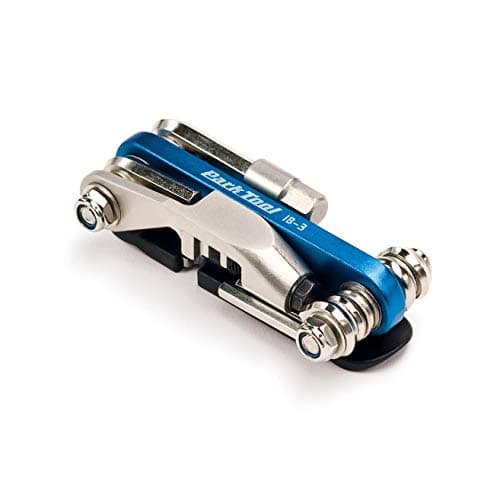
Park Tool IB-3 I-Beam
The hex keys. Almost every seatpost clamp is a 4, 5 or 6 mm hex, and this 13-function tool carries all three — it is the one our multitool roundup ranks for carrying, so it is probably already in your saddle bag.
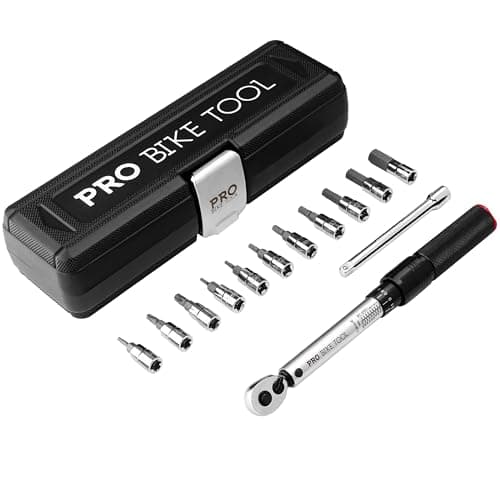
PRO BIKE TOOL Torque Wrench Set
For a carbon post or a carbon frame, where the clamp bolt has a printed figure. The 2.2–16.9 Nm range covers seatpost clamps; use the number on your component, not a table.
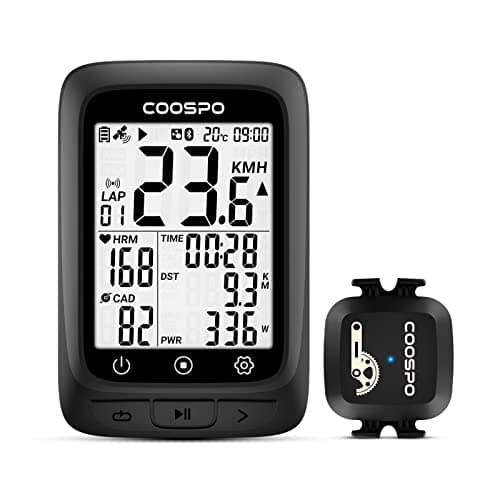
COOSPO BC107
For comparing one setting against the next over a week rather than from memory. Records the ride and pairs with a heart-rate strap over Bluetooth and ANT+, which is how you notice that a change made no measurable difference — which, inside 4% of leg length, the research says it probably did not.
$56.99 · View on Amazon$59.99 −5%
We haven’t tested any of these — they’re the parts the job above calls for, listed so you don’t have to go hunting. Prices are live from Amazon and we earn a commission if you buy. Prices as of October 18, 2026. #ad
What we are not going to tell you
A single number for your bike. We do not know your inseam, your femur length, your shoe stack or your cleat position, and all four feed into this. Anyone who gives you a figure without those has guessed.
That a particular height will make you faster.The 2022 review is explicit that inside 4% of leg length there is “no effect on oxygen uptake and efficiency”, and that there is only “limited evidence on the effects from changes in saddle height on supramaximal cycling performance or injury risk”. That second clause cuts both ways and we are quoting it rather than hiding it: the injury link is suggested by the mechanics, not established by the literature.
That you do not need a fitter. If you have persistent pain, the dynamic measurement the strong evidence points at is exactly what a fitter does for a living, with instruments and someone watching you pedal. This page gets you close; it does not replace that.
And the standing disclosure: we have fitted nobody and measured nobody. Every figure here is quoted from the published paper named beside it, retrieved on the date recorded below.
Common questions
What is the correct saddle height?
The height that puts your knee at roughly 25 to 35 degrees of flexion at the bottom of the pedal stroke, measured while you are pedalling. A 2022 systematic review of 41 studies found “strong evidence” that saddle height “should be configured using dynamic measurements of the knee angle”. There is no single number that applies to a rider of your height, because shoe stack, cleat position and femur length all feed into it.
Is the 109% of inseam rule accurate?
It is a starting point with published limitations. A 2013 study in the Journal of Strength and Conditioning Research found 56.5% of its well-trained cyclists were outside the 106–109% range, 26% had an inappropriate knee flexion angle, and concluded that the range “may not ensure an optimal knee flexion”. The same paper proposed a revised 108.6–110.4% of inseam — slightly higher than the familiar figure.
Is it better to have a saddle too high or too low?
On the published mechanics, too low is the worse error. A 2020 European Journal of Sport Science study measured greater knee adduction moments at a low saddle — 11.9 ± 1.9 Nm — for a longer duration, with larger knee flexion of 58.5 degrees, and frames that moment as the mechanism research associates with Patellofemoral Pain Syndrome. Too high produces hip rock and pain behind the knee, which is easier to spot and usually noticed sooner.
How much does saddle height actually matter?
Less than the internet suggests, within limits. The 2022 review found moderate evidence that changes under 4% of leg length produce “trivial to small changes in lower limb loads, and no effect on oxygen uptake and efficiency”. On an 80 cm leg that is around a 3 cm window. Get inside the window and stop measuring; the gains people chase in the last few millimetres are not visible in the published data.
How do I know if my saddle is too high?
Have someone watch you pedal from directly behind. If your hips rock from side to side, or you point your toes to reach the bottom of the stroke, the saddle is too high — both are the same compensation for a leg that has to reach. Pain behind the knee points the same way. Lower it 5 mm at a time and ride several times at each setting.
How do you measure saddle height?
From the centre of the bottom bracket to the top of the saddle, along the line of the seat tube. Record the figure and mark the post before you change anything, so an experiment is reversible. Also check your seatpost’s minimum-insertion mark — that is a structural limit, and if your correct height exceeds it you need a longer post rather than more post showing.
Sources
- Journal of Sports Sciences (2022) — “Methods to determine saddle height in cycling and implications of changes in saddle height in performance and injury risk: A systematic review.” 29,398 records screened, 66 full texts, 41 studies included. “Strong evidence suggests that saddle height should be configured using dynamic measurements of the knee angle”; “moderate evidence suggests that changes in saddle height less than 4% of the leg length results in trivial to small changes in lower limb loads, and no effect on oxygen uptake and efficiency”; “limited evidence on the effects from changes in saddle height on supramaximal cycling performance or injury risk” — retrieved 11 October 2026
- Journal of Strength and Conditioning Research (2013) — “Influence of saddle height on lower limb kinematics in well-trained cyclists: static vs. dynamic evaluation in bike fitting.” Saddle height outside the recommended 106–109% of inseam in 56.5% of subjects; inappropriate knee flexion angles in 26% using the dynamic method; saddle height, inseam length and knee angle highly related (R = 0.963, p < 0.001); proposed optimal range 108.6–110.4% of inseam; optimal knee flexion described as 30–40° — retrieved 11 October 2026
- European Journal of Sport Science (2020) — “Cycling with Low Saddle Height is Related to Increased Knee Adduction Moments in Healthy Recreational Cyclists.” 20 recreational cyclists, four saddle heights, 60 W at 60 RPM, motion analysis at 200 Hz and an instrumented pedal at 1000 Hz. Low saddle height produced greater knee adduction moments (11.9 ± 1.9 Nm, P < 0.05), longer duration (0.15 ± 0.01 s), larger knee flexion (58.5 ± 2.6°) and larger abduction angles (−4.5 ± 0.8°); the medium height condition was defined as 25° knee flexion at bottom dead centre — retrieved 11 October 2026
- The heel-on-pedal method is labelled convention on this page because no published validation of it was located. The 25–35° working target is the span across the papers above rather than a single consensus figure, which the papers do not provide
- Park Tool — Torque Specifications and Concepts, for the standing caveat that third-party torque tables are for reference only and the governing figure is the one supplied with the component. Cited elsewhere on this site with its original retrieval date — retrieved 5 October 2026
- Google Autocomplete — “saddle height” returns “saddle height calculator”, “saddle height bike”, “saddle height measurement”, “saddle height for road bike” and “saddle height formula”; “how to adjust saddle height” returns “bike” and “on road bike” — retrieved 11 October 2026
Read next
- How to choose a bike saddle
Which saddle, and why most saddle complaints are not about the saddle.
- How to measure your sit bones
The width number, which is the other half of a comfortable saddle.
- How to set up cycling cleats
Cleat position changes effective saddle height — do this one after that one.
- The bike bolt torque guide
For the seatpost clamp, especially on carbon.
- How to wrap bar tape
The other twenty-minute job that changes how a bike feels.
- The best cycling shorts
If the discomfort is saddle contact rather than knee angle, start here.
We haven’t ridden or tested any of the products on this page, and we don’t pretend otherwise. Read how we research — or tell us we’re wrong and we’ll log the correction.