E-Bike Tire Pressure
Every search for this wants a chart. We are not going to publish one, because the only number that applies to your tire is written on your tire — and we can prove no e-bike listing publishes it.
Heads up: we earn a commission if you buy through the links on this page, at no extra cost to you. It never decides what makes the list — here’s how that works.
The answer is moulded into the side of your tire. Find the two numbers printed on the sidewall — a minimum and a maximum, in psi and usually in bar too — and stay inside them. Then, within that range, run nearer the top than a rider on an unassisted bike would, because your bike weighs 20 to 30 kg more than theirs. That is the honest answer, it takes ten seconds to act on, and it is specific to your tire rather than to a category.
What we are not going to do is publish a chart. The internet is full of e-bike pressure tables and we cannot find the measurements behind any of them. Here is what we checked instead: all twelve e-bike listings in our catalog. Every one publishes a wheel or tire size. Not one publishes a pressure or a pressure range. So if we printed a number for you, it would not be coming from the people who built your bike.
Why the number is so much lower than you expect
If you came to an e-bike from a road bike, the pressure will feel wrong. A road tire runs at four to six times what a fat e-bike tire does, and the reason is geometry rather than engineering fashion.
Pressure times contact area is what holds the bike up. Widen the tire and you get more air inside it, so the same load needs less pressure to support it. The relationship is roughly square, not linear: the published sizes on this site include tires as narrow as a 27.5 inch wheel’s standard rubber and as wide as 26 x 4.0— about 100 mm. Set that against a 28 mm road tire and the cross-section is in the region of thirteen times larger, because (100 ÷ 28)² is about 12.8. Thirteen times the air does not need anything like the same pressure.
That arithmetic is the only thing on this page we can offer in place of a chart, and it is arithmetic from two published widths rather than a claim about ride quality. It is also why a pressure that is merely low for a road bike can be dangerously high for a fat tire: the sidewall maximum on a 4 inch tire is a small number, and a floor pump will sail past it without feeling like it is doing anything.
What all twelve listings publish, and what they don’t
Here is the full audit, from the stored live listing titles. We have added nothing.
Tire size published, pressure published
Twelve e-bikes. Twelve published wheel or tire sizes. Zero published pressures. The “Width published?” column matters because width is what decides the pressure range, and only three of the twelve print one.
| Bike | Wheel / tire as published | Width published? | Pressure published? |
|---|---|---|---|
| Heybike Mars 3.0 | 20" x 4.0 fat tire | Yes — 4.0 in | No |
| Heybike Ranger 2.0 | 20" fat tire | No — “fat” only | No |
| Heybike Cityscape 2.0 | 26" wheels | No | No |
| Vivi 27.5in Mountain | 27.5" wheels | No | No |
| Gotrax R7 | 20" wheels | No | No |
| Jasion EB5 | 26" tires | No | No |
| ENGWE L20 2.0 | 20" x 3.0 fat tire | Yes — 3.0 in | No |
| Cyrusher Kommoda 3.0 | 20" wheels | No | No |
| Hiboy Fat-Tire | 26" x 4.0 fat tire | Yes — 4.0 in | No |
| Schwinn Parkwood | 27" wheel | No | No |
| TotGuard 27.5in | 27.5" wheels | No | No |
| isinwheel Step-Thru | 30" step-thru | No | No |
Quoted from the stored live Amazon listing title of each bike. A wheel diameter without a width is not enough information to infer a pressure range from, which is why ten of these twelve rows cannot be turned into a number even in principle.
What actually decides this purchase
Four checks, in order
One: read the sidewall and write the two numbers down. They are moulded into the rubber near the rim, usually as a range like “MIN–MAX PSI”. That range is from the tire manufacturer, for that exact casing, and it outranks anything on this page or any other. If the tire is filthy, wipe it — the lettering is raised, not printed.
Two: start near the upper end, not the middle. This is the one piece of e-bike-specific judgement on the page, and here is the reasoning rather than an assertion: every published pressure range assumes a bicycle, and your bike has a motor and a battery bolted to it. Those are tens of kilograms the range was not drawn for, carried mostly low and towards the back. More load on the same air wants more pressure, so the top half of the range is the sensible starting point for an e-bike where the bottom half might suit an unassisted one.
Three: find out which valve you have before you buy a pump. Most e-bikes use the fat, blunt Schrader valve rather than the thin Presta a road bike uses, and most drop-bar pumps are optimised for the wrong one. The valve comparison explains the difference and it is a two-second check that saves a wasted purchase.
Four: check it monthly, with a gauge. This one is published. Schwalbe, in its own tire wear documentation, states that “checking and re-pumping the inflation pressure at least once a month with a pressure gauge is most important”, and in the same document that tire sidewalls “often fail before the tread is worn out”, with that premature wear “due to prolonged use of the tire with insufficient pressure”. Those are Schwalbe’s words about Schwalbe’s tires, and none of the tires on these twelve bikes is a Schwalbe — but the failure mechanism is not brand-specific, and it is the strongest published argument for owning a gauge that exists in this category.
The two tools this decision needs
Not a ranking, and deliberately only two items — because checking a tire pressure needs something that moves air and something that measures it, and on a fat e-bike tire those are genuinely two different purchases. Nothing else on this site helps with this job, so nothing else is listed.
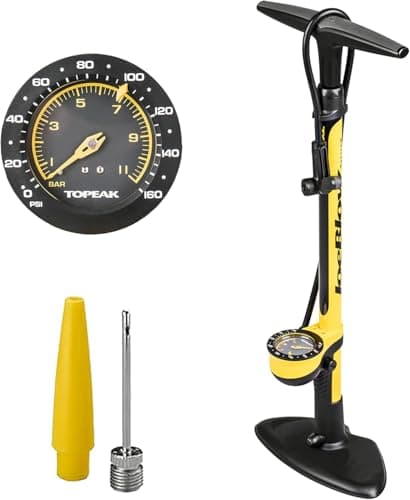
Topeak JoeBlow Sport Floor Pump
The air. Topeak publishes the head as fitting Presta, Schrader and Dunlop, which covers whatever is in your rim, and the 3 inch analog gauge is readable while kneeling next to a 4 inch tire. Rated to 160 psi, far beyond anything an e-bike tire wants.
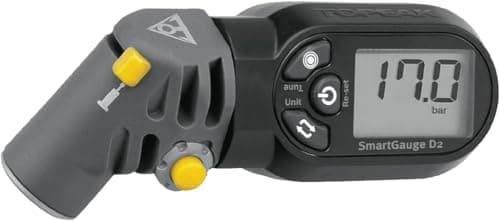
Topeak SmartGauge D2 Digital Gauge
The measurement. A digital readout removes the needle-parallax problem a floor pump dial has at low pressure, and the listing publishes Presta/Schrader compatibility. Be clear-eyed about it though: it is specified to 250 psi and publishes no accuracy figure, so on a 20 psi tire it is better than a pump dial rather than provably precise.
We haven’t tested any of these — they’re the parts the job above calls for, listed so you don’t have to go hunting. Prices are live from Amazon and we earn a commission if you buy. Prices as of October 18, 2026. #ad
Why we won’t point you at a calculator either
The two best pressure calculators we know of are honest about their own limits, and those limits exclude your bike. SILCA, which publishes the reasoning behind its tool, states that “the rougher the surface, the smaller the tire, the lower that breakpoint pressure is going to be” and, usefully for a nervous first-timer, that “it is always better to be too low than too high with your tire pressure”. Both of those are our road pressure guide’s foundations. But a calculator built for 23 to 50 mm tires on a 9 kg bike is being asked to extrapolate four times beyond its range when you feed it a 100 mm tire and a 35 kg bike, and SILCA does not claim it can.
Rene Herse Cycles, which does publish pressure guidance and does manufacture tires, is blunter still: their take-home advice is to “ride the tire pressure that feels good to you. When in doubt, let out some air”. They also record something worth knowing before you trust any chart anywhere: the widely repeated 15% tire-drop figure “was based on the recommendations of several tire manufacturers, but not on actual testing”. That is the honest status of most of the numbers in this field, and it is why the sidewall wins.
The three symptoms, and what each one means
Too low: the bike feels vague when you lean it, the tire visibly bulges at the contact patch, you get pinch flats on kerbs, and on a long enough timescale the sidewall fails — which is the Schwalbe mechanism quoted above. On a fat tire this is the common error, because a soft fat tire still looks inflated.
Too high: the ride gets harsh, grip gets worse rather than better on anything other than smooth tarmac, and you are closer to the sidewall maximum than you think. On a 4 inch tire, “too high” arrives at a number that would be laughably soft on a road bike — which is exactly why it is easy to overshoot.
Dropping steadily: all tubes lose air, and a bigger tube at low pressure shows it sooner in percentage terms. Weekly top-ups are normal; daily ones are a slow puncture, and the flat repair guide is the next page.
Common questions
What tire pressure should an e-bike be?
Whatever is moulded into your tire’s sidewall, and within that range, nearer the top than an unassisted bike would run. We are not going to publish a number, because none of the twelve e-bike listings on this site publishes a pressure or a pressure range — so any figure here would not be coming from the people who built your bike. The range on the sidewall is specific to your casing; a chart is not.
Why is fat-tire e-bike pressure so low?
Because a wide tire holds much more air, and pressure times contact area is what carries the load. The relationship goes roughly with the square of width: a 100 mm fat tire has something like thirteen times the cross-section of a 28 mm road tire, because 100 divided by 28, squared, is about 12.8. Thirteen times the air volume does not need anything like the same pressure to support the same weight.
Does an e-bike need higher pressure than a normal bike?
For the same tire, yes — because the bike is 20 to 30 kg heavier and the published pressure range was drawn for a bicycle. That is why the advice here is to start in the upper half of the sidewall range. It does not mean exceeding the maximum, which is a structural limit rather than a suggestion.
Can I use a car pressure gauge on an e-bike?
Mechanically often yes, because most e-bikes use the same Schrader valve a car does. Practically it is a poor instrument for the job: a gauge built for 30–40 psi car pressures has limited resolution at 20 psi, and most are not accurate down there. The same criticism applies to a 250 psi bicycle gauge, which we say plainly in the Essentials block above.
How often should I check my e-bike tire pressure?
At least monthly, with a gauge. That interval is Schwalbe’s published recommendation — “checking and re-pumping the inflation pressure at least once a month with a pressure gauge is most important” — and the reason it matters is in the same document: sidewalls often fail before the tread wears out, and the usual cause is prolonged riding at insufficient pressure.
Is there an e-bike tire pressure chart?
There are many, and we cannot find published measurements behind any of them. What is published is the range on your sidewall. If someone quotes you a specific psi for your bike, ask which manufacturer document it came from — it is not in the listing, because we checked all twelve.
Sources
- Tire-size and pressure audit — the stored live Amazon listing titles of all twelve e-bikes in content/catalogue.json. All twelve publish a wheel or tire size; three publish a tire width in inches (20 x 4.0, 20 x 3.0, 26 x 4.0) and two more say only “fat tire”; zero publish a pressure or pressure range
- Schwalbe — Tire Wear (“Checking and re-pumping the inflation pressure at least once a month with a pressure gauge is most important”; “The sidewalls of tires often fail before the tread is worn out. In most cases, this premature wear is due to prolonged use of the tire with insufficient pressure”). Cited elsewhere on this site with its original retrieval date; none of the tires on the twelve bikes above is a Schwalbe, and the page says so — retrieved 18 September 2026
- SILCA — Tire Pressure Calculator Explained (“The rougher the surface, the smaller the tire, the lower that breakpoint pressure is going to be”; “it is always better to be too low than too high with your tire pressure”; SILCA's own disclosure that it does not make wheels or tires — note that SILCA sells pumps) — retrieved 8 August 2026
- Rene Herse Cycles — Tire Pressure Take-Home (“ride the tire pressure that feels good to you. When in doubt, let out some air”; the 15% tire drop figure “was based on the recommendations of several tire manufacturers, but not on actual testing” — note that Rene Herse manufactures and sells tires) — retrieved 8 August 2026
- The cross-section comparison is arithmetic from two published widths — (100 mm ÷ 28 mm)² ≈ 12.8 — not a measurement of either tire
- Google Autocomplete — “e bike tire pressure” returns “calculator”, “chart”, “guide”, “gauge” and “electric bike tire pressure” — retrieved 5 October 2026
Read next
- Road bike tire pressure guide
The same question on a 25 mm tire, where the calculators actually apply.
- Gravel tire pressure guide
The middle case, and the honest status of the 15% tire drop rule.
- Presta vs Schrader valves
Which valve your e-bike has, and which pump heads will fit it.
- The best e-bike accessories
Where the pump and the gauge sit in the wider short list.
- When to replace bike tires
Schwalbe's published wear limits, and why sidewalls fail first.
- How to fix a flat
What a tire that needs daily topping up is actually telling you.
We haven’t ridden or tested any of the products on this page, and we don’t pretend otherwise. Read how we research — or tell us we’re wrong and we’ll log the correction.