Presta vs Schrader Valves
One is thin with a little nut on top, the other is fat like a car tire. The difference is two millimetres of stem and a hole in your rim that you cannot easily change your mind about.
Heads up: we earn a commission if you buy through the links on this page, at no extra cost to you. It never decides what makes the list — here’s how that works.
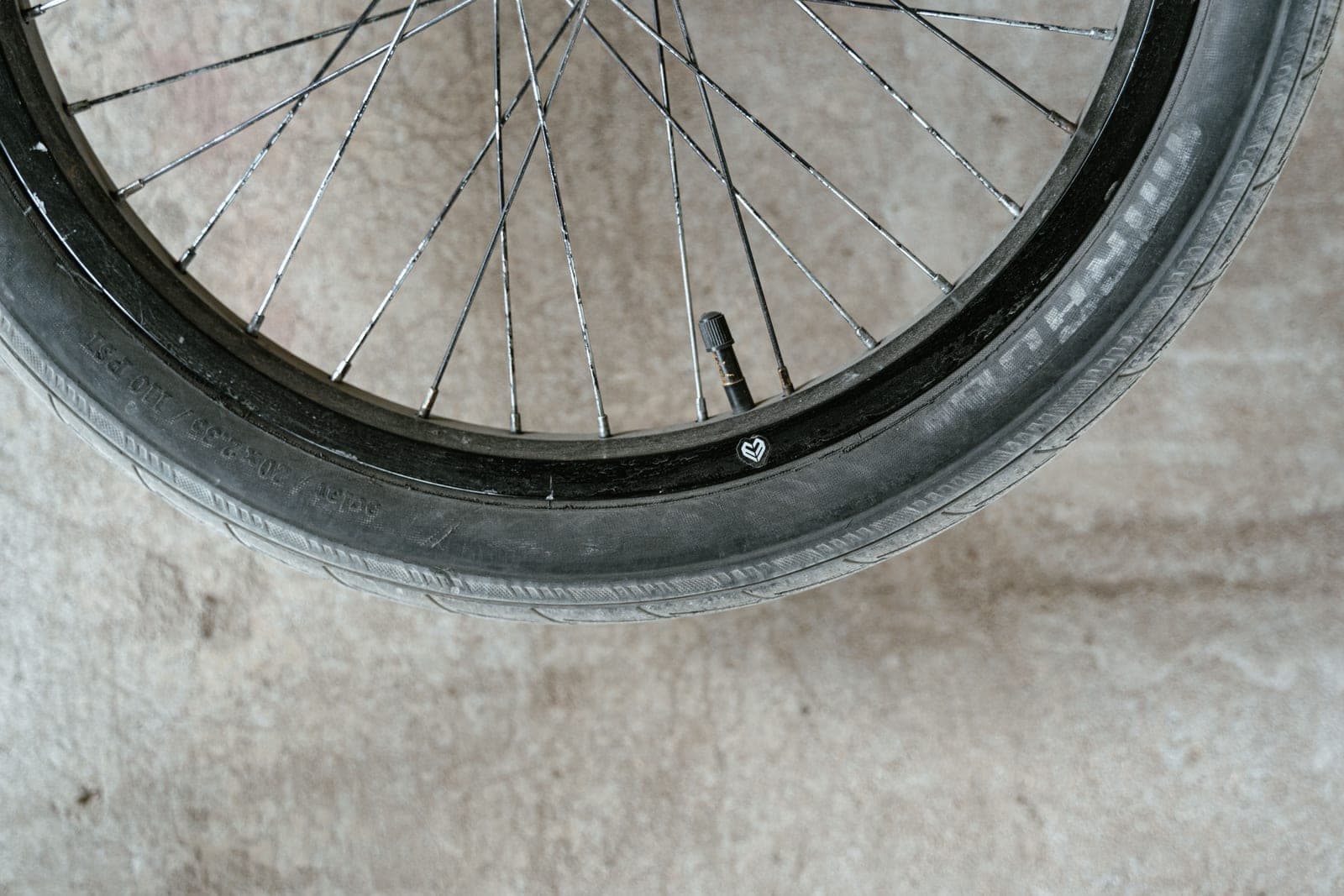
Look at the valve sticking out of your rim. If it is thin and has a small knurled nut on top that you have to unscrew before air will go in, it is Presta. If it is fat and blunt like the one on your car, it is Schrader. That is the whole identification step, and it decides which tubes you can buy, which pump heads work and which gauge will read your pressure.
The figures below are Park Tool’s published ones, not ours. We have not measured a valve and we hold no test data on which seals better — and fortunately none is needed, because this is a compatibility question with published answers.
The published difference
Park Tool sets out three valve types in its tire, wheel and inner tube fit standards: Schrader, Presta and the Woods or Dunlop valve you will mostly meet outside the United States. The Schrader, which Park Tool calls the “American-type valve”, is “approximately 8 mm (5/16 inch) in diameter” and carries a sprung internal plunger that shuts the valve after inflation. The Presta, the “French-type valve”, is “nominally 6 mm in diameter” with a small locknut at the top that must be unthreaded before air can enter.
Two millimetres does not sound like a decision you have to live with, and yet it is, because the hole drilled in your rim is sized for one of them. A Presta valve rattles around in a Schrader hole; a Schrader valve will not go through a Presta one at all.
Which one is on your bike, and why
Park Tool puts it plainly: Presta is “common on mid- and higher-priced road bikes and on higher-priced mountain bikes”, while Schrader “is common on cars and motorcycles” and is also found on many bicycles. In practice, in the US: a road bike, a gravel bike or anything with drop bars is almost certainly Presta. A department-store bike, a kids’ bike, a cruiser or most e-bikes with fat tires is likely Schrader.
There is no performance argument to be had here and we are not going to manufacture one. The smaller Presta valve needs a smaller hole, which removes less material from the rim — that matters on a narrow road rim and matters not at all on a wide one. Everything else is convention.
What to check before you buy anything
One: the valve type in your wheel right now. That is what your next tube has to match, unless you are changing the rim.
Two: the valve length. Park Tool notes that rims “with a very tall cross section require longer valve stems (60 mm or 80 mm)”. A 42 mm stem on a deep aerodynamic rim will not protrude far enough to take a pump head. Look at the tube that is in there and measure it.
Three: whether your pump head fits both. Most decent floor pumps do, either by a reversible head or a dual-sided one. The pump you keep in the garage and the pump you carry are two different purchases — our floor pump vs mini pump comparison covers that split.
Four: the tire width band on the tube. This has nothing to do with the valve and everything to do with whether the tube works. Our inner tube roundup ranks the aisle on fit before material, for exactly this reason.
One place this check matters more than anywhere else: an e-bike. Most are Schrader, the tires are often two to four times wider than a road tire, and the pressures are correspondingly low — which is a combination that makes both the pump head and the gauge resolution decisions rather than details. E-bike tire pressure is the page for that, and it includes the finding that not one of the twelve e-bike listings in our catalog publishes a pressure at all.
The four parts this decision actually touches
Not a ranking — these are the items whose choice is decided by the four checks above. Two tubes, one in each valve standard, plus the two tools that have to speak both languages. Buy the tube that matches your rim, not the one that matches this page.
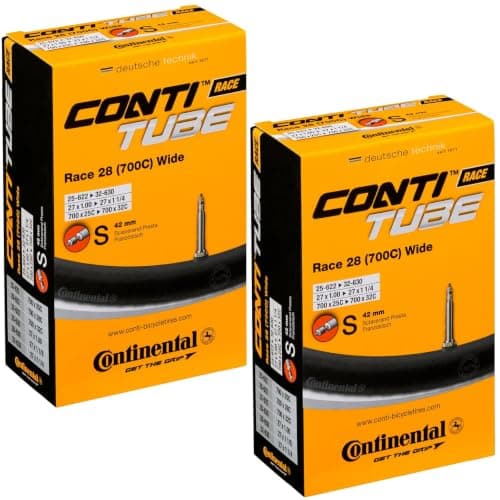
Continental Race 28 Inner Tube
The Presta side: the listing publishes a 700x25-32c width range and a 42 mm Presta stem. Right for a shallow road rim; too short for a deep-section one.
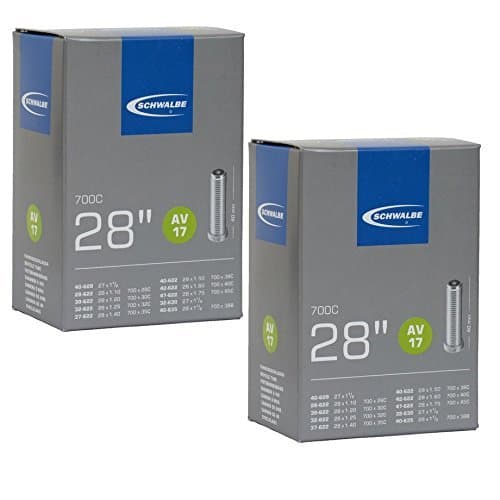
Schwalbe AV17 Inner Tube
The Schrader side: 700 x 28-45c / 28in / 27in with a Schrader valve, two per pack. This is the tube for a hybrid, a cruiser or a bike with a car-type valve.
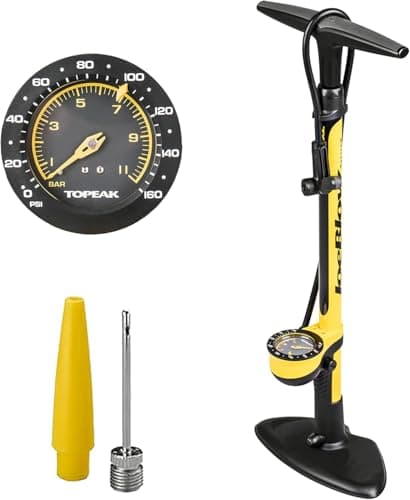
Topeak JoeBlow Sport Floor Pump
A floor pump whose head Topeak publishes as fitting Presta, Schrader and Dunlop, so it works whatever is in the rim. 160 psi rated with a 3 inch analog gauge.
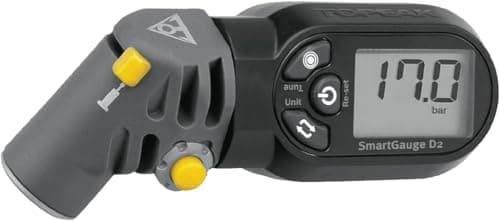
Topeak SmartGauge D2 Digital Gauge
A digital gauge published as Presta/Schrader compatible and reading to 250 psi / 17 bar — for checking pressure without relying on the pump's own dial.
We haven’t tested any of these — they’re the parts the job above calls for, listed so you don’t have to go hunting. Prices are live from Amazon and we earn a commission if you buy. Prices as of October 18, 2026. #ad
Can you put a Presta tube in a Schrader rim?
Yes, and Park Tool says how: “It is also possible to use the smaller Presta valve in a rim intended for the larger Schrader by using an adapter sleeve.” The sleeve fills the gap so the valve does not flop sideways in the oversized hole. It is a cheap part and a legitimate fix.
The other direction is the hard one. A Schrader valve physically will not pass through a Presta-sized hole, so the rim has to be drilled — and there is a published limit. Park Tool states a rim “can be typically drilled and enlarged safely to the 8 mm size by using an 11/32 inch (8.5 mm) hand drill”, with a round file afterwards to remove sharp edges, but adds the safety line that matters: “Rims that are less than 15 mm outside width should not be drilled.” That is a structural limit, not a preference. If your rim is narrower than that, buy Presta tubes.
Inflating each one without swearing
Presta. Unscrew the small locknut at the top until it stops — it does not come off. Press it once to release a puff of air, which confirms it is open and unsticks the seal. Push the pump head on square and lock it. When you are done, pull the head off cleanly and thread the locknut back down finger-tight.
Schrader. Unscrew the dust cap, push the pump head on, lock it, inflate. The sprung core closes itself. There is nothing to open and nothing to bend, which is the main practical advantage the standard has.
Park Tool also notes something worth knowing about Presta tubes: some use a removable valve core, identifiable by two wrench flats at the end of the stem. That is what makes a tube usable with sealant and with a threaded valve extender — and it is also the part that unscrews itself when you yank a stuck pump head off, which is the usual explanation for a tube that mysteriously deflates in the workshop.
The locking ring, and why it should be finger-tight
Many Presta tubes come with a knurled ring that threads onto the stem against the rim. Park Tool’s sequence is specific: loosen and remove the ring before installing the tube, install and fully inflate, then fit the ring and “snug only by hand”. Doing it up with a tool holds the valve rigid against a tube that wants to move, and the stem tears at its base. When you deflate, remove the nut first.
Valve extenders: the trap
Deep rims tempt riders into extenders rather than the right-length tube. Park Tool distinguishes two kinds and warns about one: extenders that screw into the inner threads of a removable-core valve work properly, while the simple tube-style extenders that do not let the Presta locking nut be tightened “may allow the tube to leak slowly”. If you have a mystery slow puncture on a deep-section wheel with an extender, that is the first thing to check.
The short version
Buy the valve your rim already takes. Match the length to your rim depth. Get a pump head that does both so the question never comes up again. Sheldon Brown’s tire reference is the classic long-form treatment if you want the historical version, and Park Tool’s tire and tube procedure is what to follow when you are actually doing the job — as does our own how to fix a flat.
Common questions
What is the difference between Presta and Schrader valves?
Schrader is the fat car-type valve, published by Park Tool as approximately 8 mm (5/16 inch) in diameter with a sprung internal core. Presta is the thin French-type valve, nominally 6 mm, with a locknut at the top you unthread before inflating. They need different rim holes and different pump heads.
Can I use a Presta tube in a Schrader rim?
Yes. Park Tool notes you can use the smaller Presta valve in a Schrader-drilled rim with an adapter sleeve, which fills the oversized hole so the valve cannot flop sideways.
Can I drill my rim to fit a Schrader valve?
Sometimes. Park Tool says a rim can typically be drilled to 8 mm with an 11/32 inch (8.5 mm) drill and deburred with a round file — but that “rims that are less than 15 mm outside width should not be drilled”. Narrow road rims are therefore Presta-only.
Why won't my Presta valve take air?
Almost always because the locknut at the top has not been unthreaded, or the valve has stuck shut. Unscrew the nut to its stop and press it once to release a puff of air, then fit the pump head square and lock it.
What length valve do I need?
Enough to protrude through the rim far enough for a pump head to lock on. Park Tool notes that rims with a very tall cross-section need 60 mm or 80 mm stems; a shallow road rim is fine with something in the 40s. Measure the tube already in your wheel.
Is one valve better than the other?
Neither is better, and no maker publishes a comparison that would settle it. Presta needs a smaller rim hole and is the road convention; Schrader is simpler to inflate and is what every gas station air line fits. Buy what your rim takes.
Sources
- Park Tool — Tire, Wheel and Inner Tube Fit Standards (Schrader “approximately 8mm (5/16 inch) in diameter” with “an internal spring plunger”; Presta “nominally 6mm in diameter” with a locknut “which must be unthreaded before air can enter the tube”; “Install and fully inflate the tube. Then install the lockring and snug only by hand”; removable valve cores identified by two wrench flats; rims “with a very tall cross section require longer valve stems (60 mm or 80 mm)”; extenders that do not allow the valve nut to be tightened “may allow the tube to leak slowly”; a Presta-drilled rim “can be typically drilled and enlarged safely to the 8 mm size by using an 11/32 inch (8.5 mm) hand drill”; “Rims that are less than 15 mm outside width should not be drilled”; “It is also possible to use the smaller Presta valve in a rim intended for the larger Schrader by using an adapter sleeve”) — retrieved 18 September 2026
- Park Tool — Tire and Tube Removal and Installation — retrieved 18 September 2026
- Sheldon Brown — Tires and tubes reference — retrieved 18 September 2026
- Published product claims for the four items above — each product's own live Amazon listing via the Amazon Creators API (the Continental's “42mm Presta Valve”, the Schwalbe AV17's Schrader valve and 700 x 28-45c range, the Topeak JoeBlow's “Fits Presta, Schrader, & Dunlop Valves” and 160 PSI rating, and the SmartGauge D2's “Presta/Schrader Compatible, 250 Psi/17 Bar”) — retrieved 17 July to 2 September 2026
- Google Autocomplete — “presta vs” returns “presta vs schrader” first, with valve pump, valve stem, tubes, pros and cons and adapter variants behind it — retrieved 18 September 2026
Read next
- The best bike inner tubes
Eight tubes ranked on fit first — bead seat diameter, width band, valve type and length.
- E-bike tire pressure
Where the Schrader valve and a 4 inch tire make this a decision rather than a detail.
- How to fix a flat
The job where all of this stops being theoretical.
- The best bike pumps
Five pumps, split on the charge chamber rather than headline psi.
- Floor pump vs mini pump
Why the pump in the garage and the pump on the bike are different purchases.
- Road bike tire pressure guide
Once you can get air in, this is how much of it to use.
- What to carry on a bike ride
The spare tube that has to match the valve you just identified.
We haven’t ridden or tested any of the products on this page, and we don’t pretend otherwise. Read how we research — or tell us we’re wrong and we’ll log the correction.