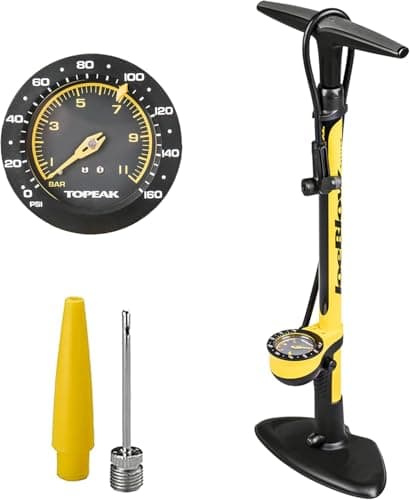
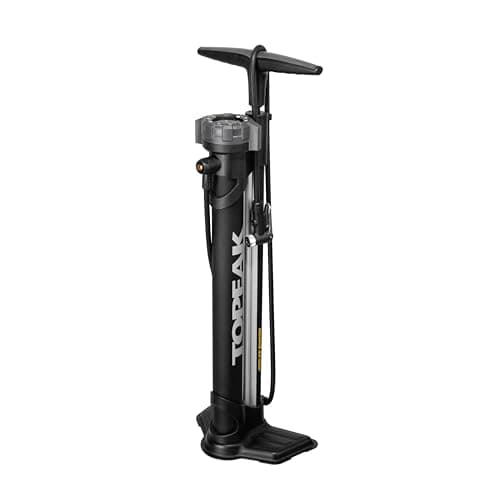
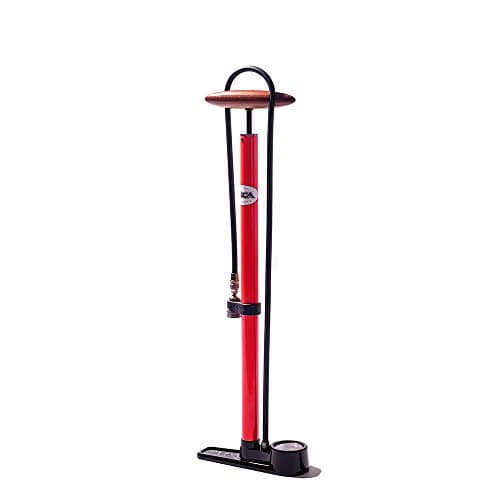
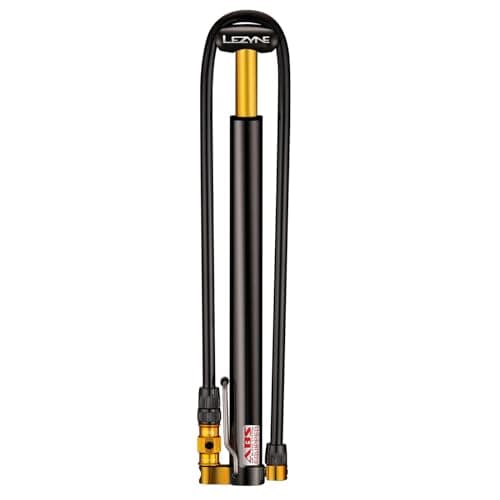
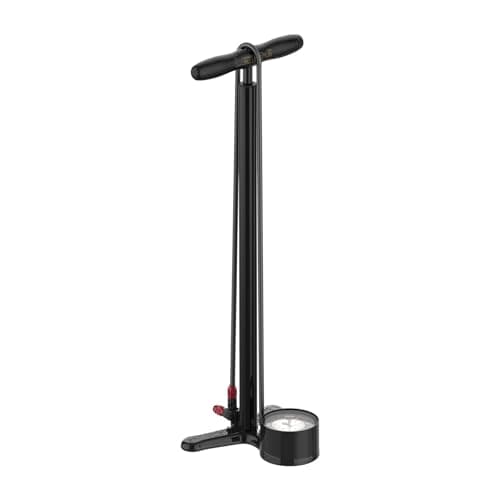
Every pump in this roundup can inflate your tire. Exactly one of them can seat a tubeless tire.That single capability is what splits the category, and it has nothing to do with the number printed on the gauge — a 220 psi pump is no better at popping a bead onto a rim than a 100 psi one. What seats a tubeless tire is a sudden large volume of air, which is why one pump here carries a one-liter chamber and the others do not.
Everything else in the category is a comfort question: how readable the gauge is, whether the chuck threads on or clamps, how stable the base feels, and whether the thing can be rebuilt in five years. Those are the axes below, using each maker’s published figures.
Maximum pressure is the least important number on the box
Road tires run somewhere around 60–100 psi depending on width and rider weight; gravel tires 25–45; mountain tires often under 25. Our road tire pressure guide and gravel pressure guide work through the actual arithmetic. Against those numbers, a pump rated to 160 psi already has enormous headroom and one rated to 220 psi has more than double.
So why does the ceiling matter at all? Because a pump working at a third of its rated pressure lasts longer and feels better than one working near its limit — seals, hoses and gauges all live an easier life. Treat the psi rating as a proxy for build strength, not as a feature you will use.
The gauge problem nobody mentions
Analog floor pump gauges are least accurate at the bottom of their range, which is exactly where gravel and mountain tires live. A gauge marked to 160 psi is being asked to resolve a 2 psi difference at 22 psi, and it generally cannot. Two things help: a physically bigger dial (the top pick’s 3.5″ face resolves far better than a 2″ one), and a published accuracy figure — Silca is unusual in quoting a 2% gauge.
If you are chasing a specific low pressure on wide tires, a separate digital gauge is a more honest tool than any pump dial, and it is a cheap addition to a bench.
Chucks: threaded, clamped, and why one pops off
The head is the part of a pump you interact with most and the part most likely to annoy you. A threaded chuck(Lezyne’s ABS-1 Pro on the top pick) screws onto the Presta valve thread: slow to fit, but it will not blow off at 90 psi and it does not bend the valve stem. A clamp or lever chuck is quicker and more convenient, and it is what most floor pumps use; the failure mode is popping off mid-stroke and dumping the tire.
The other feature worth understanding is the air-bleed button that appears on better pumps — Lezyne’s ABS system exists to release the pressure trapped in the hose before you remove the chuck, which is what saves the valve core from unscrewing itself when you pull the head off. If you have ever removed a pump and had the core come with it, that is the problem it solves — and it is also why removable valve cores exist at all, which our Presta vs Schrader guide explains alongside which head your rim actually needs.
Seating a tubeless tire, honestly
A tubeless tire has to be forced outward hard enough for its bead to snap into the rim hook and seal. A shop does that with a compressor. At home you have three options: a charge-chamber pump like the Booster, a separate charging canister, or the technique route — removing the valve core, using a tight strap around the tire center, and a lot of fast strokes. Our tubeless setup guide covers the technique version in full, and tubeless versus tubes covers whether you want any of this in your life.
What matters here is the buying decision: if you will set tires up yourself more than once a year, the chamber pump pays for itself against shop labor. If you run tubes, it is the one genuinely skippable product on this page.
Floor pump, mini pump, or both
Both, and this roundup deliberately includes one of each. The floor pump lives at home and does 95% of the inflation you will ever do. The travel pump exists for flats away from home and for trips — and the mini-floor format (a footpeg and a T-handle) is far less miserable at road pressures than a true hand pump. Our floor pump versus mini pump comparison makes the case in detail, and how to fix a flat covers what to carry alongside it.
What we could not check
We have not measured a gauge, timed a bead seating, or pressure-tested a hose. Every figure above is the manufacturer’s published specification or the seller’s listing, quoted with its source and retrieved on 18 August 2026. Where a claim is a maker’s rather than a measurement — Silca’s 2% gauge accuracy, Topeak’s one-liter chamber — the wording says whose claim it is.