Cycling power meter types, explained
Every mainstream power meter publishes an accuracy claim between ±1% and ±1.5%, so the headline number decides almost nothing. Where the strain gauge sits — and whether it watches one leg or two — decides almost everything.
Heads up: we earn a commission if you buy through the links on this page, at no extra cost to you. It never decides what makes the list — here’s how that works.
A power meter is a strain gauge — a small sensor that measures how much a piece of metal flexes — bonded somewhere in the path that runs from your foot to the rear wheel. That is the whole device. Everything a buying guide calls a “type” is really just an answer to one question: where in that path did they put the gauge?Pedal, crank arm, spider, or hub. Each spot flexes under your effort, so each spot can be turned into a wattage reading. But each spot can only see the force that reaches it — and that is the difference the marketing buries under a percentage.
Here is the percentage, gathered from the manufacturers’ own pages. Favero rates the Assioma DUO pedals at ±1%. Garmin says its Rally pedals capture data “within 1% accuracy”. 4iiii rates the Precision 3+ crank arm at ±1.0% from 0 to 4,000 watts. Stages rates its Power LR at ±1.5%, and Quarq rates the DZero spider at ±1.5%. Notice the spread: it is half a percentage point across the entire market. If you were choosing on the accuracy number, you would be choosing on nothing.
Where the gauge sits, and what that buys you
Walk the force from the outside in. Every placement is a real product category; each has a mechanical consequence you can reason about without ever testing one.
Pedal-based.The gauge lives in the pedal spindle, the very first metal your foot loads. Because there is a pedal on each side, a dual pedal set can measure the two legs genuinely independently — each spindle only ever sees its own leg. It is also the only power meter you can move between bikes with a pedal wrench in about two minutes, which is why Garmin’s own headline for the Rally is that the pedals are “rechargeable and easy to transfer.” The catch is that a pedal meter marries you to that pedal’s cleat system, and a spindle hanging out in the open is the part of the bike most likely to meet a rock or a curb.
Crank-arm.The gauge is bonded to the flat of a crank arm — almost always the left, non-drive arm, because it is cheap to reach and does nothing else. 4iiii describes exactly this: the Precision is a left-arm meter that reads your left leg. The arm flexes under that leg’s effort and the gauge reads the flex. It is the least expensive way into power, it is completely hidden and protected, and it moves between bikes only if you are willing to swap the crank arm onto a compatible crankset. The thing it cannot do is see your right leg at all, which is the whole of the next section.
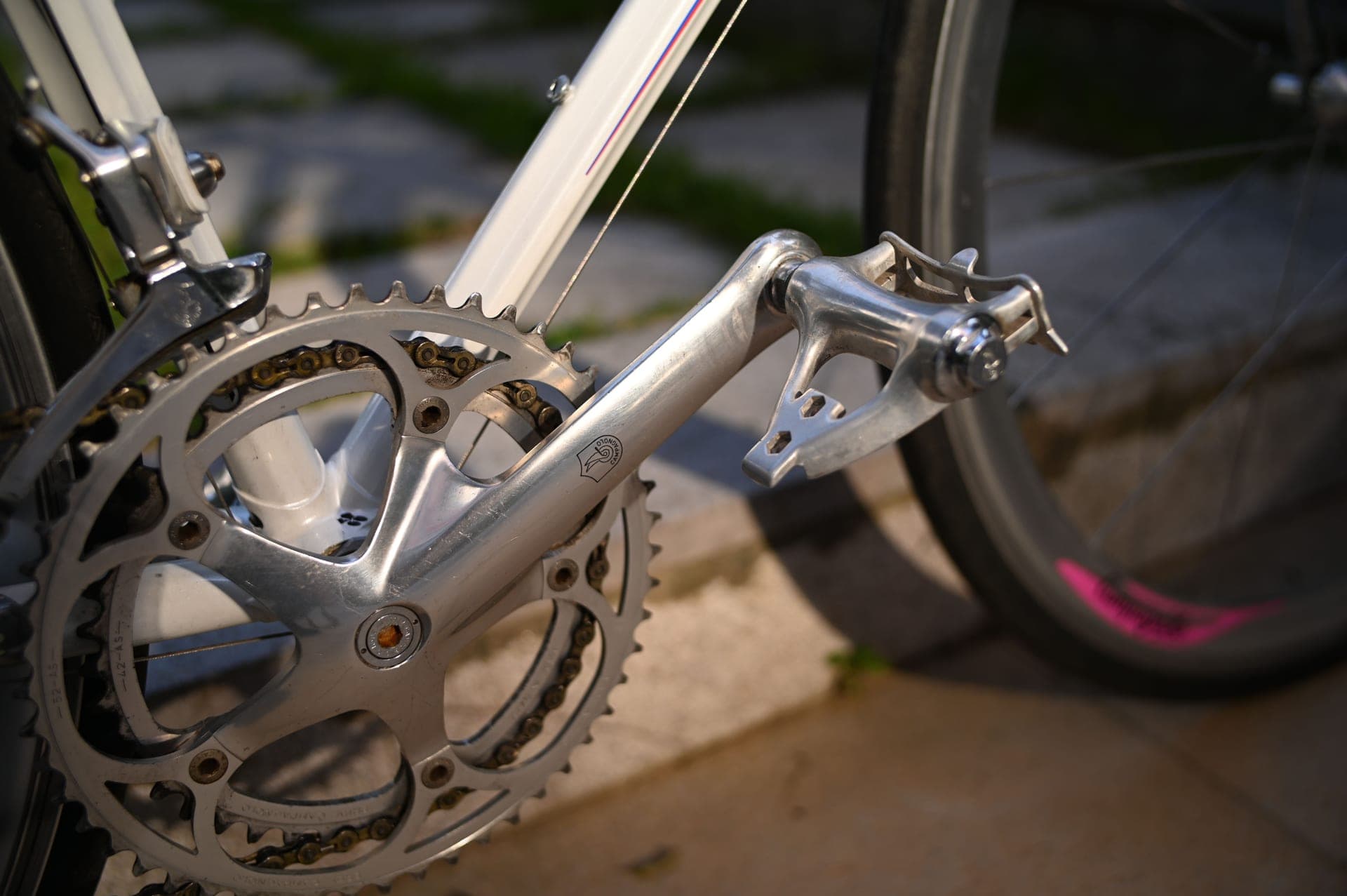
Spider / chainring. The spider is the star-shaped piece that connects the crank axle to the chainrings, and it is the last place the force from bothlegs passes through before it becomes chain tension. A gauge here therefore reads the combined torque of both legs. Quarq’s DZero sits here and its page states it is accurate “within ±1.5% measuring both legs.” A spider meter travels with the crankset, so moving it between bikes means moving the cranks — more involved than pedals, less involved than rebuilding a wheel.
Hub.Furthest downstream of all: the gauge lives in the rear hub, reading the torque in the wheel after your legs, chain and cassette have all had their say. In principle this is the tidiest place to measure — it sees the power that actually reaches the road. In practice the category has all but vanished. SRAM, which had bought PowerTap from Saris in April 2019, discontinued the PowerTap G3 hub (and the P2 pedals) on 15 February 2021, per road.cc. A hub meter is also the least portable design there is: it is welded to one specific wheel, and that wheel has to fit the bike.
Single-sided vs dual-sided: the assumption hiding under the ±1%
This is the part that matters, and it has nothing to do with the accuracy spec. A left-arm meter, or a single left pedal, physically measures one leg. To hand your computer a total, it doubles the leg it can see.4iiii states the mechanism plainly: “to calculate the total power output of a rider, the single-sided data is doubled,” and gives the example that a left arm reading 125 W becomes a displayed 250 W. Read that again. The number on your screen is your left leg, times two.
That doubling is only correct if your legs are perfectly matched — a clean 50/50 split. Most people’s legs are not. If your left leg is quietly doing 48% of the work and the meter assumes 50%, your total is wrong, and it is wrong by a margin that has nothing to do with the ±1% on the box. The gauge can be a flawless ±1% at reading the left leg and still hand you a total that is off, because the error is not in the measurement — it is in the assumption stapled to it. 4iiii is fair about this: it argues most imbalances are “fairly minor” and that power is mostly a reference to yourself over time. That is true. It is also exactly why a single-sided meter is fine for tracking your own trend and a poor choice for anyone who wants a real left/right balance number.
A dual-sidedsetup — two pedals, or two instrumented crank arms like the Stages Power LR — removes the assumption by putting a gauge on each side. Garmin draws the same line across its own range: the single-sensing Rally 110 measures power from one side, while the dual-sensing Rally 210 adds left-versus-right balance and the rest of the pedaling-dynamics metrics. You pay more for the second gauge, and what you are buying is not more accuracy in the ±1% sense — you are buying the deletion of a guess.
One honest nuance on the spider and hub meters, because it cuts the other way. A spider sits downstream of both legs on a single shared part, so it reads their combined torque directly, but it has no separate gauge per leg — any left/right split it reports is inferred from wherein the pedal stroke the force appears, not measured on each side in isolation. A hub is further removed still. So “measures both legs” means something stronger for dual pedals and dual arms (two real gauges) than it does for a spider (one gauge, inferring the balance). Worth knowing before you pay for a balance figure you assume is measured when it is partly calculated.
What the accuracy number is actually for
Since every meter here claims ±1% to ±1.5%, it is worth being clear about what that claim even does for you. Power training runs on two different things, and they are not the same. Consistency— the meter reading the same watts for the same effort today, tomorrow, and after a cold start — is what lets you compare Tuesday to Tuesday, chase a personal threshold, and trust an interval. Absolute accuracy — the meter agreeing with some external truth, or with your friend’s meter, or with the trainer at the gym — is a different property, and it is the one that goes visibly wrong when two devices with two different ±1% offsets disagree by a few watts.
For almost everyone the first property is the one that matters, and it is largely independent of the headline percentage. A meter that reads 3% high but reads it the same way every single timewill train you perfectly well, because your zones are built on its numbers, not on anyone else’s. This is why we are not going to rank these tools by accuracy. We have measured none of them; the manufacturers’ figures are all within half a point of each other; and the property that actually governs a good training experience — repeatability across temperature and time — is not the number printed on the box. Where the absolute figure earns its keep is the day you switch meters, ride a friend’s bike, or race on power against other people — then two honest ±1% devices can still show you different watts, and neither is lying.
Moving it, powering it, and reading it
Three practical things separate these placements once accuracy is off the table.
Transferability. Pedals move in minutes; a crank arm moves if the crankset is compatible; a spider moves with the whole crankset; a hub moves only if you move that wheel onto a bike it fits. If you own one bike, none of this matters. If you have a road bike and a trainer bike, or a race bike and a winter bike, the pedal meter is the one you can carry between them, and that portability is often worth more than any spec on the page.
Battery.Placements split into two camps. Some meters carry a built-in rechargeable cell — Garmin made “rechargeable” the literal headline of the Rally 110/210 launch — and you top them up like a phone. Others run on a replaceable coin cell you swap when it dies. Neither is better in the abstract; a rechargeable never needs a spare battery in your saddlebag, and a coin cell never leaves you unable to ride because you forgot to charge. Just know which one you are buying so it is a choice and not a surprise.
Reading the number.A power meter is deaf and mute on its own — it does nothing but broadcast watts over ANT+ or Bluetooth. Something has to catch that signal, show it, and record it, which is a bike computer’s entire job. You do not strictly need a dedicated unit; a phone can pair to the same broadcast, and we lay out the real trade-off in bike computer vs phone. But the meter is only half the purchase. Budget for the head unit that turns its signal into a number you can act on, and while you are budgeting, it is worth seeing where a power meter sits against groupset spend— on many bikes a spider or crank meter costs about what a full groupset tier upgrade does, and it will change your training far more than a shinier derailleur.
What we haven’t done
We have not tested a power meter, compared two on the same crank, or measured anyone’s left/right balance. Every percentage on this page is a manufacturer’s own published claim, quoted from the page linked beside it and read on 8 August 2026 — Favero, Garmin, Stages, 4iiii and Quarq. Everything else is mechanism you can verify by following the force from your foot to the road and asking, at each gauge, what can this one actually see?
Power meter placements, on the things that actually differ
No scores — we’ve tested nothing. Accuracy figures are the manufacturer’s own published claim, quoted from their page and dated 8 Aug 2026. Where a number isn’t published by a live manufacturer, the row says so rather than inventing one.
| Placement | Measures L/R? | Moves between bikes? | Claimed accuracy (published) | Notes |
|---|---|---|---|---|
| Pedal, dual-sided | Yes — a gauge in each spindle | Easiest — pedal wrench, ~2 min | Favero Assioma DUO ±1%; Garmin Rally within 1% | Two real per-leg gauges. Ties you to that cleat system; spindle is exposed. |
| Pedal, single-sided | No — left pedal doubled | Easiest — pedal wrench | Within 1% at the sensor (Garmin Rally 100-series) | Cheaper entry; some upgrade to dual later. Total assumes 50/50 legs. |
| Crank arm, single-sided | No — left arm doubled | Only if the crank arm swaps onto a compatible crankset | 4iiii Precision 3+ ±1.0% (0-4,000 W); Stages L ±1.5% | Least expensive route to power; hidden and protected. Doubling assumes matched legs. |
| Crank arm, dual | Yes — a gauge in each arm | Moves with the crankset | Stages Power LR ±1.5% | True per-leg measurement on a crank rather than pedals. |
| Spider / chainring | Combined — balance inferred, not per-leg gauged | Moves with the crankset | Quarq DZero ±1.5% ("measuring both legs") | One gauge downstream of both legs; reads total directly, infers L/R from pedal-stroke timing. |
| Hub | No — combined, at the wheel | Only by moving that wheel | Manufacturer-published, but PowerTap discontinued (2021) | Measures power reaching the road; category largely gone since SRAM ended PowerTap. |
Every accuracy figure is the seller’s own published claim, not our measurement. The claims cluster inside half a percentage point — which is the point of the table. The column that changes your experience is “Measures L/R?”, not the accuracy column, because that is the one carrying an assumption instead of a measurement.
What actually decides this purchase
Don’t choose on the accuracy percentage.Favero, Garmin, 4iiii, Stages and Quarq all publish ±1% to ±1.5%. That half-point spread is not the difference between these tools, and any guide that ranks them by it is ranking noise.
Decide single vs dual first, because that is the real fork.A single-sided meter doubles one leg — 4iiii’s own example is 125 W read, 250 W shown. If you just want a repeatable number to train against and watch trend over months, that is genuinely fine and it is the cheapest way in. If you specifically want left/right balance, or you know your legs are uneven, a single-sided meter will quietly lie to you and no accuracy spec will save it. Buy dual.
Match the placement to how many bikes you own. One bike: pick on price and buy the crank-arm meter. Several bikes, or a bike plus an indoor trainer: buy pedals, because they are the only meter you can move in two minutes, and that portability outweighs almost every spec. It matters more than it sounds indoors, too — only one of the ten trainer listings on that page publishes a power accuracy figure at all, so a pedal meter is often the only measured number in the room.
Know which battery you are signing up for. Rechargeable (Garmin made it the Rally headline) means charging like a phone and never carrying a spare. A coin cell means a swap every so often and never being caught flat by a dead charger. Pick the annoyance you prefer.
Budget the head unit too. The meter only broadcasts watts; a bike computer (or, per bike computer vs phone, a phone) is what reads and records them. And weigh the whole thing against groupset spend— power will do more for your riding than the next mechanical tier will.
For the specific pedal-against-pedal question, Favero Assioma vs Garmin Rally compares them on published figures only — and finds all four meters in our catalog publish the identical ±1% accuracy claim with no validation behind any of them.
Common questions
Which power meter type is the most accurate?
On the manufacturers’ own published figures, they are effectively tied — Favero ±1%, Garmin “within 1%”, 4iiii ±1.0%, Stages and Quarq ±1.5%. That half-point spread is not where the real difference lives. A dual-sided meter (two pedals or two crank arms) is more truthful about your totalthan a single-sided one, not because its gauge is better but because it doesn’t have to assume your legs are matched. We have tested none of these, so we won’t rank them by accuracy; we’ll only tell you what each one can physically see.
What does single-sided vs dual-sided actually mean?
A single-sided meter measures one leg — usually the left crank arm or a single left pedal — and doubles it to show a total. 4iiii’s own example: a 125 W reading is displayed as 250 W. That is only correct if both legs make identical power. A dual-sided meter puts a gauge on each side, so it measures both legs for real and can report left/right balance. You pay more for the second gauge; what you get is the removal of the 50/50 assumption.
Do I need a dual-sided power meter?
Only if you want a genuine left/right balance number, or you know one leg is stronger and you care about a correct total. For the far more common goal — a consistent number to set training zones and watch your fitness trend over time — a single-sided meter is fine, because your zones are built on its readings, not on anyone else’s. It is also the cheapest way into power.
Can I move a power meter between bikes?
It depends entirely on placement. Pedal-based meters unbolt with a pedal wrench in a couple of minutes — Garmin literally markets the Rally as “easy to transfer.” A crank-arm meter moves only if the arm fits your other crankset; a spider meter moves with the whole crankset; a hub meter moves only if you move that wheel to a bike it fits. If you run more than one bike, this is often the single most important thing on the spec sheet.
Why do two power meters show different watts for the same ride?
Because “accurate to ±1%” is a tolerance, not a promise of agreement. Two honest meters, each within their own ±1% or ±1.5% band, can sit a few watts apart and neither is faulty. Add a single-sided meter doubling an uneven leg, or a spider inferring balance rather than measuring it, and the gap widens. This is exactly why consistency — the same meter reading the same way every day — matters more for training than matching some external number.
What happened to hub-based power meters?
They mostly went away. PowerTap’s rear-hub meter was the classic example, and per road.cc, SRAM — which bought PowerTap from Saris in April 2019 — discontinued the PowerTap G3 hub and P2 pedals on 15 February 2021. The hub is arguably the tidiest place to measure power because it reads what reaches the wheel, but it is also the least portable design and the market moved to pedals, crank arms and spiders.
Sources
- Favero — Assioma DUO power meter pedals: published accuracy "± 1%", IAV (Instantaneous Angular Velocity) measurement, dual-sided per-leg measurement — retrieved 2026-08-08
- Garmin — Rally 110/210 press release: pedals capture data "within 1% accuracy"; Rally 110 single-sensing vs Rally 210 dual-sensing; "rechargeable and easy to transfer" — retrieved 2026-08-08
- Stages Cycling — Power LR (Dura-Ace R9200) dual-sided power meter product page: published accuracy "± 1.5%" — retrieved 2026-08-08
- 4iiii — PRECISION 3+ complete guide: left-crank-arm power meter, published accuracy "±1.0%" over 0–4,000 W — retrieved 2026-08-08
- 4iiii — Single-Sided vs Dual-Sided Power: "the single-sided data is doubled"; 125 W read displays as 250 W; symmetry assumption discussion — retrieved 2026-08-08
- Quarq / SRAM — DZero DUB power meter spider product page: "Accurate - within +/- 1.5% measuring both legs" — retrieved 2026-08-08
- road.cc — "SRAM discontinues PowerTap's pedal and hub-based power meter systems": PowerTap G3 hub and P2 pedals discontinued 15 Feb 2021; SRAM acquired PowerTap from Saris April 2019 — retrieved 2026-08-08
Read next
- The best power meters
Which meter to buy once you know where you want it measured.
- Best bike computers
The head unit that reads and records the power number.
- Bike computer vs phone
Whether you even need a dedicated computer to use one.
- Groupset hierarchy explained
Where a power meter fits against groupset spend.
- Favero Assioma vs Garmin Rally
Four meters, four identical accuracy claims, and what actually differs.
We haven’t ridden or tested any of the products on this page, and we don’t pretend otherwise. Read how we research — or tell us we’re wrong and we’ll log the correction.