Why Does My Bike Chain Keep Falling Off?
Which way it fell tells you what is wrong. Inside is a limit screw, outside is a limit screw at the other end, and off the back is something else entirely.
Heads up: we earn a commission if you buy through the links on this page, at no extra cost to you. It never decides what makes the list — here’s how that works.
Before anything else: which way did it go? Off the inside of the chainrings toward the frame, off the outside toward the crank arm, or off the cassette at the back? Those are three different faults with three different fixes, and one of them costs nothing while another might need a part. Answering that question first will save you from adjusting something that was never wrong.
This is a diagnosis page, not a buying page. We have not tested anything on it and the figures below are Park Tool’s published clearances, read on 18 September 2026. If your chain is not dropping but jumping under load, you want why is my bike chain skipping instead — that is a wear problem and this is a travel problem.
Direction 1: it drops off the inside, toward the frame
This is the most common chain drop by a distance, it usually happens the instant you shift into the small chainring, and it is a low-limit-screw problem. Park Tool describes the job of that screw exactly: the L-screw “controls the inward most travel of the front derailleur. Set adequately, it allows the chain to shift to the smallest ring, but not beyond so it falls off.”
The published target is small and specific. With the chain on the innermost chainring and innermost rear sprocket, sight the gap between the inner chain plate and the inner cage plate: “Only a small gap should be visible, about 1/16″ or 1mm, about the thickness of a dime.” If the chain is shifting past the inner ring and dropping, Park Tool’s fix is to tighten the L-screw an eighth of a turn and test again.
One subtlety that catches people: test by pulling the inner wire by hand, not by using the shift lever. Park Tool is explicit about why — “Using the lever may confuse limit screw issues with cable tension issues.” If you adjust limits with the lever you can spend an afternoon chasing a cable problem with a screwdriver.
Direction 2: it drops off the outside, past the big ring
Same mechanism, other end. The H-screw stops the derailleur’s outward travel, and if it is set too generously the cage keeps pushing after the chain has already climbed onto the large ring, and the chain goes over the top. This one tends to happen under power, which is also when it is most alarming.
Before touching the screw, check the two settings underneath it, because Park Tool treats them as prerequisites rather than refinements:
Height. “The gap between the teeth of the outer chainring and lower edge of the outer cage plate should be 1-2mm, about the thickness of a penny.” A cage sitting too high shifts badly; too low and it can scrape or jam.
Rotation. Sight down from directly above with the chain on the outer ring and outer sprocket. The outer cage plate and the chain should be parallel. Park Tool states the consequence plainly: “Keeping the cage and chain parallel will minimize the risk of the chain jumping off the outermost ring.” A rotated cage leaves a large gap at one end and the chain over-shifts through it.
Shimano publishes its own front derailleur setup figures in its dealer manual, and if your groupset is Shimano it is worth setting to those rather than to a generic target. Our front derailleur guide walks the full sequence.
Direction 3: it comes off the back, or jams behind the cassette
This is the expensive one and the one to stop riding for. A chain that drops off the largest rear sprocket into the spokes, or off the smallest into the frame, is a rear derailleur limit problem — and it can also be a bent derailleur hanger, which no amount of limit-screw work will fix.
The hanger is a deliberately soft aluminum sacrificial part that bends if the bike falls on its drive side, and a bent one throws every gear out at once. Park Tool publishes both the rear derailleur adjustment procedure and a separate hanger alignment one for exactly this reason. Our rear derailleur guide covers the adjustment side. If the chain has been into the spokes once, have the hanger checked before you trust the bike again.
The cause everyone forgets: a worn chain
A chain that has stretched past its service limit no longer sits properly in the tooth valleys, and a chain that is not properly engaged is a chain that leaves under load. This is the overlap between this page and the skipping one, and it is why a wear measurement belongs at the start of any diagnosis rather than at the end.
Park Tool publishes the reason to care about the number rather than the symptom: a worn chain can cause excessive wear to the rear cogs, “causing a much more expensive problem”. A go/no-go gauge turns “it might be worn” into a number in about thirty seconds, and the number decides whether you are buying a chain or a chain and a cassette.
The measurement, and the two parts it might point at
Not a ranking — these are what the diagnosis above calls for. Measure the chain first, because a worn chain is the one cause on this page that no adjustment fixes, and the torque driver is for putting the derailleur clamp back where it was without crushing anything.
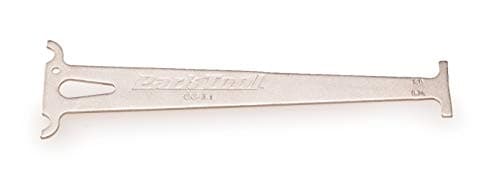
Park Tool CC-3.2 Chain Checker
Go/no-go gauge for 0.5% and 0.75% elongation, listed for 5-12 speed. Do this before you touch a limit screw — it takes thirty seconds and it rules out the expensive cause.
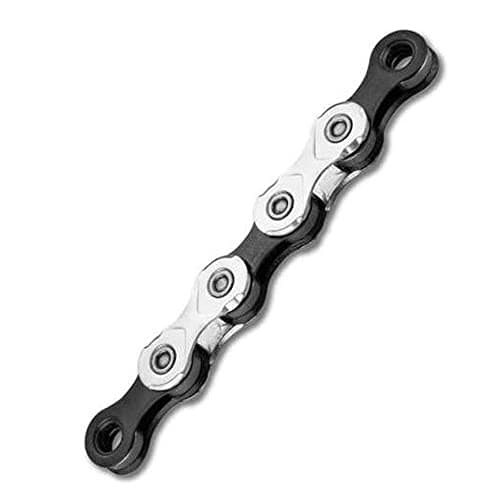
KMC X11 11-Speed Chain
A replacement 11-speed chain if the gauge says the old one is done. Match the speed count to your drivetrain first; our chain roundup covers 10-, 11- and 12-speed options.
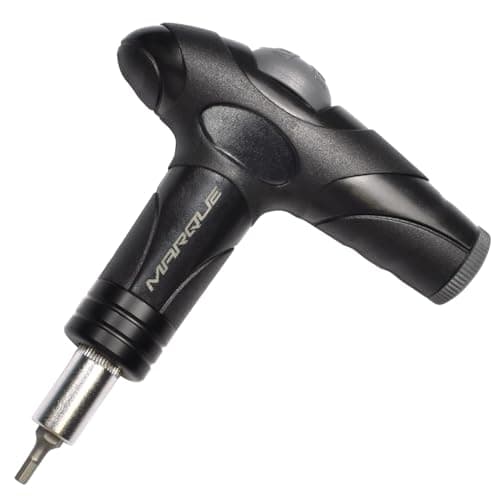
MARQUE Adjustable Bike Torque Wrench
A 4/5/6 N·m dial driver for the clamp and pinch bolts you loosen during a height or rotation change. Park Tool publishes 30-40 inch-pounds for the front derailleur cable pinch bolt.
We haven’t tested any of these — they’re the parts the job above calls for, listed so you don’t have to go hunting. Prices are live from Amazon and we earn a commission if you buy. Prices as of October 17, 2026. #ad
Five causes in the order they are worth checking
1. Chain wear. Thirty seconds with a gauge. Rules out the one cause that no adjustment solves.
2. Limit screws. Free. L-screw for inside drops, H-screw for outside drops, eighth of a turn at a time, tested by hand rather than by lever.
3. Front derailleur height and rotation. Free, needs one hex key. Park Tool’s 1-2 mm gap over the outer ring, and the cage parallel to the chain when sighted from above.
4. Cable tension. Free, at the barrel adjuster. Park Tool flags the interaction directly: “If the inner wire has too much tension, the derailleur will not rest on the L-screw stop” — and if tension then changes, “the derailleur inner limit would also change, possibly causing the chain to fall off the rings”. A cable that has settled since the bike was new is an extremely common cause of a chain that started dropping months after purchase.
5. Chainline or a bent hanger. The structural causes. If the chain still rubs the inner cage and still drops off the inner ring, Park Tool says other problems such as chainline or derailleur rotation exist — that is the point to stop turning screws and look at the geometry.
Cross-chaining is not a fault
If it only drops in one extreme combination — big ring and biggest sprocket, or small ring and smallest — you may simply be asking for a gear the drivetrain does not really offer. That is not a fault to adjust out; it is a gear to stop using, and on a double chainset the same ratio is nearly always available in a better combination. Our cassette and chainring guide explains why those combinations exist and why they are not for riding in.
This is also one of the real arguments for a single chainring, since a 1x drivetrain has no front derailleur to misadjust and no inner ring to drop off. It is not free — our 1x vs 2x comparison sets out what you give up in return.
What to do at the roadside, right now
Stop pedaling the instant it happens. Do not try to pedal it back on under power, which is how chainstays get scarred and derailleur cages get bent. Lift the rear wheel, shift the front derailleur toward the ring the chain fell off, and lift the chain back on by hand. Then, before you set off, shift deliberately through both chainrings once while soft-pedaling so you find out whether it will happen again on the next climb rather than in traffic.
When it is worth paying someone
A bent hanger, a chainline problem or a front derailleur that will not come parallel because of how it mounts are the three cases where a shop is the honest answer. Everything else on this page is a hex key, a screwdriver and twenty minutes. If you are going to do it yourself regularly, a stand makes the job far easier — our repair stand roundup covers what to look for.
Common questions
Why does my bike chain keep falling off the front?
Usually a front derailleur limit screw. If it falls toward the frame, the L-screw allows too much inward travel; Park Tool’s target is a gap of about 1/16″ or 1 mm between the inner chain plate and the inner cage plate. If it goes over the big ring, the H-screw allows too much outward travel.
Why does my chain fall off when I change gear?
Because shifting is when the derailleur is at the edge of its travel. A limit screw set slightly too far, or cable tension that has settled since the bike was new, lets the cage push the chain past the ring instead of onto it.
Can a worn chain cause the chain to fall off?
Yes. A chain that has elongated past its service limit no longer engages the teeth properly. Measure before adjusting anything — a go/no-go gauge reads 0.5% and 0.75% elongation in about thirty seconds.
My chain came off into the spokes. What now?
Stop riding it. That is a rear derailleur low-limit problem and often a bent derailleur hanger as well. Have the hanger alignment checked before you trust the bike, because a bent hanger throws every gear out and can put the derailleur into the wheel.
Should I adjust limit screws with the shifter?
No. Park Tool says to shift the derailleur by pulling the inner wire by hand, because “using the lever may confuse limit screw issues with cable tension issues”.
Does a 1x drivetrain stop chains dropping?
It removes the front derailleur and the inner chainring, which is where most chain drops happen. It does not remove rear-derailleur causes or hanger damage, and it costs you gear range.
Sources
- Park Tool — Front Derailleur Adjustment (“A properly adjusted front derailleur should shift the chain between the front chainrings but will not throw the chain off the rings”; outer cage plate to outer chainring gap “1-2mm, about the thickness of a penny”; cage and chain should be parallel and “keeping the cage and chain parallel will minimize the risk of the chain jumping off the outermost ring”; L-screw “allows the chain to shift to the smallest ring, but not beyond so it falls off” with a target gap “about 1/16″ or 1mm, about the thickness of a dime”; “If the inner wire has too much tension, the derailleur will not rest on the L-screw stop” and a tension change could cause “the chain to fall off the rings”; test by pulling the inner wire because “using the lever may confuse limit screw issues with cable tension issues”; cable pinch bolt “approximately 30-40 inch-pounds”) — retrieved 18 September 2026
- Park Tool — Rear Derailleur Adjustment — retrieved 18 August 2026
- Park Tool — Rear Derailleur Hanger Alignment — retrieved 18 August 2026
- Park Tool — When to replace a chain on a bicycle (a worn chain “can cause excessive wear to the rear cogs”, “causing a much more expensive problem”) — retrieved 18 August 2026
- Shimano — front derailleur dealer manual DM-FD0002 (Shimano's own published setup figures) — retrieved 18 August 2026
- Google Autocomplete — “bike chain keeps falling off” returns “off front”, “when changing gears”, “how to fix”, “rear derailleur” and “when pedaling backwards” completions — retrieved 18 September 2026
Read next
- Why is my bike chain skipping?
The other fault that feels like this one and is caused by wear, not travel.
- How to adjust a front derailleur
The full sequence: height, rotation, limits, tension — in that order.
- How to adjust a rear derailleur
For chains that leave from the back rather than the front.
- When to replace a bike chain
The thirty-second measurement that should come before any adjustment.
- How to size a bike chain
If the gauge says the chain is done, this is how long the new one should be.
- 1x vs 2x drivetrains
The setup with no front derailleur to misadjust, and what it costs you.
We haven’t ridden or tested any of the products on this page, and we don’t pretend otherwise. Read how we research — or tell us we’re wrong and we’ll log the correction.