Skip to content
ChainringClub

The Best Bike Repair Stands

Six stands, ranked on the number that actually rules one out — published weight capacity — and on the clamping rule that comes from your frame maker, not the stand maker.

A bike shop interior with bikes and workstands seen through the windows.
By Stephen V.Published August 18, 2026How we research

Heads up: we earn a commission if you buy through the links on this page, at no extra cost to you. It never decides what makes the list — here’s how that works.

Quick picks

Tap any row for the full write-up. Specs are the manufacturer's own published claims, read on 18 August 2026.

#ProductBest forPrice
1
Park Tool PCS-10.3

Park Tool PCS-10.3

80 lb published capacity, 18 inches of height adjustment and a clamp that opens one-handed.

Top pick
The home workshop stand most people should buy
2
Park Tool PCS-9.3

Park Tool PCS-9.3

The same published capacity as the top pick, with a simpler clamp and a lower price.

Best value in a full-size stand
3
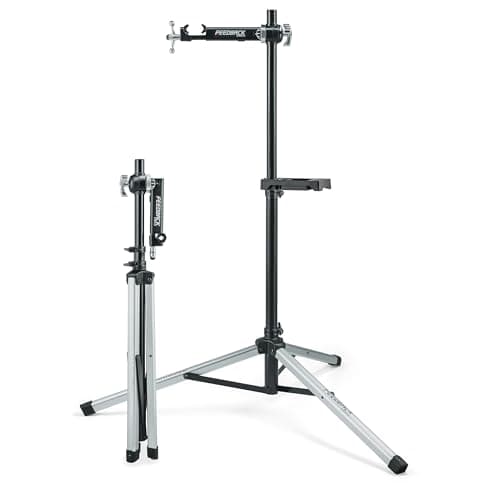
Feedback Sports Sport Mechanic

Feedback Sports Sport Mechanic

The folding alloy stand for people whose workshop is a corner of the garage.

Portability with a tool tray
4
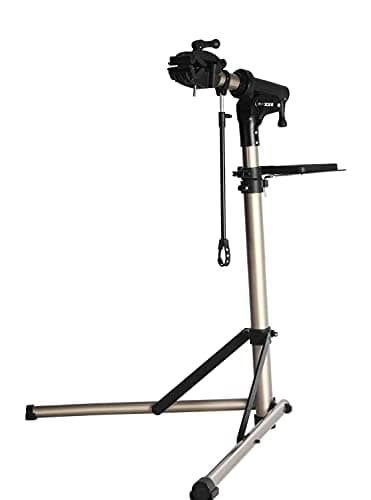
CXWXC Repair Stand

CXWXC Repair Stand

The budget stand that does the job, if you accept the trade-offs going in.

A first stand at the lowest sensible price
5
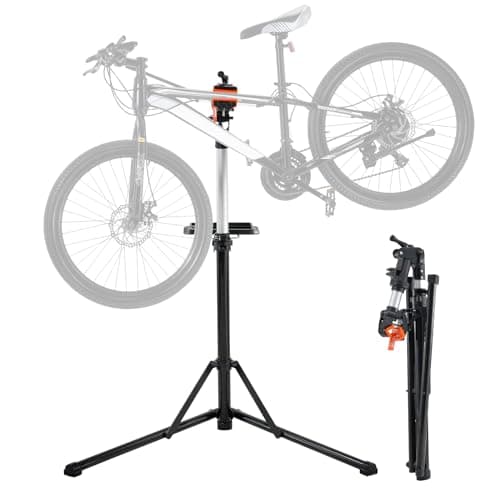
VEVOR Bike Repair Stand

VEVOR Bike Repair Stand

The cheapest stand here that publishes a capacity — 66 lbs, on the listing.

Budget buyers who want a number
6
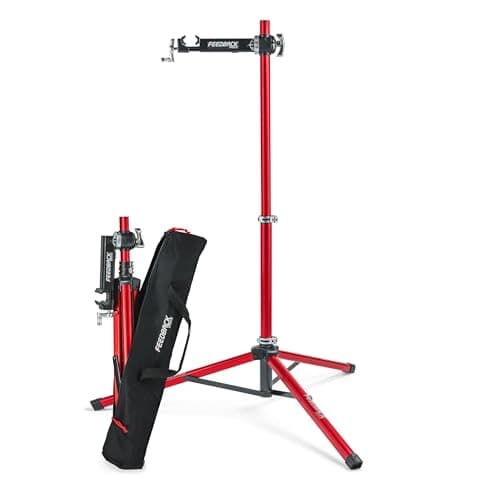
Feedback Sports Pro Mechanic

Feedback Sports Pro Mechanic

The skip for most home mechanics: superb, portable, and you pay for portability you may never use.

Mechanics who travel with the stand
Check price on Amazon →

No buyable offer right now — the link still shows the current listing.

A repair stand is bought on one number and used according to one rule. The number is published weight capacity, and it is the only spec here that can outright rule a stand out. The rule comes from your frame manufacturer rather than the stand maker, and it is the difference between a stand that holds your bike and a stand that dents it.

Start with the rule, because it is free. Cannondale’s bicycle owner’s manual is unambiguous: “Never place your bike in a bike stand by clamping the frame. Place your bike in a stand by extending the seat post and positioning the stand clamp on the extended seat post.” It adds that a carbon seatpost can also be damaged by clamping force, so the clamp should be set to the minimum force that holds. That guidance is written for carbon frames and it is good practice on aluminum too — a thin-wall down tube is not a structural member designed for a side clamp.

Capacity is the spec that excludes a purchase

Published capacities in the home-stand category cluster tightly: Park Tool publishes 80 lbs (36 kg) for both the PCS-10.3 and the PCS-9.3, Feedback publishes 85 lb for the Pro Mechanic with a note that it is optimized for bikes up to 45 lb, and the VEVOR listing states 66 lbs. Park Tool’s stand comparison guide adds the important qualifier: the maximum assumes the weight is centered over the legs.

Now compare that with what you are lifting. A road bike is 8–10 kg. A gravel bike with bags is more. A fat-tire e-bike can be 30 kg or more — comfortably inside 80 lbs, and already past the cheapest stand here. If you own an e-bike, weigh it before you buy a stand, and remember that the bike will be held by a seatpost several feet above the floor while you apply leverage to it. Our e-bike maintenance guide covers the other ways an e-bike changes home mechanics.

Clamp designs, and what each is like to live with

Cam-actuated micro-adjust(Park’s deluxe clamp) sets the jaw width once for your seatpost, then opens and closes with a lever — one-handed, repeatable, and the fastest to use when you are holding a bike with the other arm. Adjustable linkage clamps are cheaper and slower: you wind them onto the post each time. Quick-release alloy clamps on portable stands trade some holding force for weight.

The jaw itself matters more than the mechanism. Soft replaceable covers — Feedback publishes tool-free replaceable jaw covers on the Pro Mechanic — are what keep a seatpost unmarked, and they are a consumable. A hard or worn jaw on a carbon post is exactly the situation Cannondale’s minimum-force warning is about.

Steel or alloy: where the stand lives decides

Steel stands are heavier, more rigid and cheaper for the same capacity. If the stand lives in one place, that is a straight win: rigidity is what you notice when a stuck bottom bracket needs a long lever.

Alloy folding stands exist for a different job. Feedback publishes 12.25 lb and a folded footprint of 5 × 8 × 45 inches for the Pro Mechanic — that is a stand you take to a race, a holiday or a shared flat. You pay for that in money and in a little flex. Neither is better; they answer different questions.

What a stand actually changes

It is worth being honest about why this is a good purchase, because “convenience” undersells it. Almost every adjustment job on a bike requires the cranks to turn freely while both of your hands are somewhere else. Indexing a rear derailleur upside down on the floor is a genuinely different task from indexing it at chest height with the wheel spinning — which is why our rear derailleur guide and front derailleur guide both assume one.

The same is true of anything involving torque. Once you are working to published figures — and our bike bolt torque guidelists them — you need the bike held still enough that the wrench, not the bike, is what moves.

What we could not check

We have not load-tested a stand, measured flex, or clamped a carbon post to failure. Every capacity, dimension and clamp figure above is the manufacturer’s published number or the seller’s listing, read on 18 August 2026 — and where a listing publishes no capacity at all, which is true of two stands here, the table says so rather than estimating one.

Published capacity and construction

From each manufacturer’s own product page and the live Amazon listings, read 18 August 2026. Park Tool’s published capacities assume the weight is centered over the legs — a qualifier worth remembering with a heavy bike.

StandPublished capacityMaterialClampPortable?
Park Tool PCS-10.380 lb / 36 kgSteelCam micro-adjust, 360°Folds, but heavy
Park Tool PCS-9.380 lb / 36 kgSteelAdjustable linkageFolds, but heavy
Feedback Pro Mechanic85 lb / 34 kg (opt. 45 lb)6063 T6 aluminum2.6" opening, replaceable jawsYes — 12.25 lb
Feedback Sport Mechanic 2.0Not published on the listingAluminumRotating headYes
CXWXC shop/home standNot published on the listingSteel/alloy mixRotating headYes
VEVOR repair stand66 lbAluminumTelescopic arm, magnetic trayYes

Weigh your bike before you choose a row. A road bike clears every stand here; a fat-tire e-bike clears about half of them, and the two stands with no published figure cannot be assessed at all.

The picks, in detail

1

Park Tool PCS-10.3

Top pick
Park Tool PCS-10.3
$279.95 · View on Amazon

Price as of Aug 31, 2026. #ad

Best for: The home workshop stand most people should buy

80 lb published capacity, 18 inches of height adjustment and a clamp that opens one-handed.

  • Maker: 80 lbs (36 kg) capacity, centered over legs
  • Maker: 18" (46 cm) height adjustment
  • Maker: 360° clamp rotation
  • Maker: all-steel, teardrop tubing

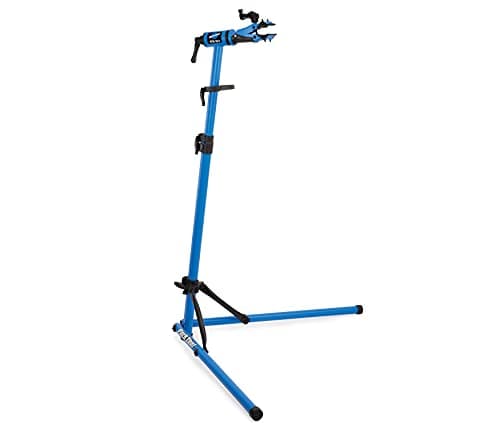
Park Tool publishes the numbers that decide this purchase: 80 lbs (36 kg) capacity, 18″ (46 cm) of height adjustment, 360° of clamp rotation and all-steel construction. For everything a home mechanic does — derailleur setup, wheel removal, bleeding brakes, cleaning — that combination is the practical benchmark the rest of this page is measured against.

Good

  • Cam-actuated micro-adjustable clamp — one hand in, one hand out, which matters when the other hand holds a bike
  • Steel construction is heavier and more rigid than the alloy stands, which is what you want in a stand that lives in one place
  • Park Tool publishes the capacity, height range and rotation, so nothing about the fit is a guess

Less good

  • Heavy to move and bulky to store compared with the folding alloy stands
  • 80 lbs is generous for a bike and marginal for a heavy fat-tire e-bike
  • Costs more than the equally capable simpler stand below it

Skip it if: Your bike is a heavy e-bike. Check its weight against the published 80 lb figure — and note Park Tool's caveat that the maximum assumes the weight is centered below the clamp and between the legs.

2

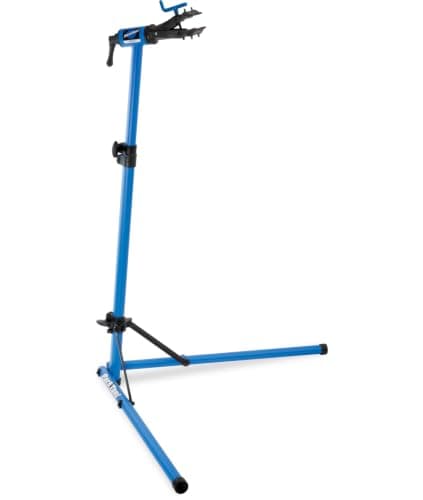
Park Tool PCS-9.3

Park Tool PCS-9.3
$219.95 · View on Amazon

Price as of Aug 31, 2026. #ad

Best for: Best value in a full-size stand

The same published capacity as the top pick, with a simpler clamp and a lower price.

  • Maker: 80 lbs (36 kg) capacity
  • Home Mechanic series
  • Adjustable linkage clamp
  • Folds for storage

Good

  • Identical published weight capacity to the deluxe stand at meaningfully less money
  • Same Park Tool parts and service backing, which matters for a tool you keep for a decade
  • Simpler clamp mechanism means fewer things to wear out

Less good

  • The linkage clamp is slower to operate than the cam clamp on the top pick
  • Less height adjustment range than the deluxe model
  • Still a steel stand — not the one to carry to races

Skip it if: You will be clamping and unclamping constantly. The cam clamp above genuinely is quicker, and if you work on several bikes a week that adds up.

3

Feedback Sports Sport Mechanic

Feedback Sports Sport Mechanic
$250.00 · View on Amazon

Price as of Aug 31, 2026. #ad

Best for: Portability with a tool tray

The folding alloy stand for people whose workshop is a corner of the garage.

  • Listing: Sport Mechanic 2.0
  • Listing: includes tool tray
  • Folding tripod base
  • Aluminum construction

Good

  • Folds down to store behind a door, which a steel stand does not
  • The tool tray is a genuinely useful feature — small bolts on a garage floor are lost bolts
  • Light enough to carry to an event without resenting it

Less good

  • A tripod base takes up more floor area than a folding steel stand's footprint
  • Alloy stands flex more than steel under a hard wrench pull
  • The listing does not publish a weight capacity

Skip it if: You need to know the capacity before you buy. Feedback publishes figures for its Pro line; this listing does not state one, and if you own a heavy e-bike that is not a gap you can ignore.

4

CXWXC Repair Stand

CXWXC Repair Stand
$86.98 · View on Amazon

Price as of Aug 31, 2026. #ad

Best for: A first stand at the lowest sensible price

The budget stand that does the job, if you accept the trade-offs going in.

  • Listing: shop/home bicycle mechanic stand
  • Adjustable height
  • Rotating clamp head
  • Tripod base

Good

  • A quarter the price of the premium stands and still holds a bike at working height
  • Rotating clamp covers the same basic functions as the expensive stands
  • Low enough risk to find out whether you actually want a stand

Less good

  • No published weight capacity on the listing
  • Budget clamps are where scratched seatposts and slipping bikes come from
  • Flex under load is the usual complaint at this price

Skip it if: You will torque a bottom bracket or a cassette in it. Heavy wrenching is where a cheap stand's flex stops being a nuisance and starts being a bike on the floor.

5

VEVOR Bike Repair Stand

VEVOR Bike Repair Stand
$66.95 · View on Amazon

Price as of Aug 31, 2026. #ad

Best for: Budget buyers who want a number

The cheapest stand here that publishes a capacity — 66 lbs, on the listing.

  • Listing: 66 lbs capacity
  • Listing: heavy-duty aluminum
  • Listing: magnetic tool tray, telescopic arm
  • Listing: foldable

Good

  • Publishes a weight capacity, which the other budget stand does not
  • Magnetic tool tray at a price where you would not expect one
  • Folds, so it can live in a cupboard rather than a corner

Less good

  • 66 lbs is the lowest capacity here and rules out most fat-tire e-bikes
  • Aluminum at this price is thinner-walled than the premium alloy stands
  • No published clamp jaw range

Skip it if: You own an e-bike. Sixty-six pounds is a real limit, and a 60 lb e-bike plus the leverage of a wrench is not a margin worth testing.

6

Feedback Sports Pro Mechanic

Feedback Sports Pro Mechanic
Check price on Amazon →

No buyable offer right now — the link still shows the current listing.

Best for: Mechanics who travel with the stand

The skip for most home mechanics: superb, portable, and you pay for portability you may never use.

  • Maker: 85 lb (34 kg) max capacity
  • Maker: optimized for bikes up to 45 lb
  • Maker: clamp opens to 2.6" (6.6 cm)
  • Maker: 12.25 lb, folds to 5 × 8 × 45"

Feedback publishes an unusually honest pair of figures for this stand: a maximum capacity of 85 lb (34 kg) and an optimization figure of 45 lb. Those are not contradictory — one is the limit, the other is where the stand is happiest — and the fact that they publish both is more than most of this category manages.

Good

  • Highest published capacity on this page, and a 2.6" clamp opening that swallows oversized frame tubes
  • Twelve pounds and a 5 × 8 × 45 inch folded footprint — it goes in a car without argument
  • Tool-free replaceable soft jaw covers, so the wear part is a part rather than a stand

Less good

  • By far the most expensive stand here
  • Feedback's own figures pair an 85 lb maximum with 'optimized for bikes up to 45 lb' — read both numbers
  • Portability is the premium, and a stand that never leaves the garage does not need it

Skip it if: The stand will live in one corner for a decade. The steel Park stands cost far less, hold within five pounds of the same weight and flex less under a wrench — the money here buys travel, not capability.

What actually decides this purchase

Check capacity against your heaviest bike.This is the one specification that can make a stand simply wrong. Published home-stand capacities run 66–85 lb; a fat-tire e-bike can be most of that before you touch it with a wrench.

Clamp the seatpost, never the frame.Frame makers say so in their own manuals, and they say to use the minimum clamping force on a carbon post. If your seatpost will not extend far enough, a cheap alloy “dummy” post for stand use is the standard workaround.

Decide whether the stand travels. Steel is more rigid and cheaper per pound of capacity; folding alloy is the one you take to races. Buying the travel stand for a permanent garage corner is the most common overspend in this category.

Look for replaceable jaw covers. They are the wear item, and being able to replace them means one worn pad does not mean a scratched seatpost forever.

Height range matters more than you expect.Working at the wrong height for an hour is what makes home mechanics stop doing their own maintenance. Published adjustment ranges — 18 inches on the top pick — are worth comparing.

Common questions

Where should you clamp a bike in a repair stand?

On an extended seatpost, not the frame. Cannondale’s owner’s manual states it directly: never clamp the frame; extend the seatpost and clamp that instead. If the post is carbon, use the minimum clamping force that holds the bike — carbon posts can be damaged by clamping force too. Riders with limited post extension often keep a cheap alloy post purely for stand use.

What weight capacity do I need in a repair stand?

More than your heaviest bike, with margin for the force you apply while working. Road bikes are nowhere near any published limit. E-bikes are the reason this question matters — a fat-tire model can approach 30 kg, which clears an 80 lb stand and exceeds a 66 lb one. Park Tool also notes its figures assume the weight is centered over the legs.

Are cheap bike repair stands any good?

For light work — cleaning, cable adjustment, wheel removal — a budget stand is a genuine upgrade over leaning the bike on a wall. The trade-offs are flex under heavy wrenching, coarser clamps that are easier to over-tighten on a seatpost, and, on two of the budget stands here, no published weight capacity at all.

Do I need a repair stand at all?

You do not need one to fix a puncture. You need one the moment a job requires the cranks to turn while both hands are busy — derailleur indexing, chain fitting, brake bleeding, any drivetrain cleaning. If you already own a torque wrench and a chain checker, a stand is the tool that makes both usable.

Can I clamp a carbon frame if I'm careful?

Frame manufacturers say no — and the reason is that carbon tube walls are engineered for riding loads, not point clamping. Cannondale’s manual says never to clamp the frame and to clamp the extended seatpost instead. A dropped bike is cheaper than a cracked frame; use the post.

Sources

We haven’t ridden or tested any of the products on this page, and we don’t pretend otherwise. Read how we research — or tell us we’re wrong and we’ll log the correction.