Every “best bike tools” page is organized the same way: here are twelve things, buy them. This one is organized around a number, because there is a published spec sitting in plain sight that quietly decides how much of your own bike you are allowed to work on, and nobody mentions it.
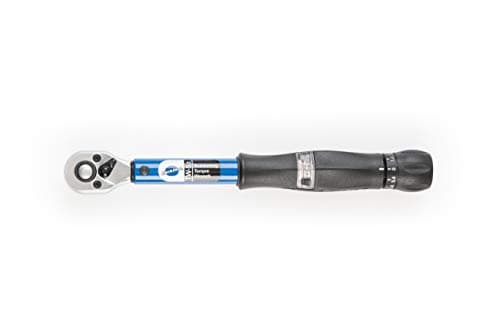
The number is 14. The torque wrench most often recommended to home mechanics — and the one on this page — has a published range of 2 to 14 Nm, and Park Tool prints the boundary in its own spec notes: “Torque wrenches are measuring instruments and are not intended for use as a general-purpose ratcheting driver. Do not exceed 14 Nm when using the TW-5.2.” Meanwhile Park Tool’s own reference torque table lists a Shimano cassette lockring at 29.4–49 Nm, SRAM at 40, Campagnolo at 50. Both documents are published by the same company. Almost nobody reads them together.
That is not a criticism of the wrench, which is excellent and correctly specified for what it does. It is a correction to how the category is sold. “Buy a torque wrench” is not one purchase — it is a decision about which half of the bike you intend to touch. The low-torque half is stems, seatposts, brake mounts, derailleur bolts and most carbon interfaces, which is exactly where over-tightening is expensive and where Park Tool says the TW-5.2 is aimed. The high-torque half is cassettes, freehubs and axle nuts, and it needs a different tool.
Four tools, four bills you stop paying
A bench tool is not really a thing you use. It is a recurring charge you cancel. That framing does more work than any function count, and it is why this page has four items on it rather than fifteen: each of these four kills a distinct, repeating reason to hand the bike to somebody else.
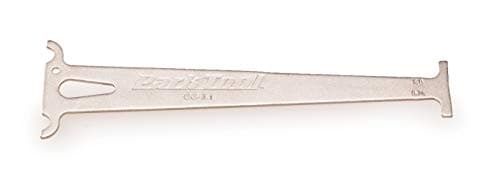
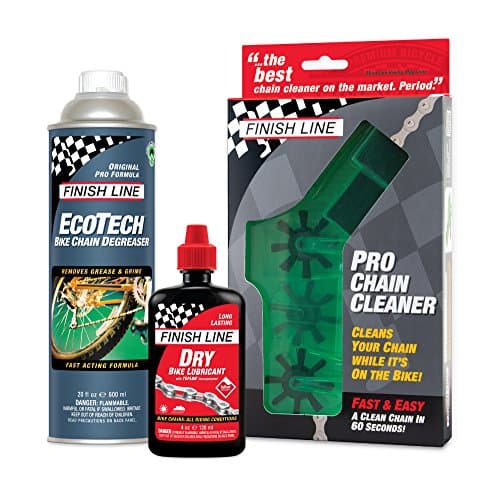
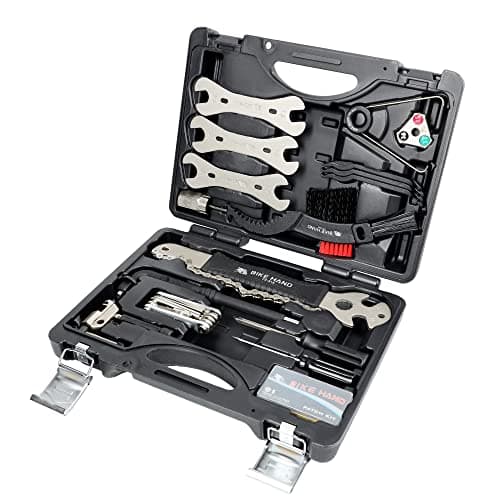
The kitkills the “I don’t have the tool for that” stall. The torque wrench kills guessing, and the class of damage that follows guessing. The chain checkerkills the single most expensive avoidable repair in cycling — a chain left long enough to wear the cassette with it. The chain cleaner kills the shop drivetrain clean, which is a job you would pay for several times a year and which is entirely mechanical.
What is deliberately absent: a repair stand. It is the obvious fifth item, it is genuinely transformative, and we do not have one in the catalog we price from — so rather than pad the page with something we cannot show you a live price for, we have left the gap and said so. If your budget stretches past these four, a stand is where we would send it.
This is not the multitool page, and the difference is the point
We keep these two categories apart on purpose. A multitool is bought on what you are willing to carry: short keys, poor leverage, four functions that matter, and the whole thing lives in a saddlebag. Its job is to get you home. A bench tool is bought on the opposite basis entirely — long handles, real leverage, one job done properly — and its job is to make sure you did not need the multitool in the first place.
The practical consequence is that short hex keys round bolts and long ones do not, so the multitool should be the tool of last resort at home and the only tool on the road. If you want that argument with the listings pulled apart, the multitool roundup is next door. There is no product overlap between the two pages.
The care instructions that decide whether the wrench stays accurate
A click-type torque wrench is a measuring instrument with a spring in it, and it goes out of true if you treat it like a ratchet. Park Tool publishes three rules in its torque wrench care guide and all three are the kind of thing you find out too late.
- “To avoid fatiguing the spring, click-type torque wrenches should be wound down to the lowest value on the scale (not zero) when not in use.” Note the parenthesis. Not zero.
- “It is not advisable to use click-type torque wrenches as common ratchet handles to remove fasteners or components. In doing so, you may exceed the maximum torque value of the wrench and stress its internal components, compromising its accuracy.”
- “With time and use, a torque wrench will eventually need calibration. Our recommendation is every 5000 clicks, or at least once a year for wrenches that see frequent use.”
And the limit that no tool fixes: “A cross-threaded bolt will not properly tighten even with a torque wrench.” A wrench measures resistance to rotation. It cannot tell the difference between the resistance of a correctly seating fastener and the resistance of one destroying its own threads, and it will click contentedly at 6 Nm while you ruin a frame insert. Start every bolt by hand.
What we can’t tell you
Two gaps, stated rather than filled. The BikeHand kit’s listing publishes a piece count and nothing else — 22 pieces, none of them named — so we cannot tell you which of the jobs on this page it covers, only that the standalone torque wrench here covers 2 to 14 Nm and is documented in full. And the Finish Line kit does not publish fluid volumes, which means the cost-per-clean arithmetic we run on the lube roundup cannot be run here. Neither gap is a claim that the products are worse. Both are limits on what anyone quoting the listings can honestly say.
Four tools, four jobs, no overlap. The “replaces” column is the honest way to think about a bench tool: it is not a thing you use, it is a bill you stop paying. Specs are quoted from Park Tool’s own product pages or from each product’s live Amazon listing.
Park Tool publishes both of these documents and they contradict the way the category is sold. The wrench on this page stops at 14 Nm — Park Tool prints “Do not exceed 14 Nm when using the TW-5.2”in its own spec notes. Park Tool’s reference torque table then lists these:
Prices are live from Amazon as of October 18, 2026. Torque figures are from Park Tool’s published torque table, read on 13 August 2026, which carries its own caveat: “Numbers provided for reference only. Note that some companies do not specify torque for certain components or parts. Contact the manufacturer for the most up to date specifications.” Use your component maker’s figure, not this table and not ours. The point of the table is not the individual numbers — it is that four of six rows sit outside the range of the wrench most home mechanics are sold.
Look up your torque figures before you buy the wrench.Not after. Write down the published values for the four or five bolts you actually intend to touch — stem faceplate, seatpost clamp, rotor bolts, derailleur mounting bolt — and check they fall inside 2 to 14 Nm. If most of your list is above that, you need a different wrench and this page has just saved you a return.
Buy the manufacturer’s number, not a reference table. Park Tool attaches the caveat itself: “Numbers provided for reference only. Note that some companies do not specify torque for certain components or parts. Contact the manufacturer for the most up to date specifications.” Many components print the figure on the part. Use that one.
The cheapest tool here has the best return. The chain checker costs a fraction of everything else on this page and prevents the failure that takes the cassette with it. If you buy exactly one item from this roundup and you already own hex keys, buy that one and read the wear thresholds.
A kit is a shortcut, not a saving. Bought individually, these tools cost more and arrive over two years; bought as a kit, they cost less and arrive in a box you will actually be able to find. But if you already own hex keys and a screwdriver set, a kit is mostly duplicates in a case. Audit your drawer first.
Start every fastener by hand, then reach for the wrench. This is the free rule and it prevents the expensive failure. A torque wrench cannot detect a cross-thread; it will click at the correct value while a fastener destroys the threads it is entering. Two fingers and no tool for the first turn.
The tools are cheap and the drivetrain is not. Same argument as everywhere in this hub. If you want the version with the arithmetic attached, the cost per 1,000 miles across seven lubes is where this hub shows its working.
One job explains why a long-handled tool earns its place on a bench: removing and installing pedals is published at about 360 inch-pounds, roughly 40 Nm, which is far beyond what a folding multitool can deliver.