E-bike maintenance: what actually changes
You already know how to do almost all of this. On an e-bike the maintenance tasks are the same as any bike — it's the interval between them that shrinks, because torque, weight and speed reach the same wear limits sooner.
Heads up: we earn a commission if you buy through the links on this page, at no extra cost to you. It never decides what makes the list — here’s how that works.
Almost nothing about maintaining an e-bike is new. You check the chain with the same gauge, measure the brake pad against the same 1mm rule, read the rotor the same way, and set tire pressure off the same sidewall. The tools are identical, the procedures are identical, and the numbers below come from the same Park Tool repair pages that apply to any bicycle on earth.
What changes is how often. A motor feeds torque through the same chain your legs do, the bike itself is heavier, and the assist keeps you at higher average speeds for longer — so the consumables reach their published wear limits sooner. The job doesn’t change; the calendar does. Treat an e-bike like a normal bike you service on a normal schedule and the first thing you learn is what a chewed cassette costs. This page is about the cadence, and about the two things a normal bike genuinely doesn’t have: a drive unit and a battery.
The drivetrain: same wear limit, reached faster
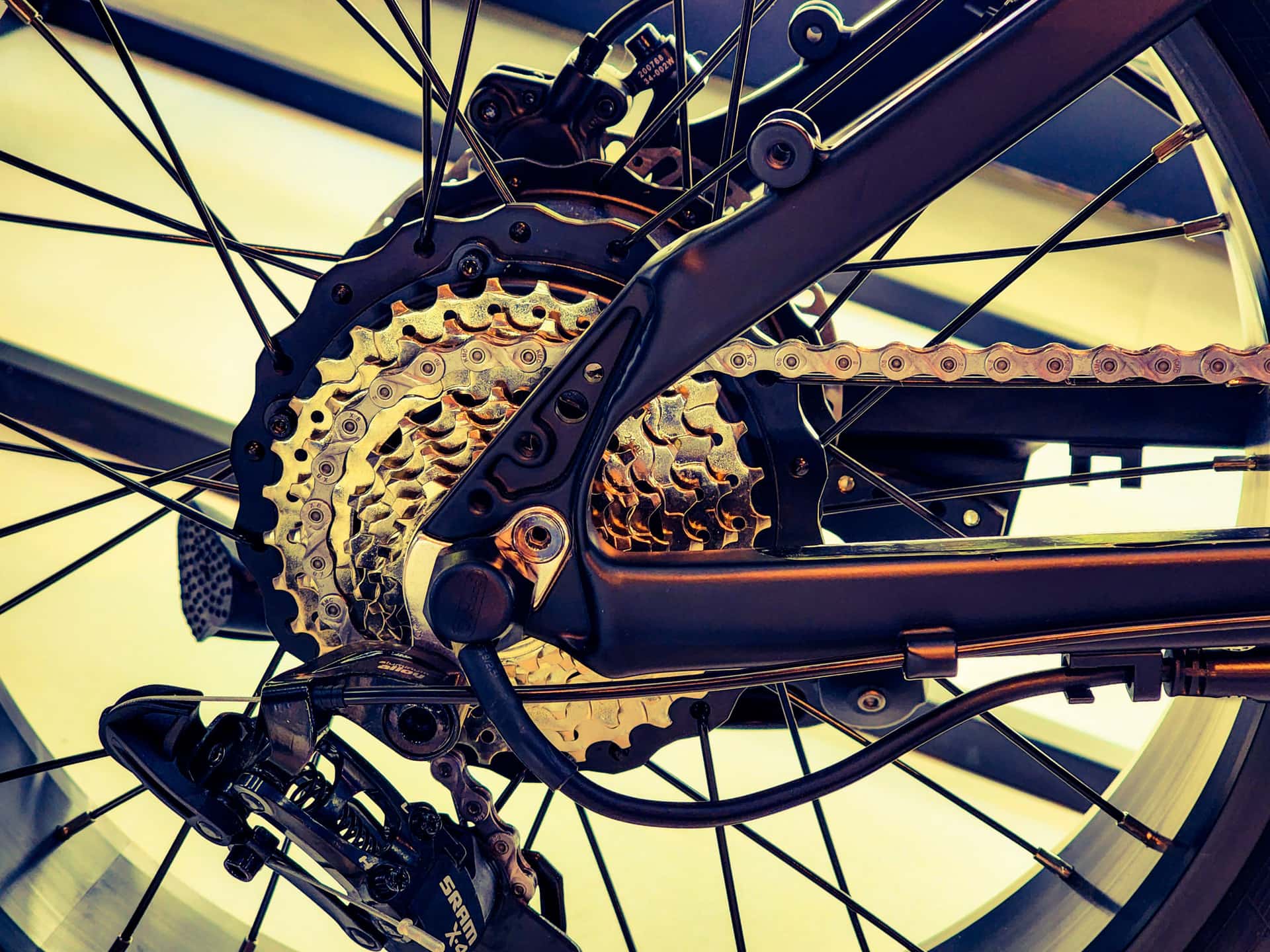
On a mid-drive e-bike the motor’s torque goes through the chain, cassette and chainring — the exact same parts your pedaling load already passes through, now with a motor stacked on top. (A hub-drive motor pushes at the wheel instead and largely spares the drivetrain, which is one of the real, under-discussed trade-offs in hub vs mid-drive motors.) More load through a chain means the rollers and pins wear against each other faster, the chain “stretches” — really the internal clearances open up — and it stops meshing cleanly with the cogs.
The wear limit itself is not an e-bike number, it’s a chain number, and Park Tool publishes it plainly: replace a chain at 0.5% elongation for an 11- or 12-speed cassette, 0.75% for 10-speed and below, and 1.0% for single-speed. The reason to care is the sentence most people skip. Park Tool: “This wear can cause the chain to mesh poorly with cogs and chainrings, causing poor shifting and premature wear to the cogs” — and “using a chain beyond its intended wear limit will prematurely wear out your cogs and chainrings”. A cheap chain caught in time protects an expensive cassette. A cheap chain ridden past the line takes the cassette with it, and on an e-bike you arrive at that line quicker.
So the single change worth making is a scheduling change: check the chain more often than you would on an analog bike, with a drop-in gauge, and don’t wait for a mileage number to tell you — measure it. The most valuable habit that slows all of this down isn’t exotic either. A clean, lubed chain wears far slower than a gritty dry one, e-bike or not; our guide to cleaning a bike chain covers the single most valuable maintenance habit there is. Grit is an abrasive paste, and motor torque grinds it in harder. Which lubricant to put back on afterwards is its own question on a bike ridden this hard — see the best chain lube for e-bikes, including the published fact that Shimano builds e-bike-specific chains.
Brakes: more energy to throw away
Stopping is physics you can’t argue with: a heavier bike carrying more speed has more kinetic energy, and every bit of it turns into heat and wear in the pads and rotors when you brake. Same brake, same procedure, more work asked of it per stop — so pads and rotors thin out sooner on an e-bike than on a light road bike doing the same rides.
The wear limits, again, are ordinary disc-brake limits, not e-bike ones. For pads, Park Tool: “the pad material should measure at least 1mm thick”, and if you don’t have calipers, “by stacking 3 business cards you can create a makeshift feeler gauge that is approximately 1mm”. For rotors, they warn that “measurable wear of 2 to 4 tenths of a millimeter or more is evidence of a worn rotor”, and give the brand minimums: Shimano rotors start at 1.8mm new and should be replaced at no less than 1.5mm; Hope rotors start at 1.8mm and are replaced by 1.4mm. A rotor worn under its minimum is a structural part running thin, not a cosmetic issue.
One more brake trap is worth naming because it’s easy to cause during e-bike cleaning: contamination. Park Tool: “Contaminants such as brake fluids, oils or grease can ruin your pads, but they’re not always easy to see”. Overspray from a chain lube or a degreaser drifting onto a rotor is enough to glaze a pad, and the fix is usually new pads. Keep spray away from the rotors, and if a brake suddenly squeals or goes weak after a wash, suspect contamination before you suspect the pads are simply worn.
Tires: the quiet consumable
Extra weight and motor torque scrub rubber off the tread faster — especially the rear, which carries more of the load and, on a mid-drive, delivers the drive. Higher sustained speed adds heat, and heat is not kind to rubber. Unlike the chain and rotor there is no single published wear percentage for a tire: you replace it when the tread is visibly gone, when the casing or wear indicators show, when it’s cut, or when it flat-spots. That’s not us dodging a number, it’s the honest state of it — tire wear depends on compound, load and surface, and no manufacturer publishes a one-size figure. The practical takeaway is the same as everywhere on this page: inspect more often, and expect a shorter rear-tire life than the same tire would give on an unassisted bike.
The two parts a normal bike doesn’t have
Torque on the mounts.A motor makes vibration and repeated high loads, and the bolts holding the drive unit and the battery interface are torqued to a specific value for that reason — too loose and a mount works itself loose under torque, too tight and you strip or crack a fitting. We are deliberately notprinting a number here, because the correct value is the one in your bike’s manual for your exact frame and fitting, and inventing a torque spec is precisely the kind of fabrication this site exists to avoid. Find yours in the manual, and tighten to it with a torque wrench rather than by feel. If you don’t own one, this is the job to let a dealer do.
Firmware.This is genuinely new versus an analog bike: the drive unit runs software, and the manufacturer ships updates for it. On Shimano STEPS, updates are delivered through Shimano’s E-TUBE PROJECTapp — you connect, open the update screen, and units with an available update are flagged for install; Bosch handles the same thing through its own app and dealer tools. Updates can change assist behavior, fix bugs and occasionally add features, and skipping them is the one maintenance item with no mechanical equivalent. It costs nothing but a few minutes and a good wireless connection.
The battery.How you charge, store and look after the pack is roughly half of what “e-bike maintenance” even means, and it has its own rules that have nothing to do with chains and pads — our explainer on e-bike range and battery care goes into it, because battery care is half of e-bike maintenance. Keep the contacts clean and dry, and never force water into them, which brings us to the one rule you can’t bend.
Washing: the one thing you must not do
Here is the single hard prohibition, and both major motor makers state it in almost the same words. Bosch: “Under no circumstances should you use a steam jet or high-pressure cleaner, as water can penetrate into sensitive components such as the drive”. Shimano’s STEPS manual is just as blunt: “Do not clean the bicycle with a high-pressure wash. If water gets into any of the components, operating difficulties may occur”.
The mechanism is the whole reason: a pressure washer or steam jet drives water past the seals into the motor, and into the bearings of the hubs, headset and bottom bracket — places that are meant to keep water out and grease in. On a normal bike a pressure wash is merely a bad idea that shortens bearing life. On an e-bike it can reach the drive electronics and the battery contacts, and it can void the warranty. This is the rare case where the e-bike rule is a genuine don’t, not just a faster do.
What to do instead is undramatic. Shimano’s guidance is to use a cloth or sponge with a neutral detergent diluted in water, and a well-wrung damp cloth on the battery and covers; Bosch recommends a gentle bike shampoo rather than aggressive agents, cleaning regularly so dirt doesn’t become ingrained. Bucket, sponge, soft brush, gentle hose at most — never a jet aimed at the motor, battery seat or bearings. Dry the contacts, re-seat the battery, and lube the chain afterward, because washing strips lube and a dry chain is exactly the abrasive situation the drivetrain section warned about.
What we haven’t done
We have not tested any of this on a bench or a ride. Every wear figure on this page is a published spec — Park Tool’s chain-elongation limits, its 1mm pad rule, its rotor minimums — quoted and linked, and every one of them applies to any bicycle, not just an electric one. The e-bike contribution is the direction of the effect: torque, weight and speed all push those same limits closer, faster. Where there isn’t a published number — tire life, your exact mount torque — we’ve said so rather than invent one. The maintenance you already know how to do is the maintenance an e-bike needs; you just need to do it sooner, and keep the pressure washer in the shed.
Two companion pages if you want the detail behind that last clause. Can you ride an e-bike in the rain takes the same two published warnings and asks what they imply about riding rather than washing — including the finding that not one of the twelve e-bike listings in our catalog publishes an ingress rating, while four of our bike lights do. And the general maintenance schedule sets these published wear limits out as a calendar, marking the three rows where no manufacturer publishes a figure at all.
Same job, shorter interval
The wear limits in the middle column are ordinary bicycle specs, sourced from Park Tool, not e-bike numbers. The right column is the only thing that’s different: why a motor gets you to that same limit sooner. Where there’s no published figure, the row says so.
| Consumable | Published wear limit (Park Tool) | Why an e-bike reaches it sooner |
|---|---|---|
| Chain | 0.5% stretch (11-12sp), 0.75% (10sp & under), 1.0% (single-speed) | Motor torque runs through the same chain; a mid-drive stacks its load on yours |
| Cassette & chainring | No gauge — they die when a worn chain has chewed the teeth | A chain left past its limit wears the cogs faster under load |
| Brake pads | Replace at ~1mm of pad material left | A heavier, faster bike dumps more energy into the pads per stop |
| Brake rotors | Shimano 1.8mm new → 1.5mm; Hope → 1.4mm | The same extra braking energy thins the rotor sooner |
| Tires (esp. rear) | No published %; replace at worn tread, exposed casing or cuts | Extra weight, torque and speed scrub rubber off faster |
Read the middle column and note there is nothing electric about it — it’s the same maintenance any competent shop does on any bike. Faster consumable wear is also a real line in the running cost; we put actual thought into that in what an e-bike costs to run.
What actually decides this purchase
Mid-drive or hub-drive decides how hard the drivetrain gets hit.A mid-drive puts its torque through the chain and cassette; a hub-drive drives the wheel and largely leaves the drivetrain alone, at the cost of other trade-offs. If you own a mid-drive, the drivetrain half of this page matters most — see hub vs mid-drive motors for what else that choice costs you.
How you ride sets the cadence more than the bike does. Constant high assist, heavy loads, hard stops and big climbs all pour more work into the same parts. A gentle commuter on low assist will wear a chain far slower than a loaded cargo bike on full boost, even on identical hardware. Match your inspection interval to how hard you actually ride, not to a number off the internet.
Wet and salty conditions multiply everything. Grit is an abrasive paste and motor torque grinds it into the chain harder. If you ride through winters, check the chain and clean the drivetrain more often, and be even more disciplined about keeping the high-pressure hose away from the motor and bearings.
Own a torque wrench, or make peace with the dealer. The motor and battery mounts have a specified torque in your manual, and vibration under motor load is exactly why it matters. Guessing by feel is how mounts loosen or fittings crack. A torque wrench is a one-time buy; the alternative is booking the shop for a two-minute job.
Budget for the wear, don’t be surprised by it.Chains, cassettes, pads and tires are simply going to come around sooner on an e-bike. That’s not a fault, it’s the physics of assist, and it’s a real recurring cost — e-bike cost to run puts a shape on it.
Common questions
Does an e-bike really wear chains out faster than a normal bike?
On a mid-drive, yes, for a clear mechanical reason: the motor’s torque passes through the same chain and cassette your legs do, so those parts carry more load and reach their wear limit sooner. Hub-drive motors push at the wheel and mostly spare the drivetrain. The wear limitis unchanged — Park Tool still says replace at 0.5% stretch for an 11-12 speed chain — you just get there quicker, so the honest fix is to check more often rather than to buy anything special.
How often should I check my e-bike chain?
More often than the mileage you’d use on an analog bike, and by measuring rather than guessing. Use a drop-in chain-wear gauge and replace at Park Tool’s published limit for your drivetrain (0.5% for 11-12 speed, 0.75% for 10-speed and under, 1.0% for single-speed). There’s no universal e-bike mileage figure worth quoting because it depends on your motor type, assist level, load and conditions — the gauge is the answer, not a number off a chart.
Can I pressure wash my e-bike?
No. Both major motor makers prohibit it. Bosch says never to use a steam jet or high-pressure cleaner because water can penetrate sensitive components such as the drive, and Shimano’s STEPS manual says not to clean the bike with a high-pressure wash because water getting into the components can cause operating difficulties. Use a bucket, sponge, soft brush and gentle detergent, keep any jet away from the motor, battery seat and bearings, then dry the contacts and re-lube the chain.
Do I need special e-bike-rated chains, tires or brake pads?
Sometimes it helps, but it’s not the point of this page. Some brands sell heavier-duty chains and e-bike-rated tires built for the extra load, and they can last longer under it. What matters more is the cadence: the wear limits and the way you measure them are identical to any bike, so the reliable win is checking and replacing consumables sooner, whatever badge is on them. Don’t let an “e-bike” label talk you out of simply inspecting more often. For the brake half of that, fitment beats badge: pads are chosen by your caliper code, and an e-bike-heavy bike is the clearest case for the metal compound.
What torque should the motor and battery mounts be?
The value in your bike’s manual for your exact frame and fitting — and we won’t print a number, because inventing a torque spec is exactly the fabrication this site refuses to do. The reason it matters is real: a motor makes vibration and high loads, so an under-torqued mount can work loose and an over-torqued one can strip or crack. Find the figure in the manual and use a torque wrench, or let a dealer do it.
Do firmware updates actually matter for maintenance?
They’re the one maintenance item with no mechanical equivalent, so they’re easy to forget. The drive unit runs software, and the maker ships updates for it — Shimano through its E-TUBE PROJECT app, Bosch through its own app and dealer tools — that can fix bugs, adjust assist behavior and occasionally add features. They cost only a few minutes and a good connection, and skipping them is the modern equivalent of never checking your bolts.
Sources
- Park Tool — When to Replace a Worn Chain (replace at 0.5% for 11-12sp, 0.75% for 10sp and under, 1.0% for single-speed; a worn chain "can cause the chain to mesh poorly with cogs and chainrings... premature wear to the cogs") — retrieved 2026-08-08
- Park Tool — Disc Brake Pad Removal & Installation ("the pad material should measure at least 1mm thick"; "3 business cards... approximately 1mm"; contamination by "brake fluids, oils or grease") — retrieved 2026-08-08
- Park Tool — Disc Brake Rotor Removal & Installation ("2 to 4 tenths of a millimeter" of wear indicates a worn rotor; Shimano rotors 1.8mm new, replace by 1.5mm; Hope rotors 1.8mm new, replace by 1.4mm) — retrieved 2026-08-08
- Bosch eBike Systems — Caring for your eBike / eBike maintenance ("Under no circumstances should you use a steam jet or high-pressure cleaner, as water can penetrate into sensitive components such as the drive"; clean regularly with gentle bike shampoo) — retrieved 2026-08-08
- Shimano STEPS EP801/EP600 User's Manual UM-7K70A ("Do not clean the bicycle with a high-pressure wash. If water gets into any of the components, operating difficulties may occur"; clean with a cloth and neutral detergent diluted with water) — retrieved 2026-08-08
- Shimano STEPS support — firmware updates via the E-TUBE PROJECT app (connect, open Update, install flagged unit updates) — retrieved 2026-08-08
Read next
- Can you ride an e-bike in the rain?
Rain yes, pressure washer never — and no e-bike listing here publishes a water rating.
- Bike maintenance schedule
The same published wear limits, turned into a calendar you can follow.
- E-bike battery range explained
Battery care is half of e-bike maintenance.
- How to clean a bike chain
The single most valuable maintenance habit, e-bike or not.
- The best chain lube for e-bikes
What to put back on the chain, and why the interval matters more than the bottle.
- E-bike cost to run
Faster consumable wear is a real line in the running cost.
- How to charge and store an e-bike battery
The maintenance job that decides how long the expensive part lasts.
- Disc brake pads: organic vs sintered
The consumable an e-bike's extra weight eats fastest.
We haven’t ridden or tested any of the products on this page, and we don’t pretend otherwise. Read how we research — or tell us we’re wrong and we’ll log the correction.