Bike Maintenance Schedule
Nobody publishes a bicycle service schedule. What they publish is wear limits. This page turns those into intervals, names the source of every one, and marks the rows where no published number exists.
Heads up: we earn a commission if you buy through the links on this page, at no extra cost to you. It never decides what makes the list — here’s how that works.
The short version: check pressure monthly with a gauge, clean and lubricate the chain whenever it looks dirty or has been rained on, and measure the chain with a gauge every time you clean it — replacing at 0.5% elongation on an 11- or 12-speed drivetrain and 0.75% on anything 10-speed or under. Those three habits prevent most of the expensive failures on a bicycle, and every number in them is published by someone we can name.
Here is what makes this page different from the dozens of maintenance schedules you can find elsewhere. We could not find a single bicycle manufacturer or tool maker that publishes a service schedule. What the industry publishes is wear limits— the point at which a part is finished. A schedule is somebody’s interpolation between those limits, and most of the ones online present that interpolation as if it came from a manual.
So this page does the interpolation in the open. Seven of the ten rows below carry a published figure with a named source. Three carry none, and are marked convention rather than being quietly numbered. That is the honest shape of the available information.
The schedule, with the published figure behind each row
Seven rows carry a number somebody published. Three do not, and say so. Where a figure belongs to one brand it is attributed to that brand, and it does not transfer to others.
| Interval | Job | The published figure | Published by |
|---|---|---|---|
| Before every ride | Squeeze the tires, spin the wheels, pull both brake levers | No published figure — convention | Nobody |
| Monthly | Check and re-inflate tire pressure with a gauge | “At least once a month with a pressure gauge is most important” | Schwalbe |
| When dirty, or after a wet ride | Clean and re-lubricate the chain | No published interval — convention. The method is published | Park Tool (method only) |
| Every chain clean | Measure chain elongation with a gauge | Replace at 0.5% (11–12sp), 0.75% (10sp and under), 1.0% (single speed) | Park Tool |
| Monthly, and whenever braking changes | Measure disc pad material thickness | “The pad material should measure at least 1mm thick” — about three business cards | Park Tool |
| Every pad change | Measure rotor thickness | Shimano rotors 1.8 mm new, replace by 1.5 mm; Hope 1.8 mm new, replace by 1.4 mm | Park Tool, per brand |
| Monthly | Inspect tires for wear and sidewall damage | Wear limit is when the puncture protection belt or carcass threads show through the tread | Schwalbe |
| By mileage | Replace tires | 2,000–5,000 km standard; 6,000–12,000 km Marathon family; often over 10,000 km Marathon Plus; “no useful mileage data is possible” for MTB tires | Schwalbe, for Schwalbe tires only |
| After any component work | Torque bolts to specification | Published per bolt, e.g. pedal into crank 35 N·m minimum (Shimano), 40 N·m (Campagnolo) | Park Tool, per brand |
| Annually, or before a big trip | Full strip, bearing check and cable or hose service | No published interval — convention | Nobody |
Every mileage and thickness figure above belongs to the brand named beside it. Schwalbe publishes mileage ranges for Schwalbe tires; those ranges are not transferable to Continental, Vittoria, Pirelli or Panaracer, none of which publishes an equivalent.
What actually decides this purchase
The three rows that actually matter, explained
The chain, because it is the cheap part that destroys expensive parts. This is the single highest-return item on the schedule. Park Tool publishes replacement thresholds of 0.5% elongation for 11- and 12-speed drivetrains, 0.75% for 10-speed and under, and 1.0% for single-speed, and explains why: a worn chain “can cause the chain to mesh poorly with cogs and chainrings” leading to “premature wear to the cogs”. A chain is a consumable. A cassette and chainring are not, and they are several times the price. Our chain wear page covers how to measure, and how to replace a bike chain is the procedure when the gauge says it is time.
Tire pressure, because it is free and nobody does it. Schwalbe publishes that “checking and re-pumping the inflation pressure at least once a month with a pressure gauge is most important”, and in the same document explains the consequence of not doing it: “The sidewalls of tires often fail before the tread is worn out. In most cases, this premature wear is due to prolonged use of the tire with insufficient pressure.” That is a published causal claim about an avoidable failure, and the fix is a gauge and five minutes a month.
Disc pads, because the measurement is trivially easy. Park Tool publishes that “the pad material should measure at least 1mm thick” and offers a calibration anyone has to hand — three business cards are approximately 1 mm. Pads that go past this start cutting into the rotor, which turns a cheap replacement into two. While you are in there, Park Tool’s rotor figures are brand-specific: Shimano rotors are 1.8 mm new and should be replaced by 1.5 mm; Hope rotors are 1.8 mm new and replaced by 1.4 mm. Those are two different limits for the same starting thickness, which is why the brand matters.
The four tools this schedule needs
Not a ranking — these are the four items the rows above actually require, and between them they cover the chain, the drivetrain clean, the lubrication and the one bolt category you can genuinely over-tighten. Nothing here is specialist; this is what turns a schedule into something you can follow.
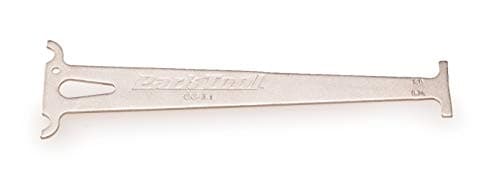
Park Tool CC-3.2 Chain Checker
The gauge that reads the published chain threshold directly. Park Tool lists it for 5 to 12 speed, and it is the tool the 0.5% and 0.75% figures in the table are expressed for.
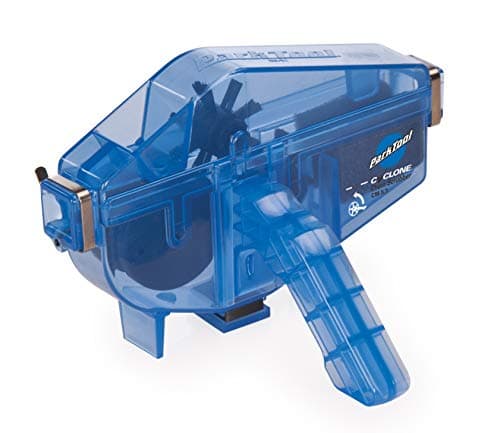
Park Tool CM-5.3 Cyclone
The chain scrubber for the clean step. A sealed-body scrubber keeps solvent off the rest of the bike, which matters because Shimano's own brake manual says to keep cleaners away from brake systems entirely.

Silca Super Secret Chain Lube
What goes back on after the clean — the top pick on our chain lube roundup, ranked there on published data and live cost per millilitre. The lubricant matters less than doing it at all.
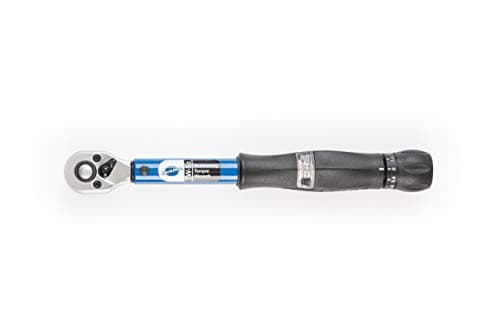
Park Tool TW-5.2 Torque Wrench
For the torque row. A click-type wrench is the only way to hit a published figure rather than guess at it — and bear in mind our home workshop roundup's finding that the commonly recommended wrenches stop well below cassette lockring specifications.
We haven’t tested any of these — they’re the parts the job above calls for, listed so you don’t have to go hunting. Prices are live from Amazon and we earn a commission if you buy. Prices as of October 18, 2026. #ad
The rows where no number exists, and what we do instead
The pre-ride check. We could not find a manufacturer-published pre-ride inspection for bicycles. The convention — squeeze both tires, spin both wheels looking for a rub or a wobble, pull both brake levers — takes fifteen seconds and catches the three things that ruin a ride. We are presenting it as convention because that is what it is.
The chain cleaning interval. Park Tool publishes the method — dirtiest first, meaning drivetrain, then frame, then wheels, then dry and re-lubricate, which is the backbone of our whole-bike guide— but no interval. Our practical answer is “when it looks dirty, and always after a wet ride”, because those are observable conditions rather than invented weeks. If you want a frequency, every two to three weeks of regular riding is where most people land, and we are telling you that is convention.
The annual full service. Bearings, cables, hoses and headsets have no published replacement interval we could find for a bicycle. “Annually, or before a big trip” is convention, and the reason to keep it on the list is that bearing wear is gradual enough that you will not notice it — which is exactly the failure mode a calendar is for.
Three published things people get wrong
Do not use brake cleaner on your brakes. Shimano’s own dealer manual for hydraulic disc brakes says to clean the brake system with soapy water and a dry cloth, and not with commercially available brake cleansers or silencing agents, which can damage parts such as seals. This contradicts a great deal of advice online, and it is the position our degreasers roundup and squealing brakes guide both hold.
Tread depth is not how you judge a bicycle tire. Schwalbe publishes that “in bicycle tires the tread is far less important than for instance in car tires”, and defines the wear limit instead as the point where the puncture protection belt or carcass threads show through. When to replace bike tires has the full set of figures, including the crack diagnosis.
A torque figure belongs to a part, not to a table. Park Tool’s own published caveat on its reference table is explicit: “Numbers provided for reference only… Contact the manufacturer for the most up to date specifications.” If a figure is printed on your component, that figure wins. Our torque guide collects the published ones with their attributions.
If you ride an e-bike, two rows change
The chain moves up the schedule, because on a mid-drive the motor’s torque goes through it — and no maker publishes an e-bike chain wear rate, so the honest response is to measure more often rather than to invent a shorter interval. The e-bike lube page covers that reasoning, and the e-bike maintenance guide carries the two published cleaning warnings from Bosch and Shimano that do not apply to a bicycle.
Common questions
How often should you service a bike?
There is no published answer, which is worth knowing before you trust one. What is published is wear limits, so the useful schedule is built around measurement: pressure monthly with a gauge, chain elongation measured every time you clean the chain, disc pad thickness monthly, and a full strip-down annually by convention rather than by any manufacturer’s instruction.
When should I replace my bike chain?
At the published elongation thresholds: Park Tool specifies replacement at 0.5% for 11- and 12-speed drivetrains, 0.75% for 10-speed and under, and 1.0% for single-speed. A chain checker reads this directly. The reason to be strict is Park Tool’s own: a worn chain meshes poorly with cogs and chainrings and causes premature wear to them, so a cheap part destroys expensive ones.
How often should I clean and lubricate my bike chain?
No manufacturer publishes an interval, so we will not pretend one exists. The honest triggers are observable: when the chain looks dirty, and always after a wet ride. Every two to three weeks of regular riding is where most people land, and that is convention rather than a published figure.
How do I know when my disc brake pads need replacing?
Park Tool publishes that the pad material should measure at least 1 mm thick, and offers a calibration you already own — three business cards are approximately 1 mm. Below that, pads start damaging the rotor. While the pads are out, check the rotor: Shimano rotors are 1.8 mm new and replaced by 1.5 mm, Hope 1.8 mm new and replaced by 1.4 mm.
How often should I check my tire pressure?
Monthly, with a gauge. That interval is Schwalbe’s published recommendation, and the published reason is that tire sidewalls often fail before the tread wears out, with prolonged riding at insufficient pressure named as the usual cause.
Do I need a bike service every year?
Nobody publishes a figure that says so. The argument for an annual strip-down is that bearing, cable and hose deterioration is gradual enough that you adapt to it without noticing — which is the one failure mode a calendar genuinely helps with. Treat it as sensible convention, not as a specification.
Does an e-bike need more maintenance?
The drivetrain does, on a mid-drive, because motor torque passes through the chain. No manufacturer publishes an e-bike chain wear rate, so the right response is to measure more often rather than to shorten an interval by a number nobody has published. Bosch and Shimano both publish instructions against pressure-washing an e-bike, which is the other genuine difference.
Sources
- Park Tool — When to Replace a Worn Chain (replace at 0.5% elongation for 11-12 speed, 0.75% for 10 speed and under, 1.0% for single speed; a worn chain “can cause the chain to mesh poorly with cogs and chainrings… premature wear to the cogs”) — retrieved 8 August 2026
- Park Tool — Disc Brake Pad Removal & Installation (“the pad material should measure at least 1mm thick”; “3 business cards… approximately 1mm”) — retrieved 8 August 2026
- Park Tool — Disc Brake Rotor Removal & Installation (“2 to 4 tenths of a millimeter” of wear indicates a worn rotor; Shimano rotors 1.8 mm new, replace by 1.5 mm; Hope rotors 1.8 mm new, replace by 1.4 mm) — retrieved 8 August 2026
- Park Tool — Wash a Bicycle (the published order: drivetrain, then frame, then wheels, then dry and re-lubricate). The method is published; no interval is — retrieved 18 September 2026
- Park Tool — Torque Specifications and Concepts (pedal into crank Shimano 35 N·m minimum, Campagnolo 40 N·m, plus the full reference table quoted on this site's torque guide; and the published caveat “Numbers provided for reference only… Contact the manufacturer for the most up to date specifications.”) — retrieved 18 August 2026
- Schwalbe — Tire Wear (“Checking and re-pumping the inflation pressure at least once a month with a pressure gauge is most important”; “The sidewalls of tires often fail before the tread is worn out. In most cases, this premature wear is due to prolonged use of the tire with insufficient pressure”; “In bicycle tires the tread is far less important than for instance in car tires”; wear limit reached “when the puncture protection belt or the carcass threads can be seen through the tread”; published mileage of 2,000-5,000 km for standard tires, 6,000-12,000 km for the Marathon family, “often much more than 10000 km” for the Marathon Plus and “no useful mileage data is possible” for MTB tires). All Schwalbe figures are for Schwalbe tires and are not transferable — retrieved 18 September 2026
- Shimano — Dealer's Manual, hydraulic disc brakes (DM-MDBR001): clean the brake system with soapy water and a dry cloth; do not use commercially available brake cleansers or silencing agents, which can damage parts such as seals — retrieved 8 August 2026
- No published bicycle service schedule was found from any manufacturer or tool maker. The three rows marked “convention” in the table carry no published figure and are labelled as such rather than numbered — retrieved 5 October 2026
- Google Autocomplete — “bike maintenance schedule” returns “bike maintenance checklist”, “bicycle maintenance schedule pdf”, “bike service schedule” and “bike maintenance guide”; “how often should you service a bike” returns “a bicycle”, “a road bike” and “a mountain bike” — retrieved 5 October 2026
Read next
- When to replace a bike chain
The published elongation thresholds, and how to read them with a gauge.
- How to replace a bike chain
The procedure for when the gauge says the chain is finished.
- How to clean a bike
Park Tool's published wash order, and the disc brake rule its article skips.
- Bike bolt torque guide
Published figures by component, each attributed to the brand that published it.
- When to replace bike tires
Schwalbe's wear limit, mileage ranges and crack diagnosis in full.
- The best home workshop tools
Four bench tools that each replace a recurring shop bill.
We haven’t ridden or tested any of the products on this page, and we don’t pretend otherwise. Read how we research — or tell us we’re wrong and we’ll log the correction.