Conversion Kit vs a New E-Bike
One option keeps the bike you already like. The other arrives as a certified system with a warranty and a class label. Here is the honest trade.

Heads up: we earn a commission if you buy through the links on this page, at no extra cost to you. It never decides what makes the list — here’s how that works.
These two options are not competing on price, whatever the shelf tags suggest.A conversion kit buys you a motor, a controller, a display and a sensor. A complete e-bike buys you all of that plus a battery, a frame designed around the extra mass, brakes specified for the extra speed, integrated lights and wiring, a warranty, a class label, and — increasingly — a certified electrical system. Comparing the kit price to the bike price compares a component to a vehicle.
The honest way to run this comparison is to add the battery to the kit, add your own labor, and then ask which set of trade-offs you would rather live with. Below are the ones that actually matter.
The two options, at today's live prices
Not a ranking — one representative product from each route, so the price comparison uses today's numbers rather than a figure we typed months ago. Remember the asymmetry: the kit price does not include a battery, and the complete bike price does.
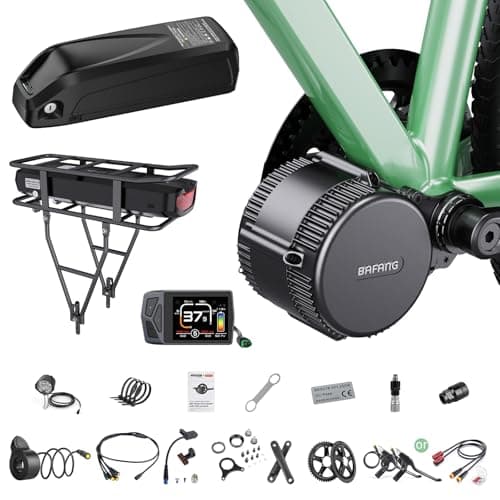
Bafang BBS02B Mid-Drive Kit
The conversion route: a mid-drive kit for a bike you already own. Add a battery, and add an evening.
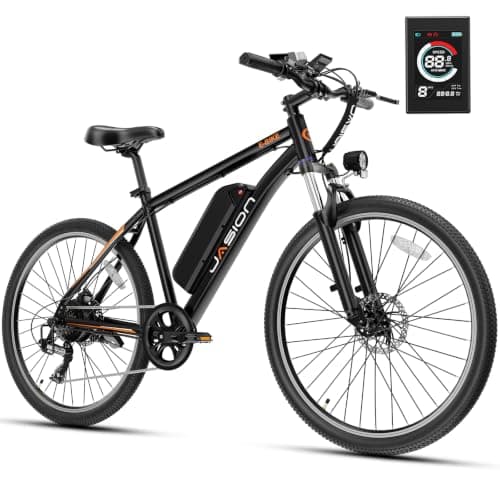
Jasion EB5
The complete-bike route: a finished e-bike with battery, brakes, lights and a warranty in one box.
We haven’t tested any of these — they’re the parts the job above calls for, listed so you don’t have to go hunting. Prices are live from Amazon and we earn a commission if you buy. Prices as of October 18, 2026. #ad
1. Certification: the difference nobody advertises
A complete e-bike from a serious manufacturer can be certified to UL 2849, the standard that evaluates the e-bike’s electrical drive train, battery system and charger combination together— specifically to reduce the risk of fires, thermal runaway and shock. Batteries have their own standard, UL 2271. A home conversion cannot hold a UL 2849 certification, because the certification is of a system combination that you assembled from parts nobody tested together.
This is not academic. New York City has legislated on precisely this point, requiring micromobility devices sold there to be certified to UL 2849 and batteries to UL 2271 — see the city’s own micromobility notices. Landlords, insurers and building managers are moving in the same direction. If you rent, or if the bike will be charged in a shared building, this may be the deciding factor before any of the riding arguments start.
2. The class label a conversion cannot have
Under the three-class framework — California’s Vehicle Code § 312.5 is the model statute — a manufactured e-bike carries a permanent label stating its class, top assisted speed and motor wattage. That label is what a police officer, a trailhead sign or a bike-path rule refers to.
A converted bike has no such label, and no manufacturer to have applied one. The finished machine may well comply with the federal definition — fully operable pedals, motor under 750 watts, under 20 mph on motor alone — but you are the only person who can say so. Our e-bike classes explainer covers what the classes actually control.
3. Brakes, frame and the mass you just added
A complete e-bike is designed as a whole: heavier tubing, wider tires, more braking, and frequently a rear rack rated for the load. A conversion takes a bicycle designed for 80–100 kg total and adds a motor, a battery and a good deal more speed.
In practice that means: rim brakes on a converted hybrid become the weakest link immediately; aluminum dropouts need torque arms; and a lightweight frame that was never intended to carry a 3–4 kg battery on the down tube is now doing so. None of this makes conversion a bad idea — it makes the base bike matter enormously. A solid steel or aluminum tourer with disc brakes is a great candidate. A twenty-year-old aluminum road bike is not.
4. Where conversion genuinely wins
- You already love the bike. Fit, geometry and handling are the hardest things to buy. If your bike fits you and you like riding it, a conversion keeps all of that and adds a motor.
- Cargo and touring bikes. A mid-drive on a cargo frame is a genuinely better tool than most factory e-bikes at similar money, because the frame was designed for load in the first place.
- You want a specific motor behavior.Mid-drive torque through your own gearing is a particular feel that many complete e-bikes at the accessible end of the market do not offer — most use hub motors, and our hub vs mid-drive comparison covers why that matters on hills.
- Repairability. Kit components are individually replaceable. A proprietary integrated e-bike battery, three years from now, is whatever the manufacturer still stocks.
5. Where a complete e-bike wins
- It works out of the box. No fitment measuring, no wiring, no torque arms, no evening.
- Warranty and support. One company is responsible for the whole system. In a conversion, the motor maker, battery seller and bike manufacturer each point at each other.
- Integration. Battery inside the frame, lights wired to the main battery, a display that belongs there, and no cable ties.
- Certification and labeling. The UL 2849 and class-label points above.
- Resale. A converted bike is worth what someone will pay for a used bike with a homemade motor. A known e-bike has a market.
6. The maintenance difference
Both need the same drivetrain care, and both punish neglect faster than an ordinary bike because of the extra torque and mass — our e-bike maintenance guidecovers the chain and brake consequences. The difference is where responsibility sits. On a conversion, every connector, cable route and mount is yours to inspect; on a complete bike, the wiring is the manufacturer’s problem until the warranty runs out.
Battery care is identical and matters more than either — see how to charge and store an e-bike battery, and e-bike cost to run for what the electricity actually costs either way.
So which should you buy?
Convert if you own a suitable bike you genuinely like, it has disc brakes and a robust frame, you are comfortable with mechanical work, and you can charge and store the battery somewhere that will not care about certification.
Buy complete if you do not have a suitable base bike, you want a warranty, you need the class label for where you ride, or the bike will be charged in a building where UL certification is required or likely to be.
Neither answer is universal, and anyone telling you conversion is always cheaper has left the battery out of the sum. Our conversion kit roundup covers the kit end, and the best e-bikes for the money covers the complete-bike end.
Conversion kit versus complete e-bike
The rows that decide it, with the legal and certification facts sourced below. Prices are deliberately absent from this table — they are live on the products above and change weekly.
| What matters | Conversion kit | Complete e-bike |
|---|---|---|
| Battery included | Usually not — buy separately | Yes, matched to the system |
| UL 2849 system certification | Not possible for a home-assembled system | Available from serious manufacturers |
| Class label (CVC § 312.5 model) | None — no manufacturer to apply one | Permanent label with class, speed and wattage |
| Brakes and frame | Whatever your bike already has | Specified for the mass and speed |
| Warranty | Per component, from several sellers | One company for the whole bike |
| Fit and geometry | The bike you already like | Whatever the manufacturer offers |
| Labor | An evening, plus measuring beforehand | Unbox and charge |
| Repairability in five years | Generic components, individually replaceable | Depends on proprietary battery availability |
| Resale | A used bike with a homemade motor | A known product with a market |
Two of those rows are not preferences. Certification and the class label are decided by statute and by standards bodies, and they are the rows most likely to matter to a landlord, an insurer or a bike-path rule.
Common questions
Is it cheaper to convert a bike or buy an e-bike?
It depends entirely on whether you count the battery, and most comparisons do not. A kit is a motor, controller, display and sensor; the battery is usually separate and often the largest single cost. Add the battery and your own labor, and a conversion of a good bike you already own is usually competitive with an entry-level complete e-bike — not dramatically cheaper.
Can a converted e-bike be UL certified?
Not as a system. UL 2849 certifies the electrical drive train, battery and charger in combination, and a home-assembled conversion is by definition an untested combination. Individual parts may carry their own certifications — a battery to UL 2271, for example — but the assembled bike cannot hold a system certification. In places like New York City, which has legislated on this, that is a practical restriction and not a technicality.
Is a converted bike street legal?
It can be, if the finished machine meets the definition: fully operable pedals, a motor of less than 750 watts and a motor-only top speed under 20 mph for a 170 lb rider. What it will not have is the permanent class label a manufactured e-bike carries, which is what enforcement and trail rules refer to. Check your own state’s rules before you commit to a kit.
What kind of bike should I convert?
Steel or aluminum, disc brakes, a bottom bracket and dropouts that suit the kit, and a frame in good condition. Touring, cargo, hybrid and hardtail frames convert well. Carbon frames and forks should not be converted, and a bike with rim brakes needs a hard look before you add mass and speed to it.
Does converting a bike void anything?
It will typically end any remaining frame warranty, since you are adding loads the frame was not sold to carry. It also changes the insurance picture: some policies distinguish between manufactured e-bikes and modified bicycles. Neither is a reason not to convert — both are reasons to know before rather than after.
Sources
- UL Solutions — E-bike certification to UL 2849 (the standard evaluates the e-bike's electrical drive train system, battery system and charger system combinations together, to reduce fire, thermal runaway and shock risk; UL 2271 covers batteries for light electric vehicle applications) — retrieved 2026-08-18
- New York City DCWP — micromobility notices (city law requiring micromobility devices to be certified to UL 2849 and batteries to UL 2271) — retrieved 2026-08-18
- 15 U.S.C. § 2085(b) — federal low-speed electric bicycle definition (fully operable pedals; motor of less than 750 watts; under 20 mph on motor alone with a 170 lb operator) — retrieved 2026-08-18
- California Vehicle Code § 312.5 — the model three-class statute, including the permanent label stating class, top assisted speed and motor wattage — retrieved 2026-08-18
Read next
- The best e-bike conversion kits
If you go the conversion route, these are the kits.
- How to install an e-bike conversion kit
The evening you are signing up for.
- The best e-bikes for the money
If you go the complete-bike route instead.
- Are e-bikes worth it?
The question underneath both options.
We haven’t ridden or tested any of the products on this page, and we don’t pretend otherwise. Read how we research — or tell us we’re wrong and we’ll log the correction.