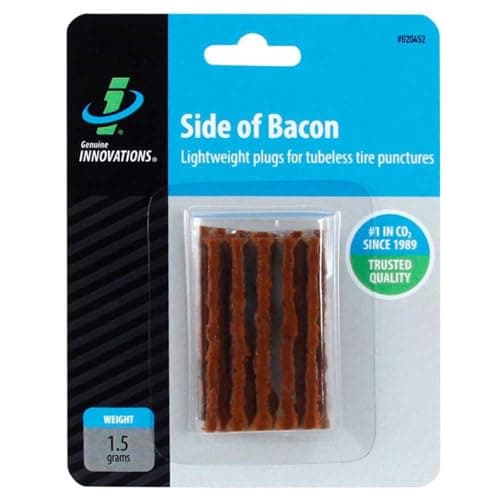
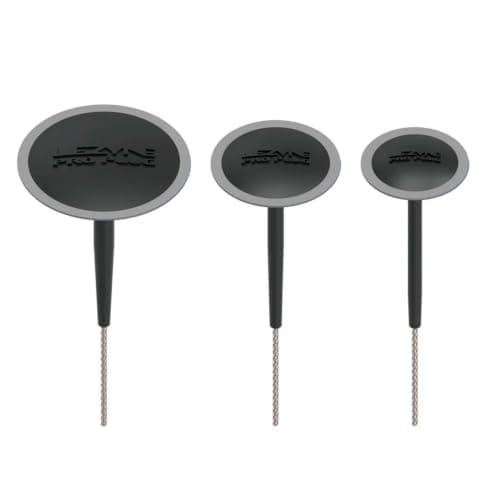
The Lezyne Tubeless Pro Plugs kit is the one to buy, because it is the only product in this catalog whose listing publishes a plug diameter — three of them, from 3 mm to 4.5 mm — which is the single fact that decides whether a kit can close the hole you actually get. The budget pick is the Genuine Innovations rope plugs, the cheapest repair here and, unusually, the most quantified listing on the page: twenty plugs, 1.5 g, 0.3 x 5 cm. Buy those as refills, not as your only kit, unless you already own a tool.
A tubeless tire fails in one of three ways, and only one of them is what this page fixes. A small puncture is sealed by the sealant itself, usually before you notice. A bigger hole needs a plug pushed into it from outside. A cut or a torn bead needs a tube and a trip home. Buying a plug kit is buying for the middle case, which is also the one that strands people.
The number that matters, and the number nobody prints
Plug kits are sold on brand and on looks, and the only thing that actually determines whether one works on your flat is the diameter of the plug against the diameter of the hole. Too thin and it blows straight back out under pressure. Too thick and it will not start into the casing at all.
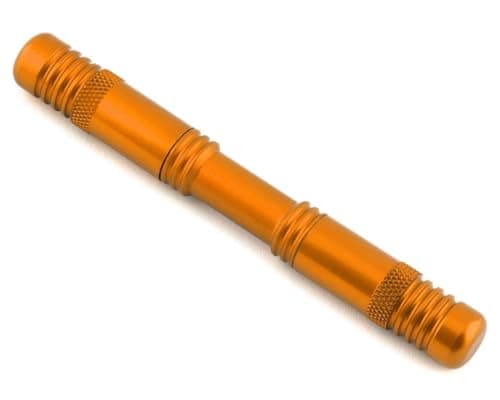
One listing in this category publishes that number. One publishes a plug dimension instead, which is nearly as useful. The most expensive and most famous tool here publishes neither. We have ranked accordingly, and we have not inferred a size for any product that does not print one.
A plug is half a repair
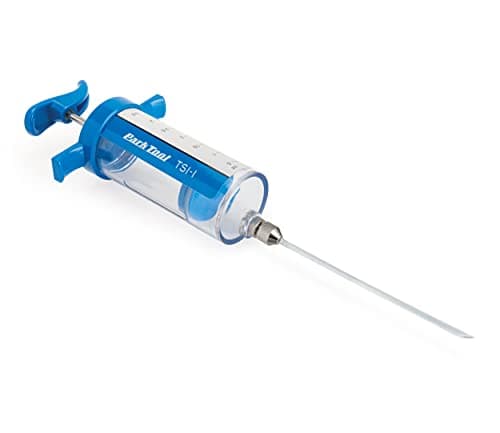
The plug closes the hole mechanically; the sealant closes the gap around the plug. A plug pushed into a tire whose sealant dried up six months ago will leak slowly and keep leaking. That is why the injector is on this page at all: the other half of this purchase is knowing when your sealant was last topped up. The sealant roundup ranks the fluids on published particle size and published refresh intervals, and Stan’s versus Orange Seal compares the two brands most people are choosing between.
Carry a tube anyway
Every rider who has plugged a tire successfully still carries a tube, because the fourth failure mode — a sidewall cut, a blown bead, a hole a plug cannot hold — ends the ride otherwise. Fitting a tube into a tubeless tire at the roadside is a messy job with its own procedure, and our tubeless flat guide walks through it, including what to do with the valve.
What this page cannot tell you
Nobody here has plugged a tire with any of these. No hole was cut, no pressure was held, no plug was pulled. Every specification above was read off the live Amazon listing on 22 November 2026, and the ranking is a ranking of what those listings are willing to state.
Nothing in this category publishes the figure that would settle it: the pressure a plug holds, in a given tire, over a given distance. Treat a plug as a repair that gets you home rather than a repair that ends the problem, and replace the tire when the ride is over.
Plug size, plug count and whether the insertion tool is part of the purchase — each as published in the seller’s own listing. “Not published” means exactly that: we have not filled a gap with a number from elsewhere.
Every middle column is a claim the seller publishes in its own listing, not a measurement of ours. Prices are live from Amazon as of November 23, 2026 and 4 of 4 rows carry one right now. Every “Check price” link is an affiliate link and Amazon pays us at no cost to you. #ad
The sealants themselves, the rim tape and the valves are ranked elsewhere: see
the sealant roundup for the fluid that does the other half of this job.
Buy a kit, not plugs. Plugs without an insertion tool are not a repair, and the cheapest listing on this page does not name a tool in its title. If you own nothing, start with the kit at the top; if you own a tool already, the cheap plugs are excellent refills.
Size the plugs to your tires. A 28 mm road tire and a 45 mm gravel tire fail differently: road casings take small punctures and gravel casings take bigger, rougher holes. A kit publishing a range from 3 mm to 4.5 mm covers both; a thin rope plug is a road-sized repair.
Check your sealant before you trust your plug.Sealant dries out, and a tire that has been standing for a season may have none left. An injector tops it up through the valve without unseating the tire — the tubeless setup guide covers how much goes in and why the bead is the part you want to leave alone.
Keep a tube and tire levers in the bag regardless. A plug handles the middle case. The worst case still needs a tube, and if the tire is tubeless the rim tape and valve add steps. Our what-to-carry list is built around exactly that redundancy.
Treat a plugged tire as temporary.The repair holds pressure; it does not restore the casing. Ride it home, then decide whether the tire has another season in it — when to replace bike tires covers the thresholds.