A storage rack has one job, and six of twelve tell you whether they can do it
Everything about buying a bike rack is a distraction except one question: will it hold the bike up. There is no comfort to evaluate, no aerodynamics, no wear item. It either carries the load or it drops your bike.
So the number that matters is the published weight capacity, and across these twelve listings six publish one. The published figures are 40 lb, 50 lb, 77 lb, 80 lb, 100 lb and 100 lb — a 2.5x spread across products that look nearly identical in a search results grid, and which sit within a few dollars of one another at several points on that range.
The other six publish nothing about weight at all, and they are not the cheap ones. The two most expensive wall racks on this page publish no capacity, while the cheapest product here — a six-word listing — publishes 50 lb.
The number on the rack is useless without the number on the bike
Here is the problem that makes this page necessary rather than merely useful. A rack publishes a limit in pounds. To use that limit you need your bike’s weight. And this site has already established, twice, that bike listings do not publish one.
On folding e-bikes, one of nine listings published a weight — and that bike was ranked first for that reason alone, because the person doing the lifting is the reader. On car racks, the same gap forced the honest conclusion: go and weigh the bike yourself, because nobody will tell you.
It is the same instruction here, and the stakes are a little higher, because a car rack that is overloaded usually tells you by sagging and a ceiling hoist tells you by letting go. If you are storing an e-bike, weigh it — bathroom scales, bike on end, or the hang-it-from-a-luggage-scale trick — and then buy a rack whose published figure clears that number with margin. Two racks here publish 100 lb. One publishes 40.
Will the hook even take your tire?
The second fit question, and the one almost nobody asks before the rack arrives. Vertical racks hold the bike by a wheel, which means the hook or cradle has to accept your wheel diameter and your tire width.
Across twelve listings, exactly one publishes a tire width (up to 3.54 in) and two publish a wheel-size range(16–29 in on a wall mount, 24–29 in on a floor stand). The best-known pivoting rack in the entire category describes its fit as “Fits Narrow Tires”— which is accurate, is honest about what the product is for, and is not a measurement.
If you ride road, this almost never bites: a 25 or 28 mm tire fits everything here. If you ride gravel at 45 mm or anything with a plus-size or fat tire, it bites immediately, and the one listing with a published width is the only one you can check against before you spend the money.
Vertical, horizontal, ceiling, floor: pick for the room
Our guide to storing a bike makes this argument at length and it is worth compressing here, because the mount type decides more about whether you will actually use the rack than the brand does.
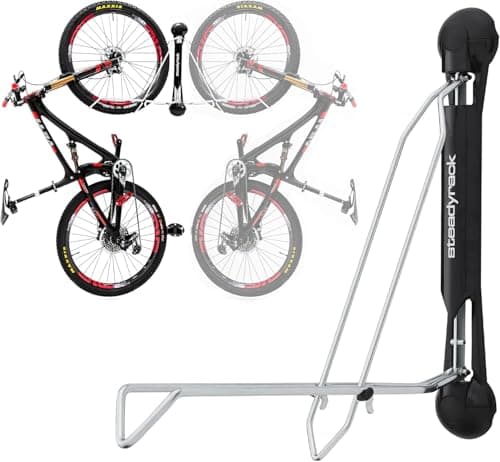
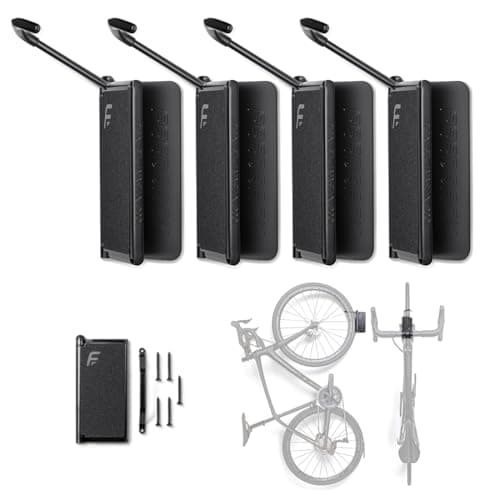
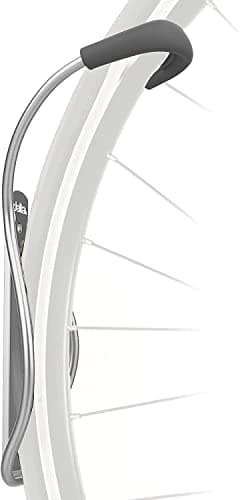
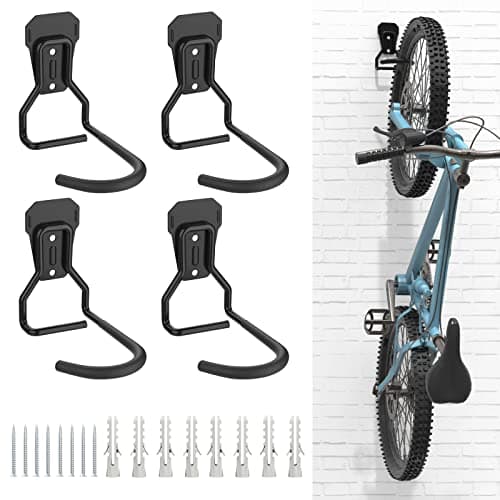
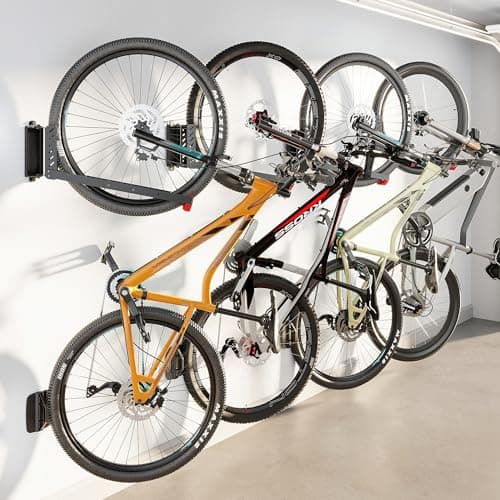
Vertical wall mounts(one wheel up, bike against the wall) are the most space-efficient option and the most common. They need about a bike’s height of clear wall and roughly a foot of depth. A pivotingvertical mount lets the bike swing flat, which is what makes a narrow garage workable — three racks here pivot and two of them publish an angle or a setting count.
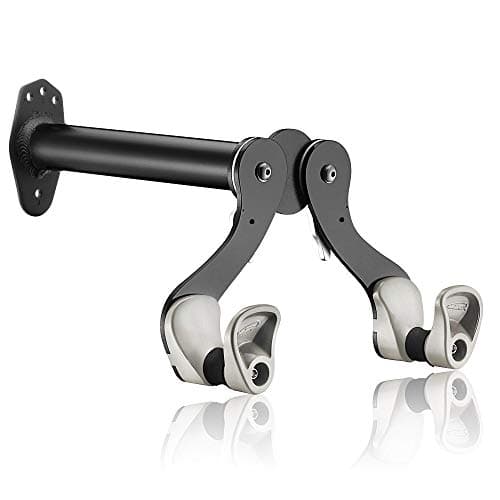
Horizontal mounts hold the bike level by the frame. They look far better in a living space and use the most floor area of anything here, because the bike sticks out its own length. One rack on this page is built this way, and it is the only one that publishes an adjustment range for keeping a sloping top tube level.
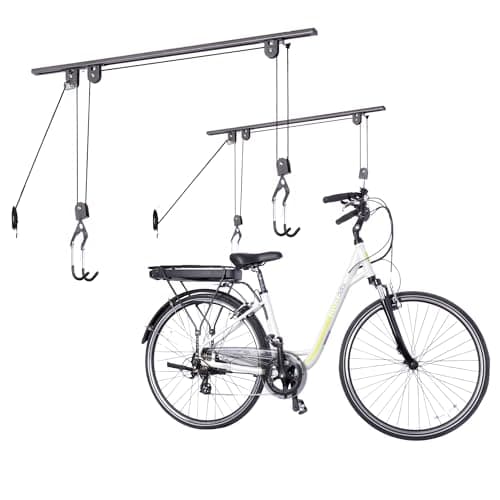
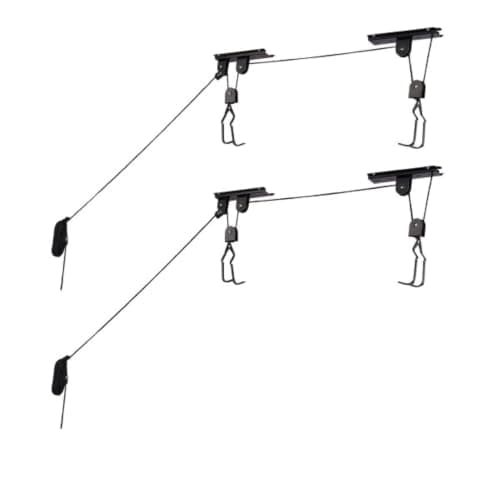
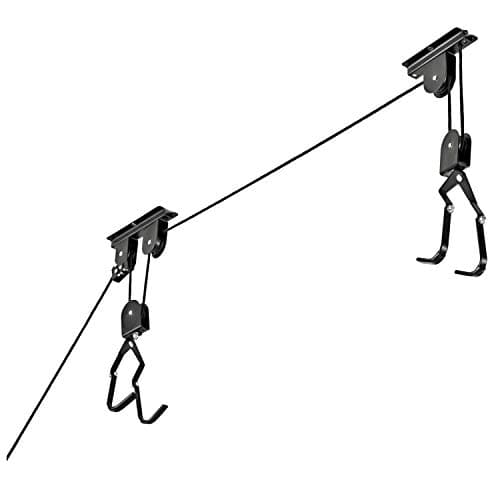
Ceiling hoists reclaim dead air above a car. Three on this page, with published capacities of 50, 100 and 100 lb, and exactly one publishing a locking mechanism. They are the slowest storage to use, which makes them right for the bike you ride monthly and wrong for the commuter.
Floor standsput nothing in the wall at all, which is the entire argument for them — see the Essentials block below.
Not a ranking. If you rent, if the wall is masonry you do not want to drill, or if you simply do not want to find a stud, these are the options that stand on the floor instead. The first one publishes a weight capacity, which neither of the other two does.
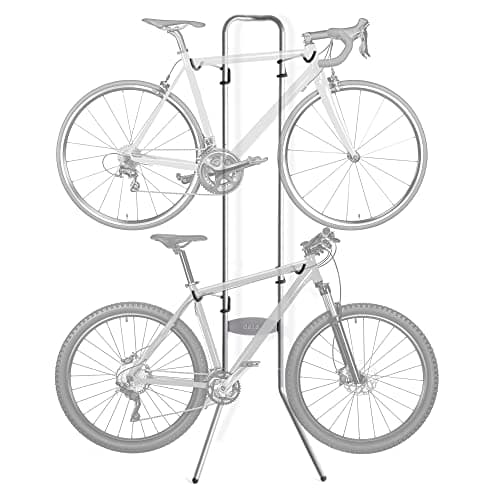
The renter's answer. A gravity stand that leans against the wall and holds two bikes, with a published 80 lb capacity and a published fit for road, MTB and hybrid bikes — the only no-drill option here that publishes a weight limit at all. Fully adjustable per the listing, so the two cradles move to suit two different frames.
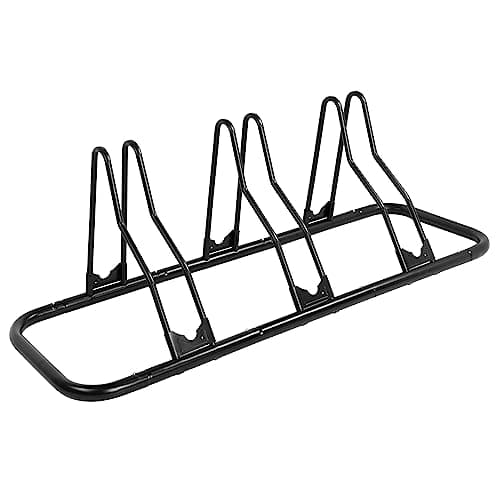
Three bikes, no wall contact. A free-standing floor rack that holds the bikes by the front wheel, published for MTB and road bikes. The right thing for a shed, a basement or a garage corner where nothing can be fixed to anything. No capacity, wheel range or tire width is published.
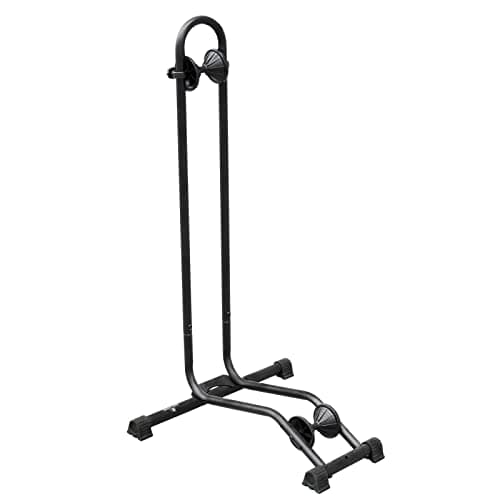
One bike, and the only floor option that publishes a wheel-size range: 24 to 29 in, for MTB and road bikes, indoor or outdoor. A single-bike floor cradle is also the most useful thing to own if the bike moves around — it parks the bike upright anywhere without a kickstand or a wall.
We haven’t tested any of these — they’re the parts the job above calls for, listed so you don’t have to go hunting. Prices are live from Amazon and we earn a commission if you buy. Prices as of November 16, 2026. #ad
The component nobody publishes anything about: your wall
Twelve listings. Six publish a weight capacity. Zero publish anything about the structure they are being fixed to— not a wall type, not a fastener spec, not a stud requirement. One mentions that screws are included, and that is the high-water mark for fixing information in this category.
This matters more than the rack’s own rating, because the rack is almost never the weak link. A steel bracket rated for 77 lb bolted into hollow drywall with the screws in the box is a drywall-strength bracket. The load path is bike → rack → fastener → wall, and the published figure only describes the second link in that chain.
The practical rules, none of which any listing here states. Into a wood stud: find the stud, use lag screws long enough to bite deep into it, and a vertical rack will hold anything in this roundup. Into drywall with no stud behind it: use proper heavy anchors and treat the published capacity as fiction. Into masonry or concrete: correct sleeve anchors, and it will outlast the bike. Into a ceiling: joists only, never the drywall, and never over a space where a person or a car sits.
And do not over-torque the fasteners on the rack itself in the hope of making a bad wall good. Our bolt torque guide collects the published figures for everything bolted to a bike; the same instinct that strips a bottle-cage boss will crush a drywall anchor.
Hanging a bike by one wheel: what it does and does not harm
The oldest worry in bike storage is whether hanging a bike vertically damages anything. The answer for a modern bike is essentially no, with two real caveats and one myth.
The myth is hydraulic brakes. A bike stored with the bars pointing down does not develop air in its lines by hanging; air in a hydraulic system comes from a leak, a bad bleed or a worn seal. If the lever goes spongy after storage, you had a problem before you hung it up — our guide to disc brake noise and feel covers the symptoms worth acting on.
The caveats are real, though. First, a wheel carrying the whole bike’s weight at one point on the rim is a load a wheel is not built for, which is mostly fine on a well-built wheel and is an argument for a cradle over a bare hook. Second, a bike that sits unused for months loses tire pressure and sealant, which is why our maintenance schedule treats storage as its own interval rather than as a pause.
One more thing about where the bike goes. A bike out of sight is a bike nobody steals, and the cheapest security measure in this whole area is a closed door — well ahead of a tracker. If the bike has to live somewhere visible, our bike tracker roundup covers what the tracking products actually publish, and our lock roundup covers the part that does the preventing.
What we could not check
Nothing on this page has been installed, loaded or weight-tested. Every “Listing:” line above is the live Amazon listing text for the exact ASIN linked, read on 26 October 2026. No manufacturer page, installation manual or third-party review figure is cited.
Two refusals worth naming. This page does not rank on build quality, because no listing here publishes a steel gauge, a weld spec or a finish standard, and “Heavy-Duty” and “Premium Quality” are adjectives. And it does not tell you what any of these racks will hold on your particular wall, because no listing publishes a wall type and the honest answer depends entirely on what is behind the drywall in your garage.